How to Draw Value Chain for an Ice Cream Start-up Business
Case Type: industry analysis; business competition; finance and economics.
Consulting Firm: IBM Global Business Services (GBS) first round full time job interview.
Industry Coverage: food & beverages; small business, startups.
Case Interview Question #01354: Häagen-Dazs is an American ice cream brand, established by Reuben and Rose Mattus in Brooklyn Heights, New York, in 1961. Starting with only three flavors: vanilla, chocolate, and coffee, the company opened its first retail store in Brooklyn, New York in 1976. The business now  has franchises throughout the United States. Häagen-Dazs ice cream comes in several traditional flavors as well as several esoteric flavors that are specific to the brand, such as Vanilla Swiss Almond and Bananas Foster. It is marketed as a “super-premium” ice cream brand.
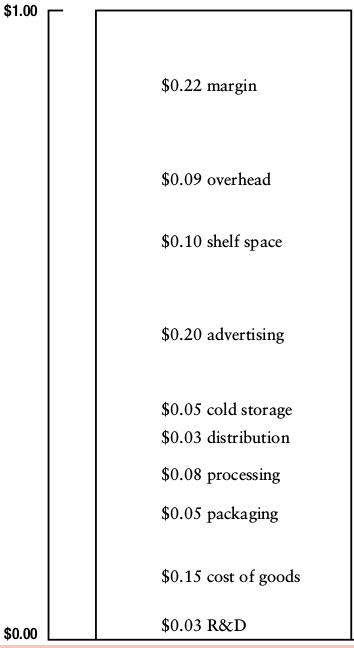
You’re about to graduate from one of the top business schools in the U.S. Rather than go into consulting, you’ve decided that you want to start a natural flavor frozen-sherbet business. You’ve done some market research and discovered that the premium brand Häagen-Dazs has the following value chain (see Exhibit 1 below). Draw a similar value chain for your natural flavor frozen-sherbet start-up business and explain how and why it would be different.
Additional Information:
Exhibit 1. Häagen-Dazs Ice Cream Value Chain
Possible Answers:
1. Case Overview
Case interviewers love to throw in a question or two that call for the candidate to respond to graphs and charts. In one sense, this is an easy way to screen out some candidates. All consultants develop an intimate relationship with their
favorite graphs. As a result, the candidate who freezes before the graph like a rabbit in the headlights will quickly become roadkill.
If you have a strong aversion to graphs, you might want to think about another profession. If you don’t have such an aversion, but you are a little bit rusty, we suggest that you at least pull out that old economics textbook and do a few problems just to build up your strength. You’ll probably be glad you did!
Although graphs are fair game for all candidates, this particular case question would most likely be found in an MBA case interview.
2. Suggested Response
For this particular case, you’d probably want to work on the graph provided by the interviewer. The question comes with its own framework – you just have to follow along the categories on the value chain.
First we’ll present one possible answer, and then we’ll identify several issues you might choose to mention in your discussion.
(1) Research and Development (R&D)
Overall, R&D would be a higher percentage of sales for the start-up.
a. Reasons the Start-Up R&D Costs Would Be Higher
* New product development from scratch is expensive and is front-loaded
* Development required on a larger percentage of total product line
* Hire on a contract basis rather than permanent
* This is likely to be a key differentiating factor for product (initial success probably not based on traditional marketing or shelf space presence)
b. Reasons the Start-Up R&D Costs Would Be Lower
* Longer-term product strategy for the start-up probably doesn’t require constant new product development – not trying to compete with entire Häagen Dazs product line.
* Shelf-space issue suggests that there is a limited return to product development – since only ten containers fit on a shelf, new flavors will replace existing flavors, not competitor flavors.
(2) Cost of Goods Sold (COGS)
COGS would be much higher for the start-up.
a. Reasons the Start-Up COGS Costs Would Be Higher
* Lower volume purchases means that there would likely be higher per-volume costs.
* Strategy may be to offer better-tasting products, requiring specialized ingredients, higher quality, higher costs.
(3) Packaging
The packaging costs would be higher for the start-up.
a. Reasons the Start-Up Packaging Costs Would Be Higher
* Lower-volume runs, higher cost per unit, especially because line change-over costs would be significant
* Have to hire outside packaging firm to print packaging
* Shipping and other fixed costs would account for a higher portion of the price.
(4) Processing
Processing costs would typically be higher for the start-up, but in some scenarios could be equal or slightly lower.
a. Reasons the Start-Up Processing Costs Would Be Higher
* Must hire outside processor to manufacture product
* Timing issues – have to wait for available capacity, scheduling conflicts
* Fewer direct controls over production means possible wastage, more outside supervision costs
* Can’t necessarily locate processing plant next to packaging/shipping locations
b. Reasons the Start-Up Processing Costs Would Be Lower
* Assuming Häagen-Dazs has its own processing plants, it needs to operate at capacity to carry overhead effectively. If it doesn’t, and if this is a smallmargin operation, cost per unit could be higher if Häagen-Dazs has to carry fixed costs with small volume.
* Häagen-Dazs doesn’t have any opportunity to negotiate a good price for manufacturing once it has dedicated capacity
* Start-up has some negotiating leverage with processor (Can refuse to buy output if quality is low)
(5) Distribution
The distribution costs generally will be higher for the start-up.
a. Reasons the Start-Up Distribution Costs Would Be Higher
* No high-volume discounts
* No dedicated shipping options
* No distribution facility
* Small-volume deliveries mean much higher labor cost per unit delivered
* Fewer retail outlets spread more thinly
* Velocity of product off the shelves may mean irregular deliveries, which could increase the costs
* No opportunity for delivery people to sell the retailers additional products or
collect shelf/competitor information for the start-up
b. Reasons the Start-Up Distribution Costs Would Be Lower
* Serve local geographic region only (short-term advantage)
* Pay only for capacity used
(6) Cold Storage
The Cold Storage costs would be higher for the start-up.
a. Reasons the Start-Up Costs Would Be Higher
* No dedicated facilities
* Limited availability of cold-storage locations means that aggressive, large-volume competitors can lock out smaller competitors by tying up all available resources
* Lower volume equals higher prices
* Minimum scale for production may still be higher than current demand, requiring longer cold-storage time before shipment of product.
(7) Advertising
This would be lower for the start-up in most cases.
a. Reasons the Start-Up Advertising Costs Would Be Higher
* Lower-volume purchases means higher per-item charge
b. Reasons the Start-Up Advertising Costs Would Be Lower
* Can’t afford/don’t do end-customer marketing
* Use guerrilla marketing techniques
* Focus on channel sales rather than customer sales
* Not competing with other big ice cream makers
(8) Shelf Space
These costs could be equal, or even lower, for the start-up.
a. Reasons the Start-Up Costs Would Be Higher
* Big brands with fast-moving volume may get price breaks on shelf space
* Big brands can manage stocking tasks, thereby taking costs out of system or retailer
b. Reasons the Start-Up Costs Would Be Lower
* Strategy involves selling through retail locations that don’t charge for shelf space
(9) Sales Commissions
These would be higher for the start-up.
a. Reasons the Start-Up Costs Would Be Higher
* Pay brokers on a commission basis for regional sales
* Häagen-Dazs doesn’t use brokers, it has a dedicated sales force
(10) Overhead
The Overhead would be lower for the start-up.
a. Reasons the Start-Up Overhead Costs Would Be Lower
* Work out of apartment
* Get by with much less infrastructure
* No public reporting requirements
* No administrative divisions
(11) Margin
The Margin would be lower for the start-up.
a. Reasons the Start-Up Margin Would Be Lower
* Costs are higher for the start-up
b. Reasons the Start-Up Margin Would Be Higher
* Made up for by higher retail price
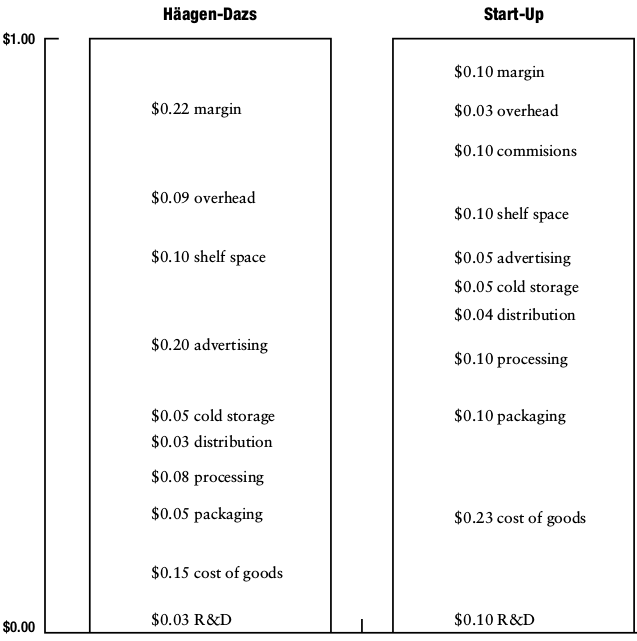
(12) Value Chain
Exhibit 2. Value Chain Comparison: Häagen-Dazs vs. Start-up
3. General Summary Comments
There are a lot of different ways in which you could explore this case question.
Some will be obvious, such as the different costs for purchases for small- and large-volume producers. Others will be less clear, such as the product-development strategy and the shelf-space issues. In addition to seeing whether or not you understand the cost structure of producing a given product, the interviewer will also be testing you to see if you have any business intuition about how to deal with these two very different business models.