Verizon to Enter Canadian Telecommunications Market
Case Type: market entry; business competition, competitive response; industry analysis
Consulting Firm: Samsung Global Strategy Group (GSG) first round full time job interview.
Industry Coverage: telecommunications, network.
Case Interview Question #01217: Verizon Communications (NYSE: VZ) is an American multinational telecommunications conglomerate and a corporate component of the Dow Jones Industrial Average. The company is based at 1095 Avenue of the Americas in Midtown Manhattan, New York City. Its Verizon Wireless  subsidiary is the largest U.S. wireless communications service provider as of September 2014, with more than 100 million mobile customers.
Wind Mobile Inc. is a Canadian wireless telecommunications provider headquartered in Toronto, Ontario. Founded in 2008, Wind Mobile was one of several new mobile carriers launched in Canada in 2008 after a government initiative to encourage competition in the wireless sector. With more than 600,000 active wireless subscribers (as of the end of May 2014) in urban areas of Ontario, British Columbia and Alberta, it is Canada’s fifth-largest mobile operator.
Your client Bell Canada is a major Canadian telecommunications company headquartered in Montreal, Quebec. It is the incumbent local exchange carrier for telephone and DSL Internet services in most of Canada east of Saskatchewan and in the northern territories, and a major competitive local exchange carrier for enterprise customers in the western provinces.
The year is 2014. This past June, Verizon announced that it was seeking to buy Wind Mobile and thus enter the Canadian market. Your client, the CEO of Bell Canada, has hired you to answer three questions. First, what impact will this have on the Canadian telecommunications market? Second, how should they respond to ensure profitability in the long term? Finally, what strategies can we implement aside from our response to Verizon to improve profitability and reassure our shareholders?
Possible Answers:
1. Case Overview & Suggested Framework
This is a very open-ended case with no forced path to the answer, thus to solve the case, the candidate must first focus on the impact of Verizon on the market as an analysis of the Canadian telecommunications market. Next, their insights from this analysis will allow them to develop strategies to counter Verizon’s entry into the Canadian telecommunications market. Finally, the last question requires them to set aside Verizon’s move and approach the question as a standard profitability case.
Additionally, this case tests the candidate’s ability to find insights from large amounts of data as only some of the exhibits are ultimately relevant to solving the case. This is especially important as there is little information that the interviewer has to tell the candidate, most of the data is contained within these charts.
2. Information Gathering
Additional Information: only give to candidates if requested
* Verizon is the largest telecommunications company in the United States, with around 140 million subscribers.
* Due to their size, Verizon will be able to buy phones at a lower cost from manufacturers.
* In addition, they can offer free roaming between Canada and the United States due to their existing networks in the US.
* All of the four major Canadian telecommunications companies (Bell Canada, Shaw Communications, Rogers Communications, Telus) offer a full range of services, Wind Mobile solely operates in the wireless phone segment.
* Government regulations do not allow the incumbents to acquire a competitor and foreign companies can only acquire a Canadian company if the target’s market share is below 10%
* Differences in cost of acquisitions come from two sources: scale (purchasing more handsets allows for purchase discounts) and effectiveness of promotions (new subscribers per million advertising spend)
* Our research shows Bell Canada’s higher churn mainly results from having a higher proportion of single-service subscriptions, who leave for package deals at Telus or Rogers.
* Postpaid subscriptions (contracts) have substantially higher revenues than prepaid phones.
3. Exhibits
EXHIBIT 1. Canadian Market Breakdown — Number of Wireless Subscribers in Year 2013.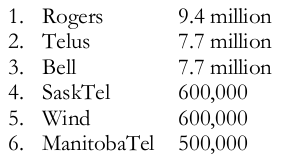
* Entire Canadian telecom market has approximately 27.5 million wireless subscriptions.
EXHIBIT 2. Canadian Telecommunications Market — Size and Growth Rates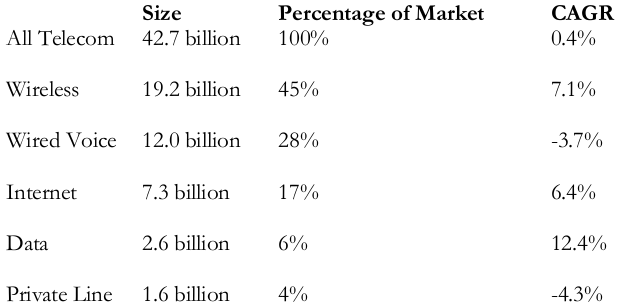
EXHIBIT 3. Market Penetration Rates (%) by Income Quintiles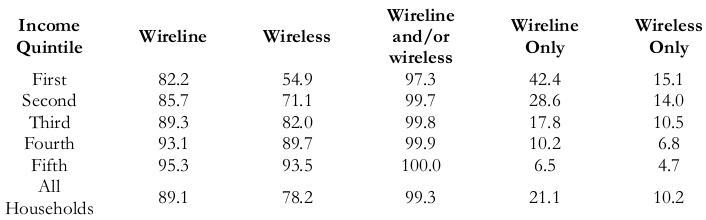
EXHIBIT 4. Wireless Industry Profitability Data — Commonly Used Metrics
* ARPU refers to the average revenue per user.
** COA is the cost of acquisitions, which is the total cost (selling, setup and COGS) of acquiring one new wireless subscriber.
*** Churn is the percentage of subscribers that leave the company on a monthly basis.
EXHIBIT 5. Wireless Subscribers (millions of subscribers)
EXHIBIT 6. Smartphone Activations for Q1 2013
* Smartphone activations is the sum of new smartphone subscribers and existing subscribers converted to a smartphone subscription.
4. Detailed Analysis
Exhibit 1: The candidate should notice that the three leading companies form an oligopoly controlling around 90% of the Canadian market. In addition, Wind Mobile has below a 10% market share, so the government regulations will not prevent Verizon from acquiring it.
Exhibit 2: Wireless presents the greatest opportunity in the short term as it is already the largest and is growing considerably faster than the rest of the telecommunications market. Over time, internet and data will become more important parts of the market while wired voice and private line will become less important.
Since Verizon is entering the wireless segment of the telecommunications market, this move will put considerable pressure on Bell Canada’s short and long-term profitability.
Exhibit 3: The market is nearly saturated as over 99% of Canadian households have either a wireless or wired connection. However, there are three important trends to note. First, wireless penetration varies more widely over the distribution of income. Second, wired connections still outnumber wireless connections, despite their lower share of industry revenue. Finally, lower income households are far more likely to have only wired or wireless connections, while high income households tend to have both.
Thus in the low income market, Bell Canada should focus on converting more customers to wireless connections since it earns a higher revenue per subscription. In the high income market, they should leverage their full range of services to defend against Verizon’s entry (since they can only offer wireless phone subscriptions).
Exhibit 4: Bell Canada’s ARPU (average revenue per user) is lower than both of the competitors and the cost of acquisitions as well as churn are both higher than the average. Thus Bell Canada can improve its profitability by raising ARPU, lowering the cost per acquisition and lowering churn.
If the candidate asks why Bell Canada’s ARPU is lower, ask them to make some suggestions themselves. When they suggest a different rate of data usage/different breakdown of subscriptions, give them Exhibits 5 and 6.
Exhibit 5: The candidate should check to see if there are significant differences in the proportion of postpaid versus prepaid subscribers. In this case, the differences are negligible and thus provide no insight on revenue differences.
Wireless Subscribers (millions of subscribers)
Exhibit 6: The number of smartphone subscriptions is lower at Bell Canada than at the other two companies. This disparity is the explanation of Bell Canada’s lower ARPU, as they are not converting low revenue customers to high revenue smartphone subscriptions at as fast of a rate as their competitors.
5. Conclusion & Recommendation
* Verizon presents a significant threat to the Canadian telecommunications industry as wireless communication is the most lucrative segment in the near future.
* To mitigate this threat, Bell Canada needs to increase the number of customers on multi-service contracts, which Verizon cannot yet offer. This will allow help to reduce the costly high churn rate.
* In addition, Bell Canada should focus on converting low income customers to wireless subscriptions and upgrading high income customers to smartphone subscriptions, which should allow them to reach the same per customer revenue as their competitors.
* Finally, they should closely monitor their advertising spending to ensure it is used effectively to avoid driving up acquisition costs.