Potash Producer Karnalyte Resources to Liquidate Assets
Case Type: business competition, competitive response; industry analysis.
Consulting Firm: Samsung Global Strategy Group (GSG) first round full time job interview.
Industry Coverage: chemical industry.
Case Interview Question #01216: Our client Karnalyte Resources Inc. (TSX: KRN) is a Canada-based chemical company engaged in the business of exploration and development of agricultural and industrial potash. Potash is any of various mined and manufactured salts that contain potassium in water-soluble form. 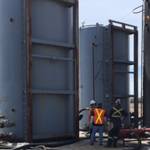 The name derives from pot ash, which refers to plant ashes soaked in water in a pot, the primary means of manufacturing the product before the industrial era.
Karnalyte Resources is a junior potash producer. On the morning of July 30th this year, Uralkali, the dominant Russian potash producer announced that it was separating from its partner, Belaruskali. What will this event do to the global potash industry? And how should our client Karnalyte Resources respond to this event?
Possible Answers:
1. Case Overview
Although the case is framed as a response by a particular company to a change in the industry dynamic, the real core of the case is thinking through the industry structure and how this drastic change will affect the potash industry.
If the candidate tries to move too quickly to strategies that Karnalyte can take, before fully understanding the implications of the industry change, push them to look at the big picture, before dealing with strategic alternatives.
Once they understand the situation, they should realize that Karnalyte’s only viable choice is to sell its assets at scrap value to try and pay off its debts. Thus this case also tests the candidate’s ability to recognize a hopeless situation, since few cases typically have liquidation of the company as the correct answer.
2. Information Gathering
Additional Information: only give to candidates if requested
* Potash is a main ingredient in fertilizer and is mined from potassium deposits in Russia and Saskatchewan.
* Historically, potash sales have been dominated by two companies: Canpotex, which represents Potash Corp, Mosaic and Agrium Inc. (which are miners); and BPC, which represents Uralkali and Belaruskali.
* To ensure high profits, the two companies have restricted production volumes and thus keep prices high: potash prices were $440/ton the day before the announcement.
* The potash industry has significant excess production capacity, both because of unused capacity by the major producers and because of many smaller miners that either have a single mine or have a mine site that they could develop.
* Uralkali says that it plans to compete on volumes against its former partners.
* Our client Karnalyte Resources does not currently have any producing mines, they have one mine site that could be developed.
* Assume that any mine that earns exactly zero profits will continue production.
* The scrap value of Karnalyte’s equipment is $5 million and the scrap value of the mines is $30 million.
3. Detailed Analysis
The key insight is that previously, the major miners have been acting as a cartel and colluding to raise prices (and profits). Once Uralkali begins competing on price, prices will fall rapidly as the potash industry approaches full capacity. When the candidate realizes that prices are going to fall, give them Exhibit 1 and have them figure out where prices will fall to.
Exhibit 1. Demand Curve for Potash
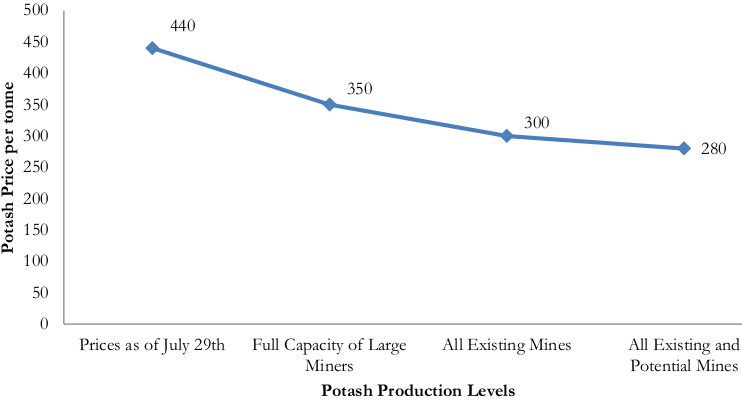
After viewing Exhibit 1, a strong candidate should ask for the costs facing each level of miner to determine whether a given level will remain profitable after the price decline. At this point present them Exhibit 2.
Exhibit 2. Production Economics of Potash Mines
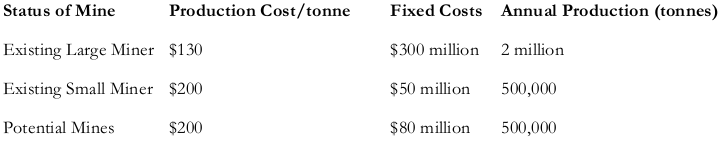
* Potential mines are those that have discovered potash reserves, but have not built the infrastructure to extract it.
From Exhibit 2, they should work in reverse to figure out which groups will produce and thus, where prices will settle once the industry stabilizes.
If undeveloped mines produce, prices will drop to $280/ton.
Price = $280/tonne
Variable Costs = $200/tonne
Gross Margin = $280 – $200 = $80/tonne
Production = 500,000 ton
Revenues = $80 * 500,000 = $40 million
Fixed Costs = $80 million
Profits= $40M – $80M = ($40 million)
Thus, undeveloped mines will not produce. Now that this possibility is ruled out, move up the demand curve to the next point and evaluate small mines when prices are $300.
Price = $300/tonne
Variable Costs = $200/tonne
Gross Margin = $300 – $200 = $100/tonne
Production = 500,000 ton
Revenues = $100 * 500,000 = $50 million
Fixed Costs = $50 million
Profits = $0
Since we know mines that earn zero profits will stay in business, the equilibrium price is $300/tonne. There is no real reason to calculate the profits of the senior miners, if the candidate does so, they should use the equilibrium $300 price and find that profits are $40 million.
Price = $300/tonne
Variable Costs = $130/tonne
Gross Margin = $300 – $130 = $170/tonne
Production = 2 million ton
Revenues = $170 * 2M = $340 million
Fixed Costs = $300 million
Profits = $340M – $300M = $40 million
Focusing on Karnalyte Resources, their mine has not yet been developed, so the prior analysis shows that they cannot develop their mine. The candidate should see from their balance sheet that they must come up with $25 million by the next year and thus must liquidate their assets.
4. Conclusion & Recommendation
* This poses a serious threat to the potash market as higher volumes will push prices down to $300 as all existing mines move to full capacity.
* Since our client Karnalyte Resources has not yet developed their mine and it no longer makes economic sense to do so, they should liquidate their assets.
* Once they pay off their debts and employees, immediate liquidation will leave $10 million for shareholders.