Kryptonite Mining Firm IMC Global to Buy Competitor
Case Type: business competition, competitive response; merger & acquisition (M&A).
Consulting Firm: Mercer first round full time job interview.
Industry Coverage: mining & metals production.
Case Interview Question #01212: Your client IMC Global (also known as International Minerals and Chemical Corporation) is a raw materials mining and production company headquartered in Lake Forest, Illinois, United States. IMC Global is in the worldwide Kryptonite mining business. Kryptonite is a powerful radioactive  mineral (the presence of which weakens the superhero Superman) appearing in Superman comics and movies. Kryptonite has been featured in a variety of forms and colors (each with its own effect) in DC Comics publications and other media.
The client IMC Global is considering an acquisition of one of their competitors. Should they proceed, and if so, what is the maximum they should pay?
Possible Answers:
1. Case Overview
The interviewer or case giver should keep the case simple for the quantitative part (i.e. assume the demand is not changing, that one processing plant can handle the product from two mines, that all mines have the same cost structure and will sell equal quantities, etc). However, after the quantitative section is complete, ask the candidate to explore these assumptions in more detail.
2. Information Gathering
Additional Information: give to candidates if requested
a. Kryptonite
* There are three known sources of Kryptonite in the world. Given the physical characteristics of this radioactive material, it is unlikely that this material will appear anywhere else on Earth.
* Kryptonite is used to power a new breed of power stations that are environment-friendly. The three sites have enough Kryptonite to last for 100 years of expected demand growth.
* The U.S. is the only country with Kryptonite mines and the only country that is currently using the Kryptonite power station technology.
* Kryptonite power stations are built and operated by private companies. These companies also have a coal co-generation plant in case they cannot acquire enough Kryptonite. However, they much prefer to use Kryptonite because it has a variable cost that is vastly less than coal (per MW of output).
* Fully-costed, Kryptonite produces twice the energy of coal, per dollar.
b. The Competition
* There are three competitors in the Kryptonite mining industry. Each one occupies one of the three Kryptonite sites. Your client and one of the competitors have been online for some time. The competitor your client is considering acquiring has just put together their facilities and will be going online this month.
* The cost structures are identical for each Kryptonite producer. Consequently, it is expected that the buyers will purchase equal quantities of Kryptonite from all producers.
c. Annual Cost Structure for all three Kryptonite mining companies
* Extraction Facilities: $7,500,000 (Capacity = 5,000 ton)
* Processing Facilities: $7,500,000 (Capacity = 10,000 ton)
* Corporate Overhead: $1,000,000
* Extraction Costs: $4,500 / ton
* Processing Costs: $500 / ton
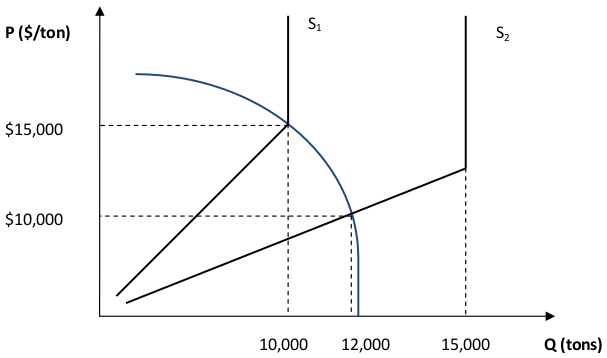
d. Industry Supply and Demand Curves (before and after new mine comes online)
3. Quantitative Analysis
A strong candidate should start the case analysis by establishing that our client would only purchase the new Kryptonite mine if it increases its long-term profitability. Once they have explored the industry dynamics, move into the quantitative analysis.
a. Current Profitability v. Profitability with New Entrant
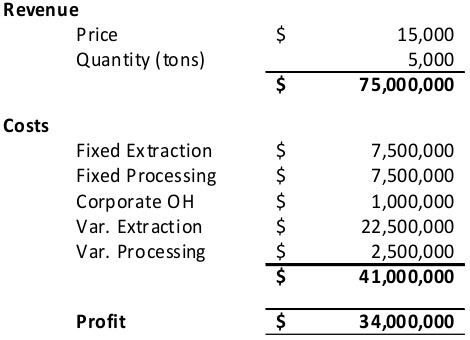
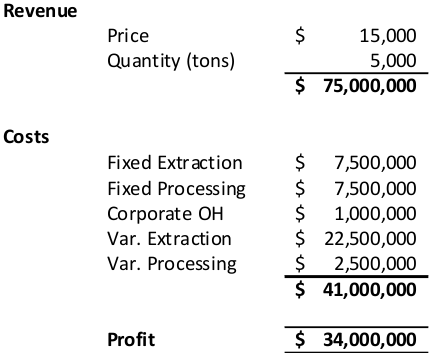
* Current Profiability
Client’s production quantity = 10,000 / 2 = 5,000 tons
* Profitability with New Entrant
Client’s production quantity = 12,000 / 3 = 4,000 tons
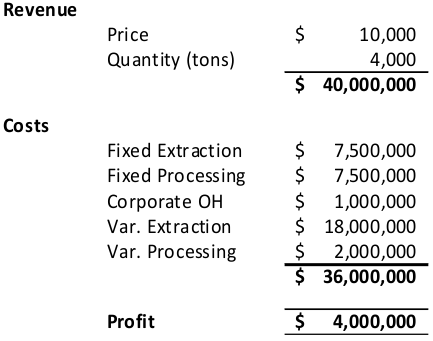
Conclusion: Our client IMC Global’s profits will be substantially affected when the new competitor starts producing (potential loss of $34M – $4M = $30M/year). Therefore, it is a good idea to purchase the competitor, if the price is right.
b. Purchase Competitor – Produce New Kryptonite v. Do Not Produce New Kryptonite:
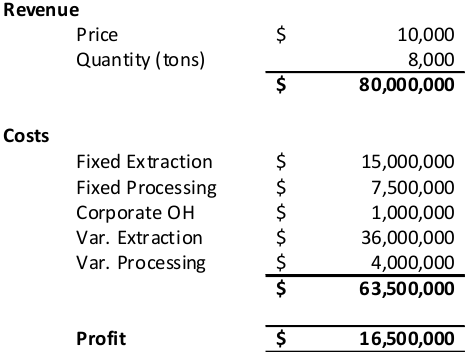
* Buy New Competitor (and produce)
Client’s production quantity = 4,000 + 4,000 = 8,000 tons
* Buy New Competitor (and do not produce)
Client’s production quantity = 5,000 tons
Conclusion: If our client IMC Global does purchase the competitor it is more profitable to sit on the asset and not produce any Kryptonite until there is more demand (profit = $34M v. $16.5M).
c. What Price to Pay
Our client IMC Global should be able to purchase the new competitor because the new competitor stands to make only $4M/year (NPV = $4M/r-g) whereas it is worth up to $34M – $4M = $30M/year to our client (NPV = $30M/r-g). This leaves lots of room for negotiations on both sides.
d. Potential Risk
It is unlikely that we would get into a bidding war with our existing competitor. They would want us to buy the new mine and shut it down — it’s better for the entire market.