Bausch & Lomb to Sell More Contact Lenses via Doctor’s Office
Case Type: improve profitability; business competition, competitive benchmark.
Consulting Firm: McKinsey & Company final round full time job interview.
Industry Coverage: healthcare: hospital & medical.
Case Interview Question #00963: Your client is a well-known contact lens provider called Bausch & Lomb. The company is one of the world’s largest suppliers of eye health products, including contact lenses, lens care products, medicines and implants for eye diseases. Bausch & Lomb is headquartered in Bridgewater, New Jersey, United  States, and employs more than 13,000 people as of 2015.
Bausch & Lomb manufactures and distributes contact lenses in the U.S. Bausch & Lomb is one of the largest players in the US market, and has been for quite some time. However, the company feels that compared to its main competitor, it is not doing as well as it could. The CEO of Bausch & Lomb has called in McKinsey & Company to find out how to solve this problem and to recommend a solution. How would you go about it?
Additional Information:
If the candidate asks for more information on the company/product, provide the following data.
* For the scope of this case, Bausch & Lomb manufactures and distributes only in the U.S.
* Demand for contact lenses has been growing steadily at about 3% annually.
The problem of the case as stated is intentionally very vague. Interviewee should clarify what is meant by “compared to its main competitor, not doing as well as it could”, not just assume that it means lack of growth, etc.
* Bausch & Lomb completed a benchmark study of itself versus its biggest competitor and discovered that its profits are not growing as fast as the competitors’.
* There are only two main players in market: Bausch & Lomb and Competitor Johnson & Johnson. Other, smaller firms exist, but for the scope of this case are negligible.
* Competitor Johnson & Johnson is also a US-only manufacturer & distributor of contact lenses.
* Market is equally divided between Bausch & Lomb and Competitor Johnson & Johnson.
* Bausch & Lomb and Competitor Johnson & Johnson are of roughly equal size.
* Bausch & Lomb and Competitor Johnson & Johnson sell the same products.
Possible Answer:
1. Suggested Framework
Question: How would you go about structuring an analysis of this problem?
Note: If the interviewee hasn’t clarified the purpose of the case (i.e. what problem does Bausch & Lomb want them to solve?), push them to do so. A lot of people automatically assume that Bausch & Lomb’s sales aren’t growing at industry rate, or that Bausch & Lomb isn’t satisfied with its market share. If they do, I usually read back the statement of the issue in the introduction (“compared to its main competitor, it is not doing as well as it could”) and ask them to explain to me what that could mean. If they still don’t get it, I point out that the statement is very subjective (as in, could be interpreted to mean many different things) and by then, they usually figure it out.
This is a profitability problem, so classic profitability framework will work: profits = revenues – costs = (price * volume) – (fixed costs + variable costs).
The best candidates will be specific about their bullet points, giving concrete examples and eliminating certain areas based on their communicated hypotheses.
Most candidates don’t do this, so after the framework is laid out, I usually push back and ask them.
2. Detailed Analysis
Question: Based on the information I’ve given you so far, and based on what you know about the contact lens industry, where do you think the problem lies?
What answer they end up with doesn’t matter, but they should concretely and rationally eliminate certain options.
The easiest way to reason out possible problem area is by thinking about current, established major contact lens players – Bausch & Lomb, and Johnson & Johnson.
This is an example of how to analyze the situation:
Contact lens industry is defined by high barriers to entry (since high R&D outlay necessary); also, industry is mature (20 years plus) & dominated by two players, so can expect the two main players to be equal in most things. Thus
(1) Cost side
* Variable costs
– Raw Material: inputs will be plastic, saline solution (water, salt), packaging (paper, aluminum foil, plastic). These are all commodities. Any issues Bausch & Lomb has with raw material costs are likely also experienced by the Competitor Johnson & Johnson. Thus not an issue.
– Labor: will be unskilled, wage rate probably set by minimum wage standards. Unless unionized and competitor not, nothing here to put Bausch & Lomb at disadvantage to Competitor Johnson & Johnson. Thus not an issue.
* Fixed costs
– Plant, Property & Equipment: given U.S. contact lens industry, probably no difference between Bausch & Lomb and Competitor Johnson & Johnson. There should be no major difference in plant costs or plant efficiency. Probably no major equipment differences.
– R&D: big cost factor, but probably equal between Bausch & Lomb and Competitor Johnson & Johnson.
– Overhead (People): Again, no major differences as both companies are of similar size.
– Marketing/Distribution: Probably no differences.
– Legal issues? Possible, but Bausch & Lomb is probably big enough that even a huge class action settlement shouldn’t affect its bottom line too much.
(2) Sales side
* Pricing
– Contact lenses are fairly commoditized. Minor differences in pricing may exist, but probably nothing major.
– Customers may be price sensitive, but given that contact lenses are fitted to a person by their doctor, customers do not purchase lens purely on price. Comfort/fit and compatibility is a big issue.
* Product mix: Maybe Competitor is selling more profitable mix of lenses?
* Distribution/Sales channels: Competitor may be selling through more profitable channels?
* Volume
– Substitute goods: May be substituting away from Bausch & Lomb? However, any substitutes (Lasik, glasses, etc.) will likely hit Competitor equally.
– Competitor may capture more of market – better branding, better distribution, better price, better products? Could be possible.
Question: After analyzing Bausch & Lomb’s cost structure, McKinsey is confident that Bausch & Lomb’s costs are extremely competitive. Knowing this, where do you think the problem could lie?
Candidate: Sales side.
Question: McKinsey analyzed the distribution channels of Bausch & Lomb and its competitor Johnson & Johnson, and came up with the following information. (show Customer Mix slide)
Slide 1. Customer Mix of Bausch & Lomb and Competitor Johnson & Johnson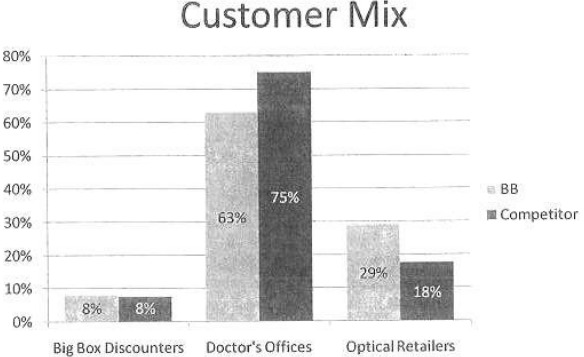
Slide is vague. Interviewee should immediately walk through and clarify what is being shown. Most candidates won’t do this. If they don’t, start pointing things out to them.
– Slide shows customer mix in terms of sales volume. Competitor Johnson & Johnson and Bausch & Lomb sell equal volume annually (10,000,000 lenses per year or whatever).
–> So big takeaway is that Competitor Johnson & Johnson sells more via Doctor’s offices; Bausch & Lomb via Optical Retailers.
* Big Box Discounter = Walmart, Target, Sam’s Club, Costco
* Doctor’s Offices = your local mom & pop non-chain doctor’s office
* Optical Retailer = Lenscrafters, etc.
–> So obviously, varying degrees of buying power. Big Box Discounter like Walmart purchases in large volume; Doctor’s office is purchasing in small quantities, probably also not super business savvy (no procurement department). Lenscrafter is in the middle.
In addition, different differentiation: Big Box Discounter like Walmart is known for cheap prices; Doctor’s office is specialized & high on service. Lenscrafter is in the middle.
* Bausch & Lomb and Competitor Johnson & Johnson charge same prices for same products (as established earlier in framework).
–> At this point, a great candidate will remember the problem at hand (less profitable than competitor), combine it with the new information and realize that there must be a pricing difference between the different sales channels.
Once difference in pricing is established, ask:
Question: Does this Surprise You?
The candidate should make some sort of intelligent comment about how, given the types of retailers, no, it does not surprise him/her.
(Now show the candidate profitability by customer Slide)
Slide 2. Profitability by Customer
| Per box of contacts (6 lenses) | Big Box Discounter | Doctor’s Office | Optical Retailer |
| Revenue | $16.50 | $28.00 | $22.00 |
| COGS | $8.00 | $8.00 | $8.00 |
| Sales, Distribution | $5.00 | $2.00 | $3.50 |
| Other Fixed Costs | $2.00 | $2.00 | $2.00 |
| Profit (ask candidate to calculate) |
Question: Can you tell me what you see here, does any of this surprise you? (show profitability by customer slide)
The candidate should point out that prices are in line with what was expected. Walmart is lowest, Doctor’s offices highest. Given purchasing power, it makes sense. Also, customers generally are willing to pay a premium at a Doctor’s office, since service is more individual.
COGS: it makes sense that COGS are equal in all channels, as the same product is sold in each channel.
Sales, Distribution: it’s interesting that Sales & Distribution Costs are different. It could be because Walmart requires more advertising, cash for shelf space?
Fixed Costs: it makes sense that Fixed Costs are equal. Again, same product.
Question: Ask the candidate to calculate profit and percent profit margin. It’s OK to estimate on margin.
* Big Box Discounter: $16.5-$8-$5-$2 = $1.5, $1.5/$16.5 = 9%
* Doctor’s Office: $28-$8-$2-$2 = $16, $16/$28 = 57%
* Optical Retailer: $22-$8-$3.5-$2 = $8.5, $8.5/$22 = 39%
Question: Does any of this surprise you?
Candidate: Make appropriate comment.
Question: Given this information and given the initial problem you’re solving for, what would you want to look at now?
Candidate: How can we sell more lenses via the Doctor’s Office channel?
Excellent candidates might also comment that they’re curious as to why Bausch & Lomb is even bothering to sell in the Big Box Channel – why not pull out and focus resources/attention on improving sales in Doctor’s Offices, instead?
Question: Like its competitor Johnson & Johnson, Bausch & Lomb relies on sales reps to distribute its contact lenses to the Doctor’s Offices. Currently, Bausch & Lomb has 5 reps in its call center dedicated to reaching out to the Doctor’s Offices and doing whatever is necessary to get them to sell as many Bausch & Lomb lenses as possible.
Interestingly, McKinsey has discovered a relationship between call frequency and sales generated:
* For every 2 calls made to a customer per month, our client sees a 5% increase in revenue from that customer.
* For every 3 calls made, our client sees a 15% increase in revenue over revenue for 1 call.
Currently, each B&L sales person has 100 customer accounts. Each account must be called at least once a month, as B&L does not want to lose any customers. Assume that sales per customers, when the customer is called once a month, is $100.
Given these findings, what should Bausch & Lomb do?
Candidate:
To maximize profits, the candidate must consider how to best distribute phone calls.
Additional Information to be given if asked:
* Each sales call takes 30 minutes.
* Each sales rep works 20 days per month, 8 hours a day.
* Each sales rep spends approximately 3 hours of each work day on administrative work, lunch break, etc.
Calculation:
8 hours a day less 3 hours a day for admin = 5 hours a day for sales calls.
5 hours divided by 30 min per call = 10 calls per day.
10 calls per day times 20 work days per month = Max. capacity is 200 calls per month per rep.
200 calls max less 100 calls necessary = 100 “free” calls.
The sales reps have already called all customers once.
– To reach 3 calls per month, they must call customer 2 more times. 100/2 = 50 customers, they are able to call 3 times per month for 50 customers.
– To reach 2 calls per month, they must call customer 1 more time. 100/1 = 100 customers, they are able to call 2 times per month for 100 customers.
* 1 call: sales per customer = $100
* 2 calls: sales per customer = $100 * 1.05 = $105
* 3 calls: sales per customer = $100 * 1.15 = $115
If all customers are called twice, then sales = 100 customers * $105 per customer = $10,500
Otherwise, 50 customers are called once and 50 customers are called 3 times, sales = 50 customers * $100 + 50 customers * $115 = $10,750
3. Recommendations
The client company Bausch & Lomb should call 50 customers once and 50 customers 3 times.
4. Additional Considerations
See Above
5. Primary Takeaways from Case
* Make sure you understand what problem you’re trying to solve. If the problem is vague, clarify it before you start your framework, otherwise, how do you know what you’re solving for?
* Don’t jump to conclusions on slides. Even if you think you understand everything on it, verify with the interviewer to make sure your understanding is correct.
* Take every sub-conclusion back to the main question.
* Sanity check everything you conclude and/or see. Does this make sense? Is this what I expected to see?