Bausch & Lomb Responds to Threat of Disposable Lens
Case Type: business competition, competitive response; new product, new technology.
Consulting Firm: Bain & Company 2nd round full time job interview.
Industry Coverage: healthcare: hospital & medical.
Case Interview Question #00939: Our client Bausch & Lomb is an American contact lens manufacturer. Founded in 1853 in Rochester, New York, Bausch & Lomb is one of the world’s largest suppliers of eye health products, including contact lenses, lens care products, medicines and implants for eye diseases. Today, the company  is headquartered in Bridgewater, New Jersey.
The client Bausch & Lomb sells lens cleaning solution, prescription long use contact lens, and trifocal/bifocal lenses. Recently, global pharmaceutical and medical device giant Johnson & Johnson (J&J) introduced the first disposable lens (consumers wear for two weeks then throw away). The J&J lenses do not need to be cleaned and offer a much better user experience. J&J spent decades developing not only the disposable lens, but also a patented automated production process. Using their computerized production, J&J can manufacture the disposable lens for a tenth of the cost of our time equivalent offering. Already J&J has gone from O% to 25% of all new installs (first time contact prescriptions), matching the number of prescriptions for our client Bausch & Lomb’s product only six months after launching the product.
Show the Candidate the following three charts:
Exhibit 1. Breakdown of Client Revenue by Product Line 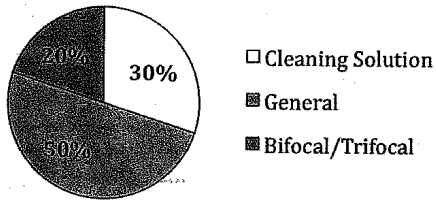
Exhibit 2. Gross Margin (GM%) and Global Market Share by Product Line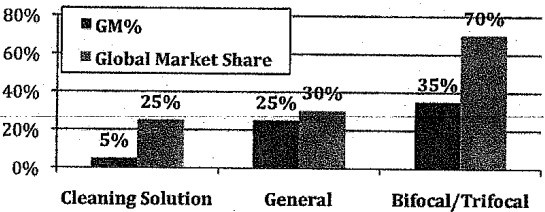
Exhibit 3. Average Standard Lens Customer Spend (Client vs. J&J)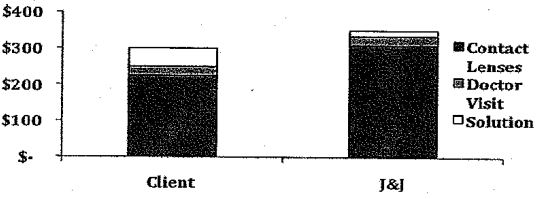
Interviewer: What do you see? What should our client Bausch & Lomb do?
Possible Answer:
Candidate should ask for time to go over the three charts and build a framework.
Candidate: Well, first a few observations. Our client Bausch & Lomb has a large share of the global bifocal/trifocal market (70%). While solution and general lens are nice complementary businesses, the money is in bifocal/trifocals. Also, it costs more to outfit a consumer with J&J lens for a year than it does to use our client’s product.
In order to make solid recommendations to our client, I would like to flesh out three key dimensions of our client’s dilemma. First, I would like to learn more about J&J’s new products, next I would like to explore how contacts/solution are sold, and finally I would further map out the contact lens market.
I would like to start with J&J’s product.
Interviewer: Sounds Reasonable.
Candidate: Great. Can you tell me how the overall user experience of our product compares to that of J&J?
Interviewer: The product is fabulous. In fact, 20 years later it is still the market leader (30% market share). People love it.
Candidate: Obviously good news for our client. To clarify: the J&J product line includes Bifocal/Trifocal lenses?
Interviewer: Due to the way the J&J lens is produced, it is impossible to create bifocal or trifocal capabilities.
Candidate: That is great news for our client. A final J&J question: can we develop similar technology?
Interviewer: J&J is years ahead in research and development (R&D) and controls all the patents that make the disposable lens possible. It may be a decade before we can offer a competing product.
Candidate: OK. Let’s shift our attention to the sales channel. I do not wear glasses, but from what I know about contacts a doctor must write a prescription for a contact lens. Do doctors receive a commission from the sale of lenses or solution? Also, is the insurance co-pay the same for either product?
Interviewer: The insurance co-pay is $35 for both products. Doctors do receive a commission on the sale of lens and solution, although most solution is not bought at the doctor’s office.
Candidate: So Doctors are receiving around a 33% larger commission from selling J&J lens than our client’s product? That might be a problem. We know customers will be happier with the J&J lenses, and now we know that the J&J lenses have the same out of pocket cost to customers as our client’s lenses and Doctors have a financial incentive to sell J&J lenses. Also, given the cost differential it means that J&J is making a much larger profit per user than our client.
Interviewer: Right. What do you think can be done about it?
Candidate: In the short term, we might consider raising the price of our lens to ensure Doctors’ financial incentives are not a problem for our client. We should also explore training our sales force to counter the J&J sales pitch and consider running a sales contest for Doctors. All three might help stabilize our market share in the short term. However, our client’s conventional lens business would seem to be a cash cow. It has a good brand, large installed base, and steady profits – but no chance of growth. Our client should consider selling it while it remains attractive or our client could use the profits from the general lens business to expand into another area. I think it’s a great time to look at the product market. Can you tell me about any trends in the contact lens market?
Interviewer: Well, other than disposable lenses, the other big trend is specialty vanity lens. Think cat eyes for Halloween or red tint for athletes.
Candidate: Interesting. How many competitors are there in the specialty lens market? Also, is there any patented technology required to enter the market?
Interviewer: The market is highly fragmented but growing. There is no proprietary technology. In fact, our current facilities could produce most types of specialty lenses today.
Recommendation
Interviewer: Oh! The CEO just walked into the room. Please give us a recommendation.
Candidate: Our client Bausch & Lomb is facing a major threat to both its general lens business from J&J, as well as its solution business since consumption of solution is much lower for disposable lenses. Our client has a large established customer base it should work to protect for as long as possible. To do so, it should raise prices of our lens and increase our client’s sales force’s interaction with doctors.
Our client should invest cash generated by its general lens business into buying a specialty lens producer, then work to consolidate its market position. All the while, the client should work to innovate and patent protect in the bifocal/trifocal market to ensure long term profits. It cannot compete long term with J&J disposable lenses, but it should be able to survive and grow by focusing on its core bifocal/trifocal business and seizing the specialty lens opportunity.