Hannaford to Improve Supermarket Shopping Experience
Case Type: business competition; increase sales.
Consulting Firm: McKinsey & Company first round summer internship job interview.
Industry Coverage: retail; general merchandisers.
Case Interview Question #00622: Our client Hannaford is a regional supermarket and grocery chain based in Scarborough, Maine, United States. They have about 200 grocery stores as of 2012, and operate in New England region (northeastern corner of the United States consisting of the six states of Maine, New Hampshire, Vermont,  Massachusetts, Rhode Island, and Connecticut) and upstate New York only. In number of stores operated, Hannaford is now the second largest supermarket chain headquartered in New England, behind only Quincy, Massachusetts-based Stop & Shop Supermarket.
Hannaford was doing very well for the last several years. However, from the most recent 2 years Hannaford’s market share growth is starting to slow down. Their margins have been falling. Their average sales per store has been decreasing. To make things worse, Walmart recently has opened 4 super centers which contain 75% of the same collection of items sold by Hannaford. And Walmart plans to open even more stores in the region.
How do we reverse the decline in Hannaford’s average sales per store? How do we successfully compete with Walmart?
Note to Interviewer:
Unlike other profitability cases, the interviewer or case giver should not give the candidate time to come up with a framework. Instead pose the first question immediately.
Additional Information: (to be given to candidate if requested)
Hannaford’s supermarket stores are a full-range stores including groceries, pet food, clothing, pharmacy, etc. Some stores include banks, dry cleaners, and post offices. A few others include child care, flower shops and catering.
- 15% have banks, dry cleaners and post offices
- 5% have child care, flower shops, and catering
- The remaining are regular grocery stores.
Possible Solution:
Interviewer: What are the reasons for the decline of average sales per store?
Candidate: It could be several reasons:
- Targeting the wrong segment
- Incorrect Location (too many competitors nearby)
- Inadequate marketing
- Pricing
- Inadequate customer service
- Convenience
- Owned store vs. franchise — take a look at franchise contracts to ensure that they are motivated to push sales.
- Economy
- We have just 5% of stores having all services. Maybe competitors have a 1 stop shop with flower, child care, dry clean, banks, etc.
- Some stores may be more profitable than the others, but some others are less profitable, thus bringing the average down.
Interviewer: We have undertaken a survey among consumers which has showed that the consumers perceive our prices to be 20% greater than that of Wal-Mart. In addition, even though our prices are similar to our nearest competitor Stop & Shop, the customers perceive our prices to be greater than them as well.
What actions can the marketing manager take to change the customer’s perception of prices?
Candidate: Does each shop have the ability to change prices or is it centrally governed for all 200 stores?
Interviewer: Each store has the ability to set their own prices.
Candidate: Some actions could be
- Direct to consumer marketing
- Offer discounts
- Bring down prices of some products which are significantly higher than our competitor
- Increase customer services
- Launch a customer loyalty program
- Check prices of affiliated services like dry cleaning, child care, flower shops, and catering, etc. Maybe high prices there has created the pricy image for the grocery store
- Franchise vs. owned stores, check for store managers’ incentives to incease price
Interviewer: The Hannaford store chain decides that they need to bring down the prices of the fastest selling 6,000 items by 15%. How much would it cost the company given the following additional information?
| Average sales per store | $20 million |
| Fastest 6000 items | 24% |
| Next 15000 items | 42% |
| Number of stores | 200 |
| Super stores | 120 |
| Stores over 15000 square feet | 108 |
Candidate: (do the calculations)
| Average sales per store | $20 million |
| Fastest 6000 items | 24% |
| Sales of fastest 6000 | $20 million * 24% = $4.8 million |
| Impact on profit | 15% * $4.8 million = $0.72 million |
| Total impact | 200 stores * $0.72 million = $144 million |
Interviewer: Good. We have the results of our recent market research: the percentage of customers who are satisfied with shopping experience, convenience of store locations, healthy foods, organic meat, good deals, store prices (see Figure 1). The client the CEO of Hannaford is eager to have us analyze the data. Could you let us know the implications of this data for our strategy?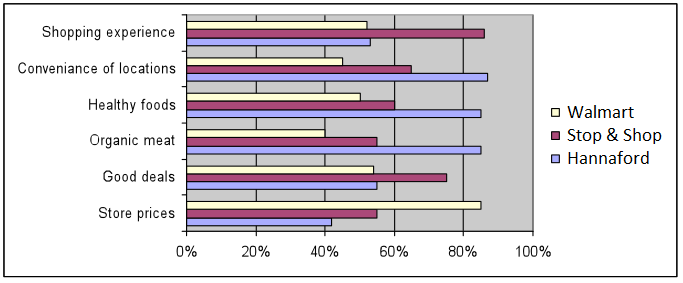
Candidate: This market research shows that we are doing well in convenience aspect and healthy foods and organic meat, but we don’t have a good shopping experience and our store prices are perceived to be high.
Interviewer: Great. Let’s assume that the CEO just walked in and would like you to give him the next steps. What would you tell him?
Candidate: You came to us with a question of what we should do to successfully compete with Walmart and reverse the decline in our revenues. We looked at the various factors that may affect the average sales/store. We also conducted market research to show where we could improve. Based on the market research, I would recommend the following:
- Improve the shopping experience
- Focus on marketing our competitive advantage — convenience of locations, healthy foods and organic meat
- Work on improving consumers perception of our prices.
Interviewer: Thank you. You did a great job.