Elgin Sweeper Company to Scale Back Production
Case Type: improve profitability; business competition.
Consulting Firm: KPMG Advisory final round job interview.
Industry Coverage: environment & waste management; industrial equipment.
Case Interview Question #00594: Our client Federal Signal Corporation (NYSE: FSS) is a global industrial conglomerate with about 2,800 employees and annual revenue of about USD $700 million. Headquartered in Oak Brook, Illinois, Federal Signal designs, develops and deploys solutions intended to  protect people, property and the environment under brands such as Federal Signal, Elgin, Vactor, Guzzler, and Jetstream.
Overall the client company is very profitable. They have engaged KPMG Advisory to examine one of their business subsidiaries that is under-performing. The subsidiary Elgin Sweeper Company manufactures and distributes street sweepers (Zamboni/lawnmower-like machines that a person would ride and which uses two large rotating brushes to sweep up the street as it moves by) and has been doing so for more than 50 years. While never a standout division, until recently it had always been profitable. 4 – 5 years ago, however, Elgin Sweeper Company’s profit margins started to fall and it is currently just above breakeven.
Senior management of Federal Signal had made a decision 2 years ago that they did not want to invest in new features for their street sweeper product lines and has the approach that they don’t want to invest significant amounts of capital now (unless they can be convinced otherwise).
KPMG’s task is to analyze the Elgin subsidiary’s performance and recommend to the management of Federal Signal what should be done. Tell me some of the areas you’d consider looking into here knowing that we only have a few weeks to finish this engagement.
Possible Answer:
Candidate: That’s a tight timeline, so let’s focus on big areas. Since profits = revenues – costs, can you tell me about recent trends with regard to costs?
Interviewer: Sure. A quick look at the numbers showed costs have been fairly constant over the past 20 years, only increasing with inflation.
Candidate: So I’m thinking I’ll then move into revenue. How has that stood up?
Interviewer: Revenue has fallen steadily over the past 5 years. Why might this be happening?
Candidate: It might be happening because of trends in the market, changes in customer preferences…
Interviewer: Since you mention it, who are the customers?
Candidate: I suppose they would be municipalities, state governments, etc. I don’t see this as being something for individual use.
Interviewer: Usually not. That’s right, Elgin Sweeper’s customers are mostly state and local governments. So we looked into the customers and they are keeping with past trends, replacing their street sweepers every 4 to 7 years, and the number of municipalities purchasing street sweepers has remained constant. So, what else might be driving revenues down?
Candidate: Prices could be coming down.
Interviewer: Prices have actually remained constant.
Candidate: So how about competition? Have new competitors entered the market or stolen market share?
Interviewer: There have been no new competitors. The following chart shows what sales have looked like 10 years ago to now. What do you want to know after looking at this?
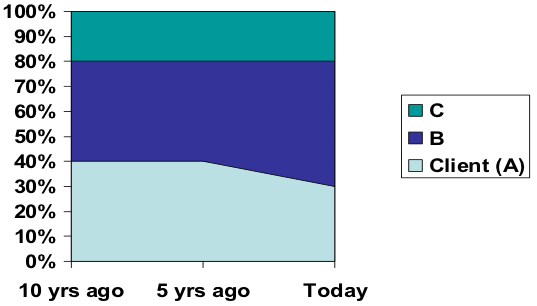
Candidate: It looks like Competitor B has taken market share from us. I’d like to know what B is doing differently. And for that matter what Competitor C is doing differently so as to be unaffected.
Interviewer: About 5 years ago, B introduced a new technology that used air vacuums to clean streets instead of the mechanical collecting methods that had always been used in the past. These air machines are more effective at picking up small debris like sand and small litter, and work more quickly and efficiently than the mechanical ones previously offered. Price points are about the same. B still sells mechanical machines, but the drop in our market share was directly related to the new air offering.
Candidate: So how about Competitor C?
Interviewer: Well, C makes machines that are far more heavy-duty, it’s really a different type of offering.
Candidate: So we don’t compete with C in reality?
Interviewer: No, but we could. Do you think we’d want to?
Candidate: Not likely without knowing much about the market. They seem to have been stable and have an expertise, so unless we can offer something new to their customers I’d guess they’ll defend their position in a niche market at all costs.
Interviewer: Good, that’s the conclusion we quickly came to on C. Now, what other information do you need to recommend something for our client?
Candidate: I need to know if we can replicate the air technology.
Interviewer: We can, but it will take 2 years and cost $100 million.
Candidate: Since you said management does not want to make a significant investment, that seems unlikely. So other than that, what trends do we expect from this market going forward?
Interviewer: What would you think?
Candidate: I guess the encouraging news is that we’re still selling despite the new technology and the similar price point. So do municipalities and state governments need both?
Interviewer: Good observation. In fact they do need both. So we broke the country into 7 regions, all of which needed the same amount of street sweepers overall. In the 3 regions in the north, on average there was a 22/8 ratio of mechanical sweepers to air sweepers needed. In the 4 regions in the south, it was 22/18 (these numbers do not include C’s models). For the entire country, what percentage of street sweeper sales were mechanical?
Candidate: So, (3/7) * (22/30) + (4/7) * (22/40) = 44/70, or roughly 66% (It’s actually 63%).
Interviewer: Yes. So why would municipalities and state governments need mechanical sweepers if air ones are more efficient, and what does this tell you?
Candidate: I’d think they’d need mechanical ones to deal with larger, more solid things on their streets. It looks like in the south they can use more air machines which would make sense because they’d have sand and small debris. In the north you might get larger rocks, chunks of ice, etc. This tells me that the market isn’t going to zero, so maybe the company can simply protect the market share that it has, scale back production to the point where the market will be in equilibrium between air sweepers and mechanical sweepers, and keep decent margins going forward.
Interviewer: Right, so that’s exactly what we recommended. Once we recognized these trends, we also looked for a strategic buyer, and in fact the parent company sold the street sweeper subsidiary to a foreign company that already had air technology developed. That was outside the scope of this case, though — just an interesting follow-up.
Candidate: Very interesting case!
Note:
The interviewer did not allow time for development of a framework — that isn’t the point of the case. Instead, the interviewer simply starts asking questions and they should be answered as thoughtfully as possible on short notice. Being thoughtful but remaining structured is vital here: sticking to profits = revenues — costs and drilling down on costs and revenues. This is a great case because if you understand basic drivers, it’s completely rational.