The Rise and Fall of PeopleExpress Airlines
Case Type: industry analysis; business competition.
Consulting Firm: A.T. Kearney 2nd round job interview.
Industry Coverage: Airlines.
Case Interview Questions #00053: The airline industry is characterized by low returns and stiff competition. In the early years after deregulation, discount carriers like PeopleExpress Airlines sprang up. Years later the discounters have gone out of business. In a price competitive industry, why is it that the higher cost carriers 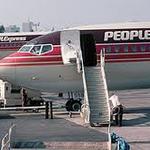 were able to survive and the low cost ones like PeopleExpress Airlines were not?
Additional Background Information:
PeopleExpress Airlines (PEx) was launched in early 1981 with service from Newark to Buffalo, Columbus, and Norfolk of Virginia. People Express grew rapidly, adding flights to Florida by the end of the year.
In May 1983, PeopleExpress began non-stop service from Newark to London’s Gatwick Airport with a leased Boeing 747. Flights were initially priced at $149 each way. The airline became an instant success with all flights sold-out for several months within 24 hours of being offered. Later, the airline added Montreal-Mirabel and Brussels to its international network.
PeopleExpress airlines used a simplified fare structure whereby all seats on a given route were offered at the same price, with slight differences between “Peak” and “Off-Peak” fares. All seats were in economy class, with the exception of “Premium Class” seating on overseas flights. Fares were paid in cash aboard the aircraft early in the flight. Passengers were permitted to bring one carry-on bag for free, while each checked bag was charged a fee of $3.00. People Express was the first United States airline to charge a fee for each checked bag. People Express also charged modest amounts for customers wishing food or beverages.
In 1985, PeopleExpress bought out Denver-based Frontier Airlines. The combined company became the United States’ fifth largest airline, with flights to most major U.S. cities, as well as an additional transatlantic route to Brussels. During this period, People Express also purchased midwest commuter carrier Britt Airways and Provincetown-Boston Airlines (PBA), a regional airline with route networks in New England and Florida.
The aggressive purchasing spree placed an enormous debt burden on the carrier at the same time major legacy carriers’ improved yield management schemes enabled them to compete better with PeopleExpress on fares. Furthermore, integrating Frontier’s operations caused labor struggles with the newly absorbed airline, and the change to a low-fare, no-frills mentality alienated Frontier’s passengers.
Debt pressure on the carrier forced a change in philosophy, as PeopleExpress sought to lure business travellers who were willing to pay higher fares. Aircraft cabins were redesigned to include a first-class cabin, a frequent flyer plan was initiated, and the simplified fare structure was abandoned in favor of a more traditional airline industry “revenue management” pricing scheme.
The failed integration and enormous debt stretched People Express too far. In June 1986, the company announced it was working with an investment bank to seek buyers for part, or all, of the airline. A deal to sell Frontier off to United Airlines fell through due to the inability of United to agree to terms with its unions on how to incorporate Frontier’s staff, leading PeopleExpress management to cease Frontier’s operations and file the subsidiary for bankruptcy protection.
In the end, PeopleExpress was forced to sell itself entirely to Texas Air Corporation for roughly $125 million in cash, notes, and assumed debt. Due to concerns about regulatory approval for the purchase, Texas Air purchased the assets of Frontier from People Express in a separate transaction worth $176 million. People Express ceased to exist as a carrier on February 1, 1987, when its operations were merged into the operations of Continental Airlines, another Texas Air subsidiary, under a joint marketing agreement.
Possible Solution:
The following are some of the basic issues to be flushed out:
Characteristics of discounters: Low fares, limited service.
Characteristics of major carriers: Higher fares but better coverage and service. Hub systems channeling traffic.
Competitive moves by major carriers: Innovative use of information technology for yield management and differential pricing. Basically they priced every seat individually based on continuously monitoring demand/supply. They wooed leisure customers with fares lower than discounts and charged more from business travelers (indifferent to price but sensitive to service and frequency). They stole the discounters’ market and forced them out.