Quahog Public Schools to Boost Students Performance
Case Type: operations strategy.
Consulting Firm: Bridgespan Group first round full time job interview.
Industry Coverage: education; non-profit organization.
Case Interview Question #01369: Quahog is a small city in Providence County, Rhode Island, United States. The official population of the city is 80,600 as of the 2020 census, making it the third largest in the state. Quahog is a part of the Providence metropolitan area.
Our client Mr. Peter Griffin is the superintendent of a system of public schools in Quahog, Rhode Island. He is concerned because the performance of students from these schools in national standardized tests has been repeatedly subpar. Mr. Peter Griffin has asked our consulting firm what he should do about it. What would you recommend?
Additional Information:
Provide the candidate with the following additional information when asked:
Q: What is “system of public schools”?
A: e.g. Chicago Public Schools, New York City Public Schools
Q: What are national standardized tests?
A: e.g. SAT, ACT
Q: What is subpar performance?
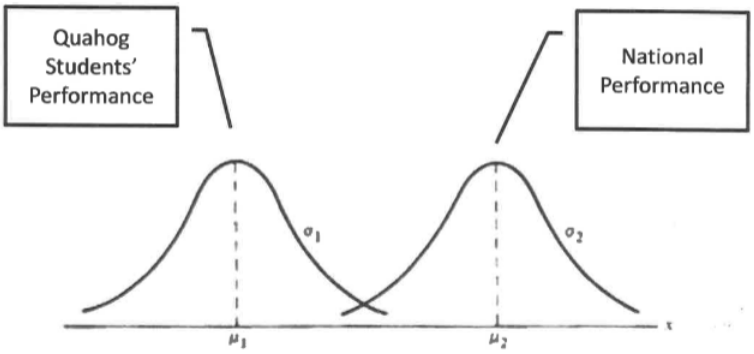
A: On average, a student from Quahog Public Schools does poorly on standardized tests like SAT, ACT compared to the national average. Show Exhibit 1.
Exhibit 1. Students’ test scores in standardized tests: Quahog Public Schools vs. National
Possible Answers:
1. Suggested Framework
A good framework for this case would consider at least four dimensions.
a. Students
– Attendance rates? E.g. Criminal / unsafe neighborhoods –> low attendance –> bad results
– Demographics. E.g. poor students –> work after school –> low attention to studies
b. Teachers
– Recruitment standards (i.e. do we hire bad teachers?)
– Training programs (i.e. do we keep our teachers current in pedagogical skills?)
c. Resources
– Syllabus (i.e. are we customizing our syllabus to these standardized tests? )
– Textbooks
– Library and Laboratories
– Blackboards, etc.
d. Teaching environment
– Windows / Air conditioning; i.e. are our classrooms too hot or too cold to be taught in?
2. Detailed Analysis
– In response to the candidates’ questions about teachers / teaching environment, inform them that it is at par with other public schools.
– If the candidate asks about students’ demographic, inform them that students are from low-mid household income category.
– If the candidate has not brought out the issue of “textbooks”, inform him/her that the Quahog Public Schools provide the books to the students.
– Early findings suggest the shortage of textbooks has been a major factor affecting student performance at Quahog.
Question #1: How do you think we can address this?
This is a classic “What Else?” situation. Probe and test the ability of candidate to think from multiple perspectives. Good candidates will also structure their responses into three groups.
Possible Answer:
* Raise money to buy books
- Fundraising (grants / donations)
- Price discrimination to students (if students can pay for books, they have the option to buy through the school)
* Arrange new books without additional money
- Gifts (in-kind donations)
- Borrow from other public school systems
- Partnership with online bookstores like Amazon, etc. (retailers) for used books, as a philanthropy measure on their part.
* Manage with current number of books
- Coordinated book sharing system
- Scan / copies
Question #2: An immediate area of concern is Grade 6 math and science books. We have identified a shortage of 8,000 such books. 60% of these books are math books and the rest are science books. The math books are available on Amazon but the science ones are not. By partnering with Amazon, we can reduce shortage of math books by 70%. Independently, by coordinated book sharing, we can reduce shortage of science books by 20%. What is the total impact of this?
Possible Answer:
* Total shortage = 8,000 books
– Math books shortage = 60% * 8000 = 4,800
– Science books shortage = 40% * 8000 =3,200
* Benefit
– Amazon partnership = 70% * 4,800 = 3,360
– coordinated book sharing = 20% * 3,200 = 640
– Total benefit = 3,360 + 640 = 4,000 books
Note: Good candidates will spot the pattern in percentages. Total benefit = 70%*60% + 20%*40% = 42% + 8% = 50% = 4,000 books
Now the interviewer could focus on the “so what?” of the 50% benefit.
Question #3: You meet Mr. Peter Griffin, the superintendent in the hallway and he asks you what have you found so far. What will your response be?
Possible Answer:
Good candidates will spot that this is the “final recommendation” question, and will be comfortable verbalizing their recommendation.
Sample Answer
* Preliminary analysis has shown that shortage of textbooks is the leading indicator of Quahog’s subpar student performance.
* We have identified several ways to reduce effective shortage, in three categories: fundraising, arranging books without additional cash, and managing with same number of books.
* Our estimates indicate that we can reduce Grade 6 book shortage by 50% by two of these initiatives: (1) partnership with Amazon; and (2) coordinated book sharing.
The next steps are:
– Estimating how to reduce remaining 50% book shortage.
– Quantitatively estimating impact of reduced book shortage on student performance.
– Exploring other drivers of subpar student performance (teachers, etc).