Publisher Macmillan Group to Develop M&A Strategy
Case Type: operations strategy; mergers and acquisitions (M&A).
Consulting Firm: LEK Consulting first round full time job interview.
Industry Coverage: Publishing, Mass Media & Communications.
Case Interview Question #01344: Our client is Macmillan Group, a large, global publishing company headquartered in London, England, U.K. It has offices in 21 countries worldwide and operates in more than 15 others. The company is best known for its consumer and educational publishing assets in the U.S.  and the U.K.
The client Macmillan Group has hired our consulting firm to help it with its mergers and acquisitions (M&A) strategy. The company had a lot of M&A activity in the last 10 years, and a new CEO has come in to ask us to help him reevaluate that activity. How would you structure that? What would you recommend to the client’s new CEO?
Additional Information: provided to candidate during questioning
* The client Macmillan Group is a large, global publishing company with holdings in a variety of markets internationally and with holdings in several industries. A full breakout of the company’s holdings is included in Exhibit 1 (which should be given to the candidate once he or she asks for more details on the client’s holdings).
* The new CEO of Macmillan is a new client to our consulting firm. The firm is hoping to establish a long-term consulting relationship with the client. The new CEO is also the great-grandson of one of the founders of the company. When the company was originally founded, it was a railway industry reporting company; however, it made its name in the business news reporting industry. Given this information, the new CEO would likely be very reluctant to sell off his family’s company’s founding assets, like the professional publishing companies.
* The company is best known for its consumer and educational publishing assets in the U.S. and the U.K. Overseas, its brand is less category-specific, and its overseas businesses are growing faster than its U.S. businesses.
Possible Answers:
1. Case Overview
This is a 3C’s + market setting/dynamics case. A successful candidate will find out/ask about the company’s assets very early on in the case. The exhibits are used both to give the candidate information about the case and to test the candidate’s ability to sort and analyze qualitative and quantitative data, the crux of many strategy cases.
An advanced candidate might bring up portfolio theory to evaluating the M&A strategy going forward, but that would only be expected of a business school graduate.
2. Detailed Analysis
Candidate: So, it sounds like we’ve been brought in by a new CEO to reevaluate this publishing company’s holdings and recommend an M&A strategy going forward. Is that correct?
Interviewer: Yes, that’s correct. How might you structure that kind of analysis?
Candidate: Can I have a few minutes to collect my thoughts?
Interviewer: Of course. Just let me know when you’re ready to begin.
Candidate: Well, I would want to divide my analysis into four major buckets:
(1) What are the company’s core capabilities and interests?
(2) What are the market dynamics like in the markets that the client currently has business in? Are they attractive, or unattractive markets?
(3) Who are the client’s customers in each line of business and are there revenue synergies and cross-selling opportunities for those customers between businesses?
(4) What’s the competition like for each of the businesses that we’re in? Where is the competition beating us, and where are we likely to beat the competition?
3C’s Framework + Market Dynamics
COMPANY
* What’s in our portfolio? What lines of business?
* What industries do we play in? What customer groups do we serve?
* What geographic markets are we located in?
* Where are there cost synergies within the portfolio?
* What are our core capabilities?
* What are we best known for?
CUSTOMERS
* Who are the customers for each of the businesses?
* Are there any revenue synergies between businesses?
* What are those revenue synergies and how much are they worth?
COMPETITORS
* Who are our competitors?
* What do we have that differentiates us from our competition?
* Where are our competitors strong? Where are we stronger than them? Market shares?
* What markets/industries are we losing to the competition in?
MARKET SETTING/DYNAMICS
* What markets are growing? What markets are shrinking?
* What markets that we are in have good barriers to entry?
* Are there attractive markets adjacent to the markets that we’re currently in that we might like to enter?
* What markets carry the most risk for our businesses?
Interviewer: Let’s begin with your questions about the company. What would you like to know most?
Candidate: Sure. I’d actually like to know a little more about both this new CEO and the company’s holdings. If the client has been doing a lot of M&A activity in the last 10 years, I imagine that it has a lot of different lines of business. Can I get a better sense of that?
Interviewer: Sure. Both are good topics to have a good understanding of. The client Macmillan Group is a large, global publishing company with holdings in a variety of markets internationally and with holdings in several industries. A full breakout of the company’s holdings is included in Exhibit 1.
Exhibit 1: Client’s Business Holdings
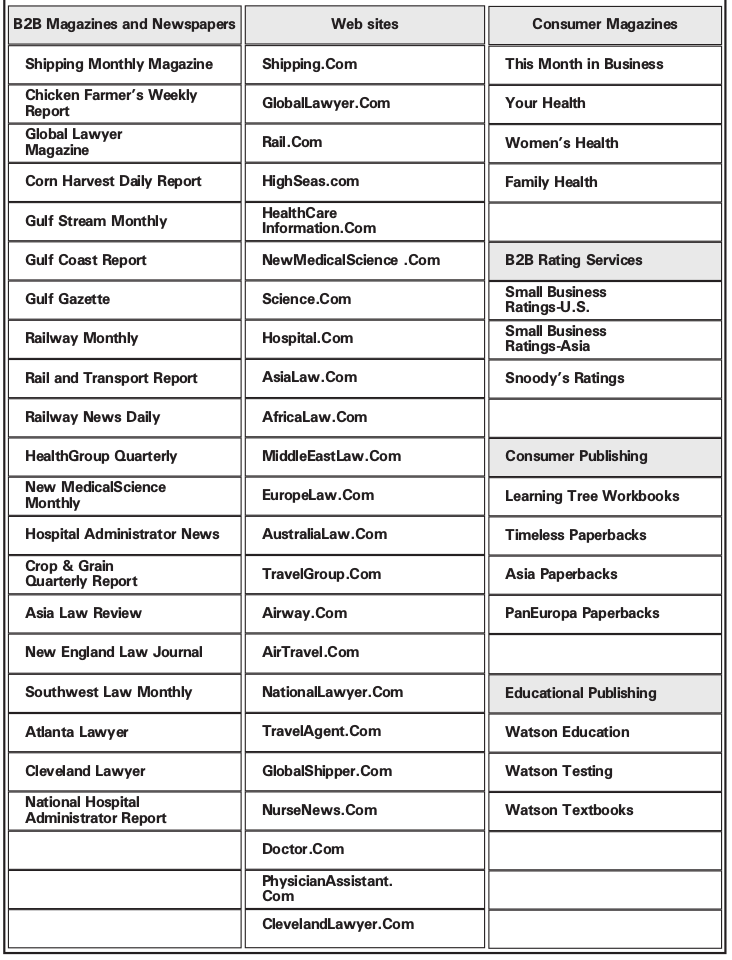
The company Macmillan Group is best known for its consumer and educational publishing assets in the U.S. and the U.K. Overseas, its brand is less category-specific, and its overseas businesses are growing faster than its U.S. businesses.
In terms of the new CEO, there’s a lot to know there, too. The CEO is a new client to our consulting firm and is also the great-grandson of one of the founders of the company. When the company Macmillan Group was originally founded, it was a railway industry reporting company; however, it made its name in the B2B news reporting industry. Given this, the new CEO would likely be very reluctant to sell off his family’s company’s founding assets, like the professional publishing companies.
Candidate: That’s good client background to have. I imagine that we’re trying to impress this new CEO so that, if we do a good job with this project, we’ll get more work.
Interviewer: We definitely are. Our firm is hoping to establish a long-term consulting relationship with the client. But that doesn’t mean that we are just going to tell him what he wants to hear. We need to impress him with sharp, data-driven analysis. What are you most interested in looking at in your analysis given what you know now?
Candidate: Right. Well, in looking at Exhibit 1, it looks like this is more than just a publishing company, even if that’s what the company is best known for. It looks like it has a lot of web sites, and some other businesses, like ratings agencies.
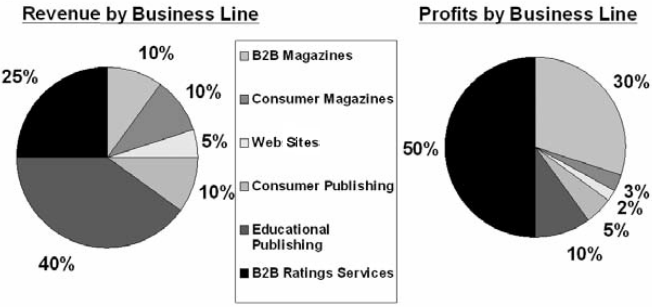
Interviewer: That’s right. It’s gotten pretty diversified. Most of the web sites were purchased in the last 10 years of M&A activity. Let me give you some more data on the company’s holdings (show Exhibit 2). What does this exhibit tell you?
Exhibit 2: Revenue and Profits by Business Line
Candidate: It tells me a few things.
First, it looks like the educational publishing business brings in a significant amount of the revenue, but only 10% of the profits.
Second, it seems like the B2B ratings services, while small, bring in almost half of the profits. The story is very similar with the B2B magazines business.
Third, it seems like the consumer magazines and publishing businesses are not the real drivers of profits for the company.
(Note: Here, the candidates should make at least two observations from the data in Exhibit 2. If they do not get all of the observations listed above, that’s fine, but the interviewer is entitled to push them to observe as many things as possible from the data before moving on.)
Interviewer: That’s great. Now let me show you some more data that we put together for the case (show Exhibit 3). What does this exhibit tell you?
Exhibit 3: Revenue and Profits by Industry Sector
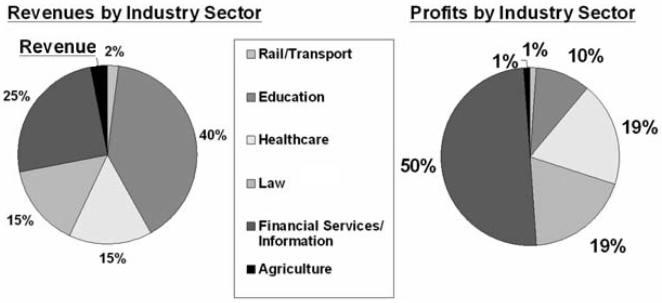
Candidate: Let me make sure that I understand the difference between the two exhibits first. Exhibit 2 showed the company’s revenue and profits by its lines of business, and Exhibit 3 shows the company’s revenue and profits by the industry sectors that it’s in. So, the web sites in the legal sector are in “Law” instead of in “Web Sites”.
Interviewer: That’s exactly right.
(Note: the interviewer will likely make sure that the candidate understands the difference between the two exhibits before analyzing the data – it’s the same revenue and profits, just divided up and looked at in two difference ways.)
Candidate: Well, it tells me a couple of things.
First, again, the education sector seems to make up a large portion of the revenue for the company – but not the profits. Second, it looks like the rail/transport sector doesn’t make up a large portion of the revenue or the profits of the company. Agriculture doesn’t look that necessary, or attractive either. Fourth, it looks like both the legal sector and the health care sector contribute significantly to both revenue and profits.
(Note: Again, the candidate should make at least two observations at this point – but should be pushed to come up with more, as this data will likely drive the case.)
Interviewer: That’s right. So, I just have one more piece of data on the company that I’d like to know your thoughts on. What does the Exhibit 4 tell you?
Exhibit 4: Revenue Growth by Market: Average CAGR by Time Period by Market

Candidate: Well, I have to say that I’m not surprised. If I’m reading this correctly, Exhibit 4 illustrates the growth rates for the company’s businesses in different geographic markets for the last few decades.
Interviewer: Yes, that’s correct.
Candidate: Well, they also look similar to the relative growth rates for the GDPs of the countries in these regions for the last few decades. What I take from this in a nutshell is that the U.S., U.K. and European businesses are no longer growing nearly as fast as the businesses in developing parts of the world, like Latin America, Asia, Africa and the Middle East.
Interviewer: That’s right. And you’re right about it tying to GDP growth. Why might that be?
(Note: Answering this question will give a candidate bonus points, but is not necessary for a successful case interview.)
Candidate: Well, from the looks of these businesses, it seems like the client mainly serves B2B customers and education customers. So, as long as there’s healthy economic growth and development in a market, I imagine the businesses will do well, especially that ratings agency business, which probably really takes off when economies and capital markets start to develop.
Interviewer: That’s right. We found that revenue growth for these businesses had a strong correlation with capital market development in a country.
Anyhow, let’s say that you run into the client’s new CEO in the hallway at the client site, and he’s eager to know how the case is going and what we’re likely to recommend. How would you summarize this case?
Candidate: Well, I would say that we’ve done a lot of analysis on the key revenue and profit drivers for his company, and that it looks like the company’s business lines in B2B publishing and ratings services, particularly in the legal, health care and financial services sectors, drive a lot of the company’s current profitability. Those businesses should definitely not be sold. Furthermore, if he’s concerned with where he should make strategic acquisitions going forward, he should look to developing countries and markets, where his businesses are growing faster, as their economies are growing faster.
Interviewer: And what about the businesses he should sell?
Candidate: Well, that’s a tricky one. I mean, the rail/transport sector does not look that significant in terms of revenue or profits; so, it could easily be sold. But I know that this was this CEO’s great-grandfather’s business; so, if we’re going to recommend that he sell it, I imagine that will be a hard sell, and one that I wouldn’t necessarily try to make when I ran into the CEO in the hallway.
Interviewer: That makes sense, and you’re probably right. Good job!
(Note: An advanced candidate might bring up portfolio theory in the summary of which businesses to sell and which to keep, but that would only be expected of a business school graduate, and even then, probably only in a case interview for a corporate finance consulting practice.)