Pan American Considers a New Hub in Kansas City
Case Type: operations strategy; business optimization; math problem.
Consulting Firm: Boston Consulting Group (BCG) 2nd round full time job interview.
Industry Coverage: airlines.
Case Interview Question #01316: Pan American World Airways, commonly known as Pan Am, was the principal and largest international air carrier in the United States from 1927 until its collapse in December, 1991. During most of the jet era, Pan Am’s flagship terminal was the Worldport located at John F. Kennedy International  Airport in New York City. In an era dominated by flag carriers that were wholly or majority government-owned, Pan Am was also the unofficial overseas flag carrier of the United States.
In the 1960s, Pan Am had a monopoly on routes within the United States from the West Coast to the East Coast. These routes originated from three points on the West Coast — Seattle, San Francisco, and Los Angeles, with terminating points in New York City, Washington DC, and Atlanta (see Exhibit 1 below).
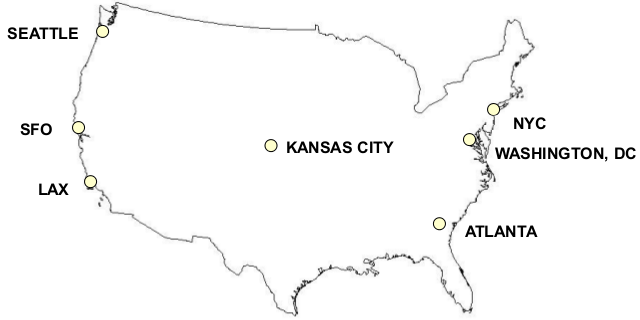
The Pan Am airline was recently presented with the option to introduce a stopover point in Kansas City (see Exhibit 2 below). Why would the airline want to do this?
Additional Information:
Exhibit 1. Current Routes
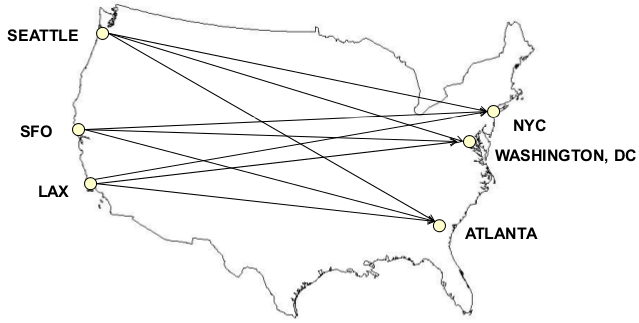
Exhibit 2. Proposed Routes
Possible Answers:
Question #1: Why would the airline want to do this?
Possible Answer:
The first question of the case requires the candidate to brainstorm all the potential reasons for wanting to stop in Kansas City.
A sample of responses could be:
* Using different airplanes (shorter range) — it turns out the same plane is used on all routes.
* Picking up additional passengers — no additional passengers are picked up from Kansas City.
* Picking up additional cargo — no additional cargo are picked up from Kansas City.
* Attempting to open up a new hub — No need; Kansas City is a small market.
* Load factors are low; Pan Am is attempting to consolidate new routes — Yes, current load factors are indeed low. Press the candidate on why load factor is important here (Load factors are used as a utilization factor for scheduling and purchasing aircraft, increasing load factors also increases revenue per aircraft).
All of the above answers are acceptable, but load factor is the critical area. The candidate should specifically ask for load factor amount (currently at 50%).
Question #2: Provide the candidate with Exhibit 2 and have him/her explain the new route network he/she would utilize.
Possible Answer:
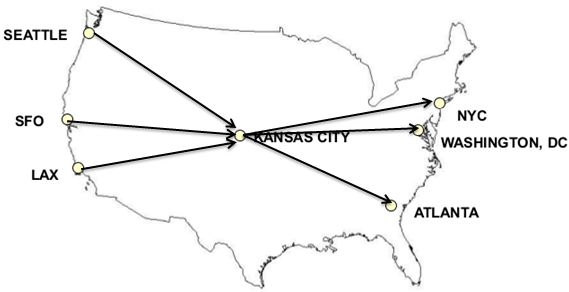
The candidate should realize that, at 50% load factors, airplanes/flights can be consolidated.
Question #3: If the passenger load factor is 50% on all of Pan Am’s routes from the West Coast to the East Coast, what will be their new load factor from Kansas City to the East Coast if they now stop in Kansas City?
Possible Answer:
A shortcut the candidate could use: examine all three routes from ONE city and extrapolate.
* Currently Pan Am has 9 routes from the West Coast to the East Coast:
– Seattle-NYC
– Seattle-DC
– Seattle-Atlanta
– SFO-NYC
– SFO-DC
– SFO-Atlanta
– LAX-NYC
– LAX-DC
– LAX-Atlanta
Key assumptions:
* Assume that all the passengers are evenly distributed among the 9 routes.
* Assume that each route is served by only one flight currently.
* Assume that every airplane has a capacity of 200 seats (but can be used for any number of seats).
Because current passenger load factor = 50%, each one of the 9 flights/routes has a passenger count of 200 * 50% = 100. Therefore:
– among the 300 people flying from Seattle, 100 will go to NYC, 100 will go to DC, 100 will go to Atlanta.
– among the 300 people flying from SFO, 100 will go to NYC, 100 will go to DC, 100 will go to Atlanta.
– among the 300 people flying from LAX, 100 will go to NYC, 100 will go to DC, 100 will go to Atlanta.
* total number of passengers = 900
Now that all 900 passengers will stop in Kansas City, the new routes and their number of passengers will be:
– Seattle-Kansas City: 300 passengers
– SFO-Kansas City: 300 passengers
– LAX-Kansas City: 300 passengers
– Kansas City-NYC: 300 passengers
– Kansas City-DC: 300 passengers
– Kansas City-Atlanta: 300 passengers
Since each airplane has a capacity of only 200 seats, two planes or flights are needed to carry the 300 passengers on each route. With each plane carrying 150 passengers, the new load factor will be 150/200 = 75%.
Question #4: What if the load factor was 80%? What will be their new load factor from Kansas City to the East Coast if they now stop in Kansas City?
Possible Answer:
Applying the same approach as in Question #3, the candidate should discover that the new load factor is still 80%.
Because passenger load factor = 80%, each one of the 9 flights/routes has a passenger count of 200 * 80% = 160. Therefore:
– among the 480 people flying from Seattle, 160 will go to NYC, 160 will go to DC, 160 will go to Atlanta.
– among the 480 people flying from SFO, 160 will go to NYC, 160 will go to DC, 160 will go to Atlanta.
– among the 480 people flying from LAX, 160 will go to NYC, 160 will go to DC, 160 will go to Atlanta.
* total number of passengers = 480 * 3 = 1,440
Now that all 1,440 passengers will stop in Kansas City, the new routes and their number of passengers will be:
– Seattle-Kansas City: 480 passengers
– SFO-Kansas City: 480 passengers
– LAX-Kansas City: 480 passengers
– Kansas City-NYC: 480 passengers
– Kansas City-DC: 480 passengers
– Kansas City-Atlanta: 480 passengers
Since each airplane has a capacity of only 200 seats, three planes or flights are needed to carry the 480 passengers on each route. With each plane carrying 160 passengers, the new load factor is still 160/200 = 80%.
Question #5: At which point does the load factor become irrelevant, i.e., consolidation of aircrafts/flights will not be economically beneficial?
Possible Answer:
Once the consolidated passenger count of one route exceeds the capacity of two planes, then three planes will be needed per Kansas City-East Coast route. At this point, the load factor = 2/3 = 66.7%
Therefore, once the old load factor exceeds 66.7%, the load factor becomes irrelevant and consolidation of aircraftswill not be economically beneficial.
Question #6: Based on the above calculations, what does this suggest about Pan Am’s decision?
Possible Answer:
Above a certain load factor (66.7%), the benefit of establishing a stopover point in Kansas City is moot.
Question #7: What recommendations would you make to the management of Pan Am?
Possible Answer:
Before we establish a stopover point in Kansas City, several factors should be considered:
* Will load factors increase on West Coast-East Coast routes beyond 66.7%?
* Are additional opportunities for Kansas City expansion available?