Nordstrom Store to Investigate Declining Profitability
Case Type: improve profitability; operations strategy.
Consulting Firm: Cognizant Business Consulting (CBC) first round full time job interview.
Industry Coverage: apparel, clothing, textiles; retail.
Case Interview Question #01291: Your client Nordstrom is a mid-size department store similar to Macy’s. Founded in 1901 by Swedish American John W. Nordstrom and Carl F. Wallin, Nordstrom has only one store and is located in the suburb of Seattle, Washington. Nordstrom store has mainly two categories of products  - apparel and home decor.
* Apparel – Mens, Womens and Children apparel.
* Home decor – all kinds of home furnishing products.
The Nordstrom department store recently has seen declining profitability and has hired your consulting firm to investigate the possible causes of its declining profitability. Also, Nordstrom would like to understand what are its strategic next steps. What would you recommend they do?
Additional Information: to be provided to candidate upon request
* The client’s apparel business is seeing declining profitability.
* Industry for both apparel and home decor is growing at a steady rate of 5% to 10% per year.
* The client has only been selling through traditional sales channels. Currently they have no online channel.
* Latest industry trend: People shop online, people do not like to travel long distances to buy apparel. The Nordstrom store is located in a suburban area similar to where Walmart, K-Mart are located. People shop more around downtown.
Possible Answers:
Question 1: What do you think are some of the key drivers we should evaluate?
Possible Answer:
The candidate should first try and understand, which of the two categories is driving the profitability decline?
For that category evaluate a few more details:
a. Industry details
* Is this an industry wide issue?
* What are the latest trends in the industry?
* How does the competitive landscape look?
* Who are our customers and how have their purchase preferences changed?
b. Economic analysis
* Break down of profitability of different product categories
* Is this a margin issue, or is the company not able to breakeven?
* Understand the revenue and cost structure of the apparel business and its categories.
* Determine the purchase frequency, profitability per category and compare and contrast the apparel and home decor business
* Historic performance of the store
c. Changes in Nordstrom at an organization level
* Has there been any recent changes at Nordstrom store: suppliers, management, etc?
* Has the company looked at expanding its distribution channels to include online?
* Have we invested or divested in categories?
d. Changes in and around Nordstrom store
* Has a new competitor placed a store around Nordstrom store?
* Has there been a change in the display at the store?
* Are we holding the right product categories and styles of apparel in our store?
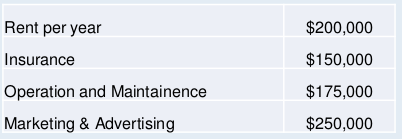
Question 2: What is the profitability per square feet per category?
Additional Information to be provided to the candidate:
a. Gross Margin
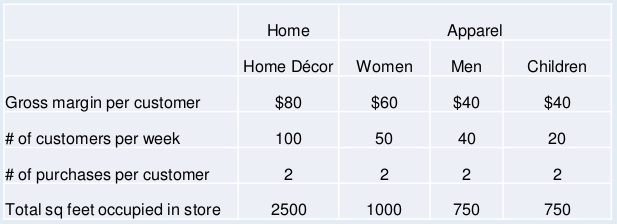
b. Fixed Cost
Possible Answer:
Calculation Table
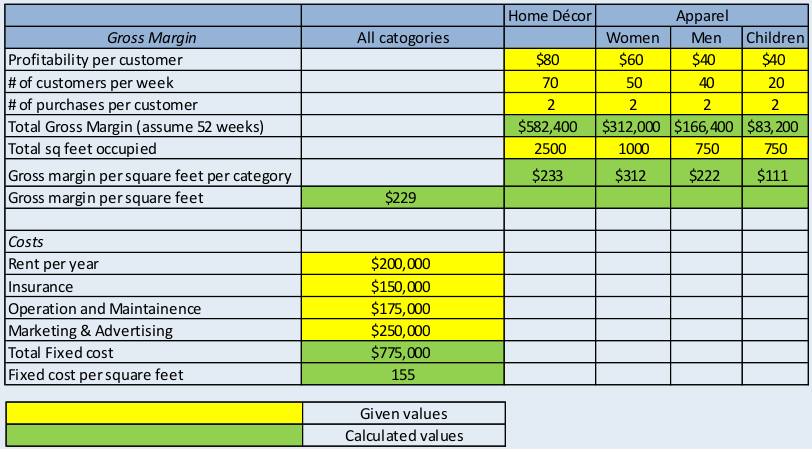
Conclusion: The gross margin for children’s apparel is below the fixed cost per sq. feet.
Question 3: How many more customers of children’s apparel should Nordstrom sell per week to achieve a target average profitability of $200 per sq. feet?
Possible Answer:
Total desired gross margin for children’s apparel = $200 per sq. feet
Total number of customers of children’s apparel to achieve target = $200 per sq. feet * 750 sq. feet/($40 * 2 * 52) = 36
Increase in customers = 36 — 20 = 16
Increase in percentage = 16/20 = 0.8 = 80%
Conclusion: The client need 16 more customers of children’s apparel — 80% more than the existing customers per week (20).
Note: Bonus point for the candidate to recognize the percentage increase and the feasibility of such an increase. Cut points if the candidate provides the total number of customers and not the increase.
Question 4: Why do you think the Children’s apparel category is not doing well?
Possible Answer:
Possible reasons could include the following:
* People who come to buy home decor do not come with the intention to buy clothes for children.
* Nordstrom does not hold the right categories of children’s apparel.
* Children’s apparel is not strategically placed inside the store.
* Young parents do not have time to go to stores any more. They are more willing to buy children’s clothes online.
* The location of the store is not ideal to take an entire family for shopping and hence Nordstrom loses business to better
located competitors
* The company has used traditional forms of media and have not embraced online social media.
* Parents like to buy expensive/stylish clothes for their children. Nordstrom store does not hold the latest styles.
* Nordstrom has not been allocating the correct marketing budget for children’s apparel. Bulk of the budget is
used for home decor.
Question 5: What do you think are some of the strategic alternatives for our client Nordstrom?
Possible Answer:
Any of the below three options is fine as long as the candidate is able to justify the option.
Option 1: Divest from the children’s apparel business
* Children’s apparel business is not profitable
* Its not intuitive to have a children’s apparel section in a home decor store.
* The client could use the children’s apparel shelf space for other profitable categories.
* Risks: Less chance to cross sell between categories.
Option 2: Divest from the apparel business completely
* Home decor is by far more profitable than any of the apparel categories.
* Nordstrom can be known as an exclusive home decor store, removing any form of ambiguity in the
customer’s mind about the store.
* The client could use the apparel shelf space for other profitable categories of Home Decor, including expanding the
categories (e.g. perhaps a gallery for top paintings, etc.)
* Risks: Less chance to cross sell between categories. Many people may not come to the store with the intention to buy home decor.
Option 3: Create a separate store for apparel in the city (maybe with a sub-brand) and hold profitable and popular categories of clothing.
* Separate brand removes the confusion for the customers between home decor and apparel.
* Introduce an online channel for sales; build up the ecommerce platform.
* Risks: Increase in rent and other fixed costs. Increase in competition because of change in location.