Unilever USA Under Pressure From Activist Investor
Case Type: operations strategy; reduce cost.
Consulting Firm: PricewaterhouseCoopers (PwC) Advisory final round full time job interview.
Industry Coverage: household goods, consumer products.
Case Interview Question #01261: Your client Unilever USA is the American subsidiary of global consumer packaged goods (CPG) company Unilever. The parent company is co-headquartered in London, United Kingdom and Rotterdam, Netherlands. For this case, we are only concerned with Unilever USA.
Unilever USA is a large CPG company with multiple business units including snacks, beauty, and home (cleaning) products. Recently, your client Unilever USA is under pressure from Mr. Carl Icahn, a high-profile activist investor that has built a 7% stake in the company. The client Unilever USA has asked you to help predict Mr. Carl Icahn’s likely demands that could increase stock price or company performance. What are your ideas to deliver short-term and long-term value back to the shareholder?
Activist Investor background: An individual or group that purchases large amounts of a public company’s shares and/or tries to obtain seats on the company’s board with the goal of effecting a major change in the company. The activist investor benefits when equity prices rise significantly or dividends are paid.
Possible Answers:
1. Case Overview
This case challenges the candidate to think from an investor and company perspective, then balance the short-term and long-term objectives. Success with this case requires the candidate to correctly evaluate the financial options and give a recommendation that is operationally realistic.
2. Additional Information:
The interviewer or case giver should guide the candidate through the case. Provide the following additional information if requested:
* Unilever USA is a large business in North America. The client operates in ~70 countries globally.
* Revenue:
– Snacks $19B
– Beauty $31B
– Home $29B
– EBITDA: $24B
– Target Savings: $10B
* This activist investor Mr. Carl Icahn likely has influence on the board and cannot be ignored.
3. Suggested Framework
This case is meant to have interviewer guidance. Provide little guidance for advanced candidates.
An activist investor is looking for an increase in stock price, and the client Unilever USA is looking for this plus long-term success. Possible frameworks should incorporate some of the following:
a. Short-term Value
* Sell a business unit (split off a whole business, brand, or geography)
* Cost saving (delayer company, shut-down plants)
b. Long-term Value
* Restructure product supply, move to low-cost countries
Allow the candidate to drive the case and explore. Award bonus points for strong options that may create shareholder value. Make sure the candidate understands what an activist investor is targeting and the likely time horizon (1-2 years).
It is important to acknowledge that Mr. Carl Icahn, the activist investor may want short-term actions that the company would disagree with due to long-term repercussions.
4. Detailed Solution
Prompt #1 — Supply Chain Restructuring
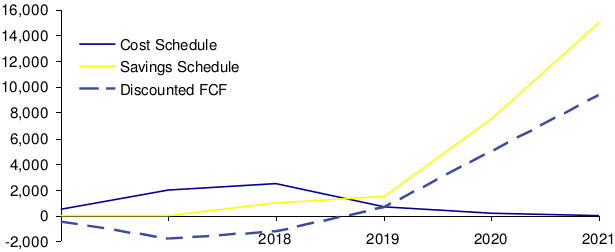
The partner on this case talked to the product supply (manufacturing) contact at the client company who provided a supply chain restructuring opportunity. Do you think this is a viable option to satisfy the activist investor and the client Unilever USA? (provide Exhibit #1)
Exhibit #1. Supply Chain Restructuring ($M)

Note: All effects of depreciation and change in net working capital are included in the costs and savings schedule.
Possible Answer:
From Exhibit #1, the candidate should realize that a net present value (NPV) calculation is necessary but should approximate using the graph. NPV calculation is shown below as a reference.
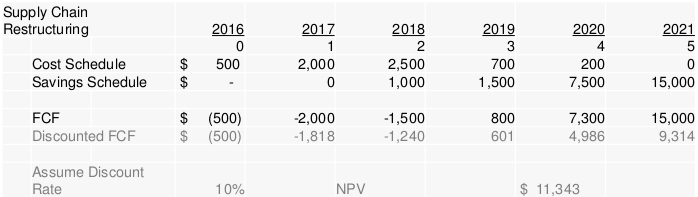
A strong candidate will realize the savings are too far out for an activist investor who usually seeks only short-term gains. Regardless of the NPV, this project should be secondary to a short-term strategy. Once this option is deemed insufficient, continue with Prompt 2.
Prompt #2 — Low Cost Countries
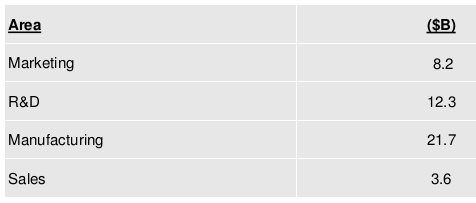
The client Unilever USA mentioned that other companies have successfully used low cost sourcing. The example companies effectively moved or rehired functions from developed regions to countries like India, China, or Brazil. Do you think the options in Exhibit 2 can meet the client’s needs for the snacks business?
Exhibit #2. Projected savings (NPV) for various outsourcing options
Possible Answer:
The low cost options are unlikely to meet the client needs because it threatens long-term operation. This prompt is meant to test the candidates ability to structure open-ended questions (a common part of final round interviews with partners).
| Area | $B | Suggested Solution |
| Marketing | 8.2 | Unlikely: Marketing and R&D are necessary for innovation. It is difficult to find top talent in developing countries. Also, the client has a large North America based business. |
| R&D | 12.3 | Unlikely: Marketing and R&D are necessary for innovation. It is difficult to find top talent in developing countries. Also, the client has a large North America based business. |
| Manufacturing | 21.7 | Not Feasible: CPG snack products are inefficient to ship long distances usually. Outsourcing could hurt trust in brand. Additionally, we just saw a major manufacturing project would take too long. |
| Sales | 3.6 | Not Feasible: Low savings and managers must meet key customers in developed countries (Walmart, Target, Kroger, etc.) |
Strong candidates should realize these are poor solutions. Guide the candidate as necessary and move to prompt #3 when candidate realizes other savings are needed.
Prompt #3 — Sell Businesses
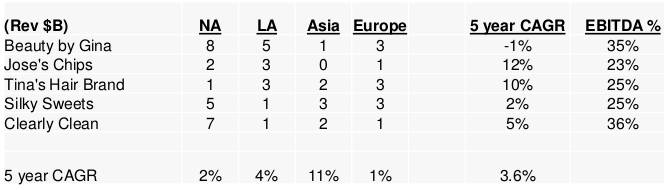
Other companies have seen significant cash and stock price increases when splitting off non-core businesses. The client Unilever USA would like you to value these brands/businesses (show Exhibit 3) and consider divesting them. Is there any additional information needed to estimate the market value?
Exhibit #3. Potential brands (businesses) that could be divested (Rev $B)
Possible Answer:
When asked provide: Benchmarking comparable firms gives Future Value FV/EBITDA = 3.5
A strong candidate will realize that a multiple is needed to find a sale price for each brand or region. If the candidate proposes using C/(r-g), give them the multiple to use instead.
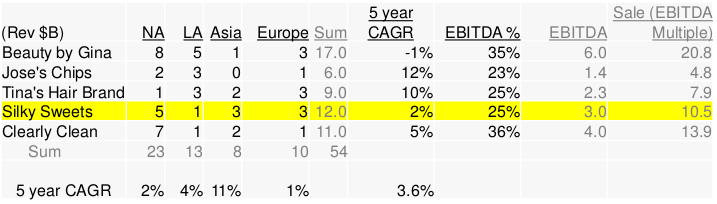
Silky Sweets is the best choice since it meets the target cash value to return to shareholders and has low growth over the past 5 years.
5. Recommendation
Strong recommendations include the following items or similar reasoning:
The client Unilever USA should prepare to divest the “Silky Sweets” brand
* The $10.8B savings will meet the activist investor goals
* This strategy does not compromise long-term operations of other brands
* The client Unilever USA should court the activist investor and attempt to align long-term goals
Additional recommendations and risks:
* Long-term product supply restructuring could benefit the client
* Delayering (layoffs) could be appropriate in some parts of the company but would need evaluation
* Risk: Actual sale price and stock performance could vary based on the market
6. Performance Assessment
a. Average Candidate
* Few mathematical errors
* Frames the problem and dynamics between investor and company goals (short-term/long-term)
b. Good Candidate
* Performs the above plus…
* Correctly evaluates the options (quantitatively and qualitatively)
* Quickly moves through overall case
c. Excellent Candidate
* Performs the above plus…
* Drives toward short-term opportunity to sell brands (may mention CPG examples)
* Provides 1-2 creative options in addition to the case defined options.