Procter & Gamble to Reduce Package Size of Diapers
Case Type: operations strategy.
Consulting Firm: Boston Consulting Group (BCG) first round full time job interview.
Industry Coverage: household goods, consumer products.
Case Interview Question #01259: Our client Procter & Gamble Co. (P&G, NYSE: PG) is a large, multinational consumer products company headquartered in downtown Cincinnati, Ohio, USA. The company primarily specializes in Shampoo, Diapers, Baby food and Cold medicine. P&G has business operations in  over 200 countries. Today, we are going to focus on its US business only.
Our client P&G has been following US demographic trends and has found that after the 2008 financial crisis low income households have been growing two times as quickly as other consumer segments. Low income is defined as families with income at the poverty level or below.
Our client P&G has always had a premium product strategy. It sells its products in grocery stores, convenience stores, mass retailers, etc., but its products are always priced at the high-end of their respective categories. It has never targeted the low income segment before and doesn’t have a low income strategy, but given the growth of this segment, our client is considering entering the low income segment. Our client has 3 questions for BCG.
(1) Should it have a low income strategy?
(2) If it should have a low income strategy, what are some tactics it should deploy?
(3) What are some of the risks the client P&G may face?
Additional Information: to be provided upon request
* Low income consumers purchase largely in smaller, local shops
* Low income consumers can’t afford salons, but will indulge on shampoos
* Low income consumers are willing to spend more on baby food to protect their children
* There are valid generics that compete with our client’s cold medicine
Possible Answers:
Candidate: Can I take a few seconds to think it through?
Interviewer: Sure of course, take your time.
Candidate: Before addressing the 3 questions, I’d like to gather more information.
Interviewer: What would you like to know to help the client answer its 3 questions?
Candidate: I’d like to know more about our client, their product lines, and revenues of each product line.
When the candidate asks about product lines, share Exhibit 1.
Exhibit 1. Sales by product category
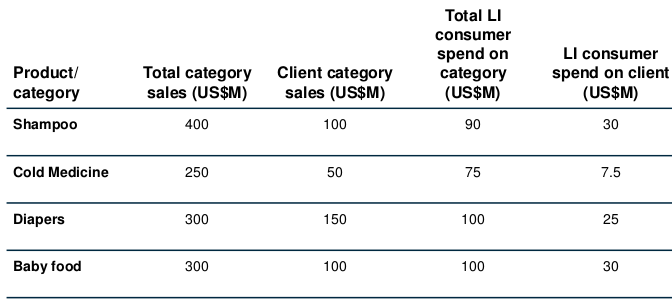
Interviewer: The client P&G has shared some data for its key products (Exhibit 1). What do you make of this information?
Candidate: Calculate overall market share and share of low income consumers by product/category
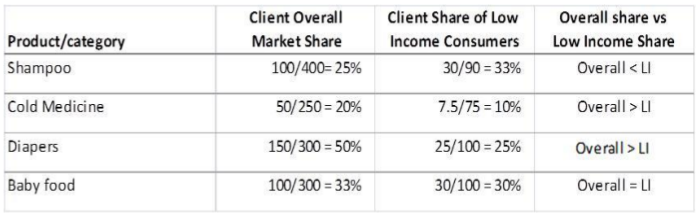
Interviewer: If the client achieved its fair share of the low income segment, how much additional revenue would it generate?
Candidate: Calculate incremental revenue for cold medicine and diapers
* Cold medicine = (20%-10%) * $75M = $7.5M
* Diapers = (50%- 25%) * $100M = $25M
* Total incremental revenue = $7.5M + $25M = $32.5M
Interviewer: What else would you like to know about diapers and cold medicine to assess the opportunity?
Candidate: I’d like to know why the client is able to achieve its fair share of the low income segment in Shampoo and Baby food, but not in Cold medicine and Diapers.
Interviewer: OK. The client is not interested in cold medicine, but it has done customer research that suggests low income consumers are interested in buying diapers. (Share Exhibit 2) What do you see that could help us figure out why low income consumers aren’t buying our client’s diapers?
Exhibit 2. Package size and price by product category
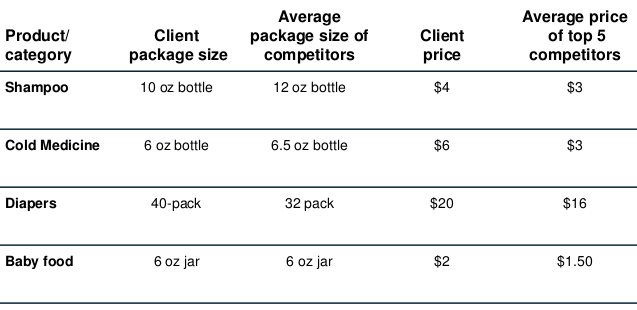
Candidate: Our client sells diapers with a bigger package size, and also higher price. I assume low income consumers are very price-sensitive, thus they’re not willing to buy our client’s diapers.
Interviewer: Good. What would you recommend the client do to change that?
Candidate: The obvious choice would be to reduce the package size of diapers.
Interviewer: What else should our client think about as it develops a low income strategy? What are the risks?
Candidate: You mentioned earlier that our client has always had a premium product strategy. To develop a low income strategy may have negative impact on their premium brand name.
Interviewer: Great. I think we have covered it all. Why don’t we wrap here. Can you make a final recommendation for the client?
Candidate: OK. The client P&G should pursue a low income strategy, focusing on diapers, which could generate an additional $25M in revenue.
To pursue low income consumers, our client P&G should reduce its package size. Today, our client’s package size is significantly larger than its competitors. Our client could keep the price/diaper the same, but if it dropped the package size from 40 diapers to 20 diapers, it would cut the absolute price of the box to $10, even lower than its competitors.
There will be some risks involved with adopting a low income strategy including cannibalizing business from existing products and brand risk.