Steel Dynamics to Switch to High-Quality Ore Supplier
Case Type: operations strategy; industry analysis.
Consulting Firm: Huron Consulting Group first round full time job interview.
Industry Coverage: mining and metals production.
Case Interview Question #01257: Your client Steel Dynamics Inc. (NASDAQ: STLD) is a major steel producer headquartered in Fort Wayne, Indiana and operating in the American Midwest. With an annual production capacity of more than 8 million tons, the client Steel Dynamics is the 5th largest  producer of carbon steel products in the United States.
Over the past couple of years, demand for steel has declined sharply, even as large amounts of new capacity have been added to the industry. As a result, profitability in the steel industry has collapsed and put many of the companies in peril. One analyst report speculated that about 50% of companies in the steel industry would be forced into bankruptcy over the next 5 years. After reading this report, the client’s CEO hired your consulting firm to help think through the future of their business. How would you go about it?
Possible Answers:
1. Case Overview
This case is a much higher-level case than most, partially because there is no clear right answer to whether or not the client company should stay in business. As long as the candidate recognizes that they are trying to identify whether the company should close or not, they are on the right track to one of the many ‘right’ answers.
The real crux of the case is a discussion about how much risk the senior management of this firm would be willing to tolerate. For this reason, this case should only be given by an interviewer who would feel comfortable discussing the business situation in general. Thus generally someone with some consulting or similar business experience would make for the best interviewer.
2. Information Gathering
Additional Information: only give to candidates if requested
* We can assume that the analyst report is approximately accurate. Although the exact number may not be 50%, many companies in the steel industry will go bankrupt in the next 5 years.
* A similar pattern of overcapacity, steel price crashes and bankruptcy had happened twice before in the past. Typically the companies that survived the downturn ended up twice as profitable as they had been before the crash.
* Our client’s financial resources are not significantly different than those of the other firms in the industry, so we cannot predict whether we will survive based on that.
* Historically, the management of firms that went bankrupt were forced into early retirement by the stigma of presiding over a failed firm.
* A competitor has offered to buy the client at a 20% discount to what the client sees as the value of their business.
* The steel industry is characterized by many small firms, each of whom made the decision to expand capacity independently due to high steel prices during the past 2 years.
* The profitability of steel firms in the industry varies widely, mostly based on the operational efficiency of each firm’s smelting process (process of turning iron into steel).
* The client firm’s smelting wastage ratio is 15%.
* Ore quality is determined by the supplier and is impossible to change without switching to another supplier; assume that by switching suppliers, the cost would go up, but waste would fall to 10% (from 30%)
* Waste in electrolysis and reduction can be reduced by half at minimal costs by adopting industry best practices, no further reduction would be possible.
* No other areas of smelting wastage can be reduced by a significant amount without incurring prohibitively high costs.
EXHIBIT 1. Operational Review: Steel Companies from 2007 to 2012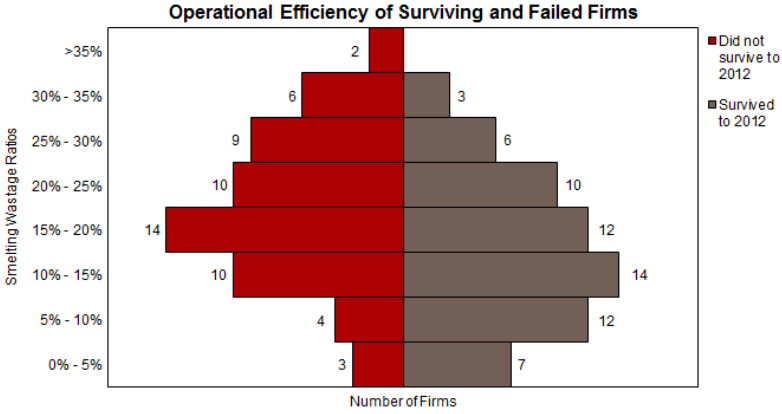
Note: The smelting wastage ratio is the percentage of iron ore input that is not used for the production of steel during the smelting process.
EXHIBIT 2. Operational Review: Client Ore Wastage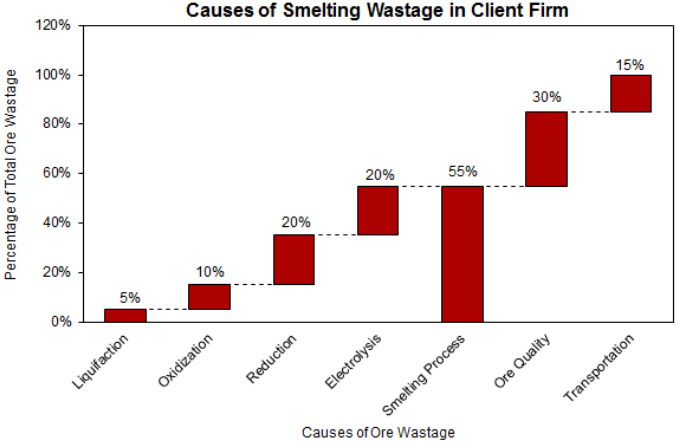
3. Detailed Analysis
When the candidate recognizes that there may be data available that distinguishes why certain companies survived and others did not in past downturns, give them Exhibit 1.
From Exhibit 1, the candidate should recognize that on average, firms with lower smelting wastage ratios (i.e., better operational efficiency) tended to survive the last downturn and those with higher wastage ratios did not. However, they should also note that having a low wastage ratio does not guarantee survival, it just improves the probability. Although it is not necessary for the candidate to calculate exact probabilities, the odds of survival in each bucket are listed below:
| Smelting Wastage Ratio | Odds of Survival (%) |
| >35% | 0% |
| 30% – 35% | 3/9 = 33% |
| 25% – 30% | 6/15 = 40% |
| 20% – 25% | 10/20 = 50% |
| 15% – 20% | 12/26 = 46% |
| 10% – 15% | 14/24 = 58% |
| 5% – 10% | 12/16 = 75% |
| <5% | 7/10 = 70% |
Even without the exact probabilities, they should recognize that the odds of survival in the 10% – 20% range are not great. Furthermore, because the client’s ratio is exactly 15%, they cannot be sure which of the two buckets it falls into (10%-15% or 15%-20%). They should ask if there is any possibility to reduce the wastage ratio, at which point, give them Exhibit 2.
Since the largest contributors to smelting wastage are ore quality, electrolysis and reduction (in that order), they should ask about each and find that in total, they can reduce smelting wastage by 40%, which takes the overall ratio from 15% to 9% (60% of 15%).
At this point, the client firm is clearly in a safer bucket (75% chance of survival) and thus it might be reasonable to suggest that they stay in business. However, push the candidate to discuss the risks of both possible strategies: (1) selling out and (2) remaining in business.
In particular, note that in an acquisition, there is some possibility that the acquirer will fire the existing management team. On the side of staying in business, there is still a 1-in-4 chance that they will fail and that by switching suppliers, they have both raised their cost and damaged an existing business relationship. Also, note that the client may adopt these changes, but that competitors can do the same as well. Finally, what distinguished successful and unsuccessful steel companies in the past might not continue to be true.
Regardless of which perspective the candidate takes, they should endeavor to convince you of their side.
4. Conclusion & Recommendation
* The client Steel Dynamics Inc. should remain in business and turn down the acquisition offer. Although they face short-term risks, surviving until the next upturn will provide significant benefits.
* To increase their chances of surviving, they should switch to a high-quality ore supplier, and adopt industry best practices in their smelting operation.
* By doing so, they best position themselves to ride out the downturn as similarly efficient firms did during the last downturn.