Cartier’s Superfoods to Relocate Suburban Stores to City
Case Type: increase revenues; operations strategy, optimization.
Consulting Firm: Accenture 2nd round full time job interview.
Industry Coverage: retail.
Case Interview Question #01234: Our client Cartier’s Superfoods Ltd is a chain of supermarkets and grocery food stores based in the London metropolitan area in the United Kingdom. The first Cartier’s food stores were small local grocers opened more than 80 years ago, which expanded across the south of England.  Today, the Cartier’s stores range in size from around 140 square meters to around 1,200 square meters, and therefore fall into the convenience store size range and the bottom end of the supermarket size range, as these two terms are used in the United Kingdom.
The client Cartier’s Superfoods recently expanded from the suburban areas to the city. However, their market share has decreased despite the opening of these new stores. What factors might be contributing to this and what should our client do to regain their market share?
Possible Answers:
1. Information Gathering
Additional Information: (to be provided to candidates upon request)
* Our client Cartier’s Superfoods sells products ranging from grocery food to clothing (similar to Walmart, Target, Costco, etc.)
* Retail industry in the London metropolitan area has a positive growth rate of around 2%.
* Around the same time as our client’s expansion, one major competitor opened their 14th, 15th and 16th store in the city.
* There has been no change in our client’s operations, management or product segmentation.
* Our client currently has 24 stores in the London metropolitan area — 20 in suburban regions and 4 in the city.
* On average, each customer buys 5 items per visit, with average price being $5/item.
* The stores are open Monday — Friday 10 am to 10 pm and Saturday — Sunday 11 am to 5 pm.
* Exhibit 1: Number of customers vs. number of stores.
Exhibit 1: Total number of customers vs. number of stores (industry average)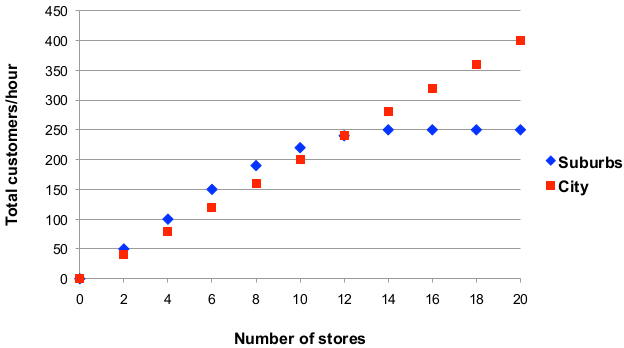
Insights from Exhibit 1:
(1) Suburbs are reaching saturation
(2) The client is not capturing market in cities
2. Sample Structure (any reasonable one is acceptable)
Decrease in market share?
a. Internal factors
* Product mix
* Pricing
* Hours
* Location
* Store appeal
b. External factors
* Competition
– Existing players
– New entries
* Consumers
– Number
– Segmentation
3. Detailed Analysis
Interviewer note: ask the following questions sequentially and provide Exhibits when prompted.
Question #1. What are some reasons that sales are not increasing proportionally to the number of stores?
Possible Answer:
* Growing competition
– Increase in number of competitors
– Increase in market share captured by existing competitors.
* Decline in customer base
– Not meeting needs of customers in the city (customers have less purchasing power in the city)
– Non-ideal store locations
– Mismatch between products and customer preferences
Question #2. What is our client’s yearly revenue?
Possible Answer:
To answer this question, the candidate will need to know how many customers our client is getting, how many items are purchased per visit, and how much an item costs. Provide Exhibit 1 when the candidate asks about customers.
* Suburbs
– 20 stores in suburbs –> 250 customers/hour in total
– 12 hours/day * 5 weekdays + 6 hours/day * 2 weekend days = 72 hours/week
– 72 hours/week * 50 weeks/year = 3,600 hours/year
– 3,600 hours/year * 250 customers/hour = 900,000 customers/year
– 900,000 customers/year * 5 items/customer * $5/item = $22.5 million/year
* City
– 4 stores in the city –> 80 customers/hour in total
– 3,600 hours/year * 80 customers/hour = 288,000 customers/year
– 288,000 customers/year * 5 items/customer * $5/item = $7.2 million/year
* Total revenue = $22.5 million/year + $7.2 million/year = $29.7 million/year
Question #3. What can our client do to increase their market share?
Possible Answer:
* Get more customers by either of the following:
– Open more stores in the city. Initially, the city attracts fewer customers but as the number of stores increases,
the number of customers increases proportionally
– Relocate stores from suburbs to the city. From Exhibit 1, we can see that they have reached saturation point in the suburbs:
* Establish an online store (this is just a suggestion; there’s no actual evidence here for this)
* Establish membership loyalty/rewards program.
Question #4. Our client does not wish to open any more stores, however, they are open to the idea of relocating up to half of their existing stores. What advice would you give them?
Possible Answer:
* They should relocate their stores in a way that maximizes the number of customers/hour.
* They’re willing to relocate up to 12 (half of 24) of their stores.
* From Exhibit 1, the city is significantly more profitable than the suburbs after 12 stores, so if our client relocates 12 of their suburban stores to the city, they would have 16 stores in the city and 8 stores in the suburbs.
– 16 stores in the city –> 320 customers/hour in total
– 8 stores in the suburbs –> 190 customers/hour
– Total = 320+190 = 510 customers/hour
– 3,600 hours/year * 510 customers/hour = 1,836,000 customers/year
– 1,836,000 customers/year * 5 items/customer * $5/item = $45.9 million/year in revenue
Conclusion: This would be an increase of $45.9-$29.7 = $16.2 million/year (more than 50% increase)
4. Conclusion & Recommendation
Question #5. Ask the candidate to summarize his/her findings and make a final recommendation to the client.
Possible Answer:
I recommend that the client relocates 12 of their suburban stores to the city to maximize their revenue. They are seeing a decline in market share because the suburbs are reaching saturation and they do not have enough stores in the city. Without opening new stores, the fastest way to increase revenue is by moving more stores into the city.
Potential risks include competitor response and increased costs. Moving forward, our client can also consider establishing online stores or rewards programs to attract new and retain existing customers.