WHO to Launch Global Polio Eradication Initiative
Case Type: operations strategy, optimization.
Consulting Firm: Bridgespan Group first round full time job interview.
Industry Coverage: healthcare: hospital & medical; government, public sector.
Case Interview Question #01203: Your client The World Health Organization (WHO) is a specialized agency of the United Nations that is concerned with international public health. It was established in 1948, headquartered in Geneva, Switzerland. Since its creation, WHO has played a leading role in the eradication  of a number of communicable diseases.
WHO recently launched the Global Polio Eradication Initiative and they hired your consulting firm to help them with their fight to eradicate polio. Polio is an infectious disease caused by the poliovirus. Poliovirus is usually spread from person to person through infected fecal matter entering the mouth. It may also be spread by food or water containing human feces and less commonly from infected saliva. The disease is preventable with the polio vaccine; however, a number of doses are required for it to be effective.
WHO is struggling with two related problems in the Global Polio Eradication Initiative. One, out of the countries that have requested their help to fight polio, which should they choose to go into first. Second, once they have chosen a particular location to go into, what factors need to be considered to ensure success. To start, what are the characteristics you would look for to identify the best location for the WHO to start with?
Possible Answers:
1. Case Overview
This case is a very unusual scenario — most candidates will have little, if any, background on the minutiae of large-scale vaccination campaigns. However, this problem does force people to be able to apply structured thinking to cases even outside of their sphere of knowledge. Also unlike most cases, this case is fully interviewer-driven (aka McKinsey-style cases), since the interviewer will walk the candidate through a series of relatively independent questions until they reach the conclusion.
2. Detailed Analysis
Question #1: What are the characteristics you would look for to identify the best location for the WHO to start with?
Possible Answer:
After the first question, the candidate should list some factors, such as:
* prevalence of polio in the country
* overall population of the country
* death rate from polio
* quality of countries medical system
* quality of infrastructure (ease of transportation)
* cultural attitudes towards “outsiders” and medicine in general
Make sure to ask probing questions so that the candidate fully explains the category and why they think it is relevant; this is especially important if the candidate comes up with an odd category in their response.
Question #2: Once the candidate has created a good list and justified all of the ideas they’ve listed, give them Exhibit #1. Ask the candidate: “out of the 7 countries that have requested WHO’s help to fight polio, which one should you choose?”
Exhibit 1. Global Polio Study – countries requesting assistance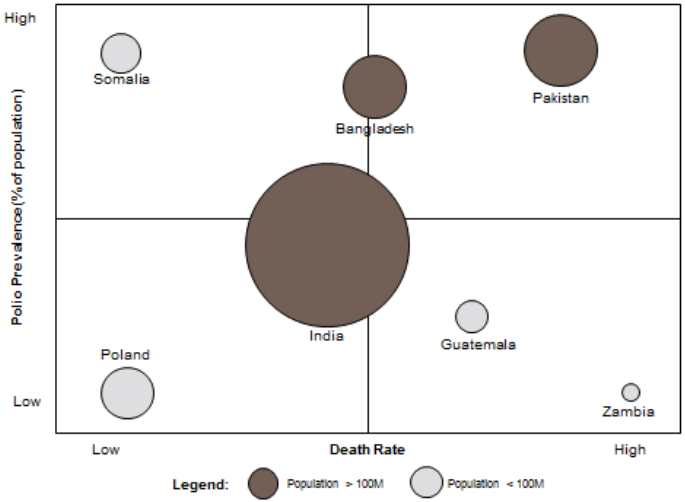
Possible Answer:
In this chart, the candidate should notice the three important data points:
* the prevalence of polio as a percentage of the population,
* the death rate, and,
* the overall population of the country.
Obviously a location that has high values for all three of these data will be the most attractive as a starting location. Based on this, the candidate should gravitate to one of two locations: India and Pakistan. Although Pakistan has a high prevalence and death rate, India’s massive population means that it almost certainly has more cases overall. If the candidate asks if they can choose two countries, tell them the WHO wants only one country and thus they have to choose.
Question #3: After they’ve made their choice, ask them: “Let’s suppose that the WHO chose to start in Pakistan. They plan to fight polio by vaccinating uninfected people against the disease. What factors do you think are most important to consider when they are planning their strategy for entering Pakistan?”
Possible Answer:
Again, the candidate should give an number of different factors and explain their reasoning for including them. Be sure to test them if they seem uncertain about a particular idea, so that they keep only the ones they truly believe should be there.
Question #4: Next, give them Exhibit #2 and tell them: “The WHO has conducted some research on polio vaccinations and have produced a chart to help guide our decision. What do you think about this data?”
Exhibit 2. Global Polio Study – Epidemiological S-Curve: effectiveness of vaccination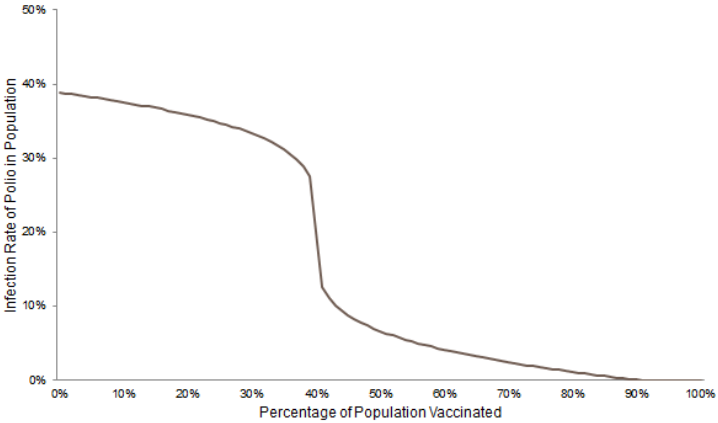
Possible Answer:
As soon as the candidate understands that the graph shows the decline in the infection rate as the vaccination rate increases, they will notice that at around 40% vaccination, infections decline dramatically. Once they make that observation, ask them why this might be. The answer is the idea of ‘herd immunity’, which is the concept that as more people are vaccinated, there will be fewer channels of transmission for the disease. Since it will be less likely that any given person will encounter someone carrying the disease, the likelihood that they will contract it will fall as well.
Question #5: Once they’ve explained this phenomenon, ask them what vaccination rate the WHO should target in the short and long term.
Possible Answer:
In the short term, a reasonable target would be some number around 50% – 60%. The reason for being above 50% is so that the WHO can fully capture the sharp decrease that occurs around 40%. A common mistake is suggesting 40%, since this is where the decrease is the sharpest. However, this causes them to miss out on sharp declines just after 40% (e.g., at 40% vaccination, there’s an infection rate of 20%, at 41% vaccination, infection rates are 13%, and by 50% vaccination, infections have fallen to 7%).
In the long term, they should target some number between 80% and 90% so that they can fully eradicate polio. As a result of the herd immunity effect, they do not need to vaccinate 100% of people to achieve a 0% infection rate (in this graph, infections hit 0% at 86% vaccination).
Question #6: Following this, ask them: Another area that they want us to look into is their distribution method. Broadly speaking, distribution strategies can be more centralized, operating out of a few of the largest cities, or more decentralized, with WHO workers going out to the smaller towns and villages to distribute the medicine. What are some advantages and disadvantages of each?
Possible Answer:
The candidate should come up with some of the following ideas, or similar ones:
* from a financial perspective, centralized models will be cheaper for the nearby people, but more expensive to reach those farther away;
* from a safety perspective, it will be much easier for the WHO workers to administer a centralized model, rather than needing to go out to the villages;
* finally, from the perspective of maximizing vaccination, it is possible that under a centralized model, many people from farther away will not come and get vaccinated, meaning that these smaller towns and villages will remain susceptible to polio as their local vaccination rates will not be high enough to create herd immunity.
Question #7: Last, tell them: The WHO wants us to calculate the total cost of some of their different distribution methods. Pakistan has an overall population of 200M people and the WHO wants to estimate the cost of vaccinating half of them. They are considering three different distribution methods, A, B, and C (in order from most to least centralized).
* Method A costs $200 per person for the first 40M people and then $800 per person for everyone after that.
* Method B costs $300 per person for the first 80M people and $700 per person thereafter.
* Method C costs $500 per person for everyone.
Possible Answer:
The candidate should calculate the costs as shown below:
* Method A Costs = $200 * 40M + $800 * 60M = $8B + $48B = $56B
* Method B Costs = $300 * 80M + $700 * 20M = $24B + $14B = $38B
* Method C Costs = $500 * 100M = $50B
Thus, Method B has the lowest overall cost.
Question #8. Once they get to this point, ask the candidate: what might be a potential issue with adopting Method B from a financial perspective?
Possible Answer:
The insight is that the long-term target is much higher (~90%), so while Method B might be cheaper for the first 100M, Method C is likely to be cheaper for larger numbers (Method C becomes cheaper after 80% vaccination rates). After this, ask them to wrap up.
3. Conclusion & Recommendation
Question #9: Ask the candidate to summarize his/her findings and make a final recommendation to the client.
Possible Answer:
To start the WHO’s Global Polio Eradication Initiative, they should go into Pakistan first, which has the highest polio prevalence and death rates among their population.
To ensure that all regions can achieve herd immunity, the WHO should choose a decentralized distribution strategy, which will limit the costs of achieving high immunization rates.
Our estimates show that achieving full immunity will cost around $90B, so this will need to be a long-term project for the WHO.