City Council to Increase Number of Angel Investors in Atlanta
Case Type: math problem; operations strategy.
Consulting Firm: Google first round full time job interview.
Industry Coverage: government, public sector; startups.
Case Interview Question #01185: Alphabet City is the capital of and the most populous city in the U.S. state of Georgia, with an estimated 2016 population of 472,522. Alphabet City is the cultural and economic center of the AC metropolitan area, home to more than 5,710,000 people and the ninth-largest metropolitan  area in the United States. Alphabet City’s economy is considered diverse, with dominant sectors that include logistics, professional and business services, media operations, and information technology.
Alphabet City is governed by a mayor and the Alphabet City Council. The city council consists of 15 representatives – one from each of the city’s 12 districts and three at-large positions. Recently, the Alphabet City Council has approached you to identify and roadmap how Alphabet City can become one of the top cities for entrepreneurship in the United States. How would you approach this challenge?
Possible Answers:
1. Suggested Framework
The candidate should create a framework, considering the current and historical state of entrepreneurship in Alphabet City, as well as factors that might create and support entrepreneurs, for example:
* Talent: universities and research institutes, technology companies, STEM graduates.
* Financial support: angel investors, venture capital firms, bank loans.
* Network and mentor support: technology incubators/accelerators, experienced entrepreneurs to act as mentors, networking events and organizations (i.e. chambers of commerce)
* Supportive culture: risk tolerance, collaboration, inclusivity to newcomers.
An interviewee not familiar with entrepreneurship may not be able to come up with much specific detail or jargon (e.g., angel investors, incubators, venture capital) but should be able to create a framework covering these aspects broadly.
2. Detailed Analysis
Prompt #1: Push the interviewee to create a comprehensive framework before identifying major areas of focus; this should include current state of entrepreneurship.
Possible Answer:
See “Suggested Framework”
Prompt #2: If the interviewee asks for data on current state of entrepreneurship, give them Exhibit #1
Exhibit #1: State of Entrepreneurship In Alphabet City
A. Number of new startups by year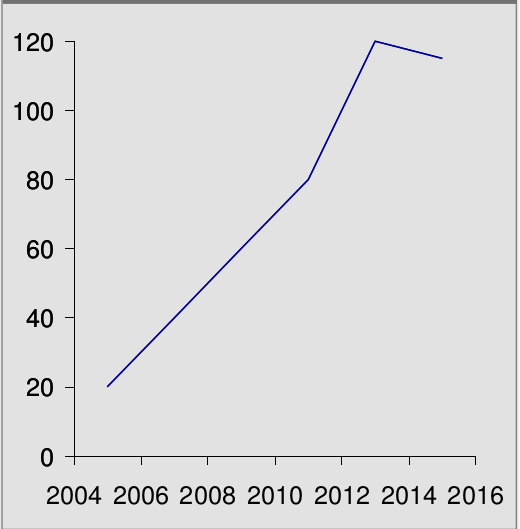
B. Number of successful startup exits by year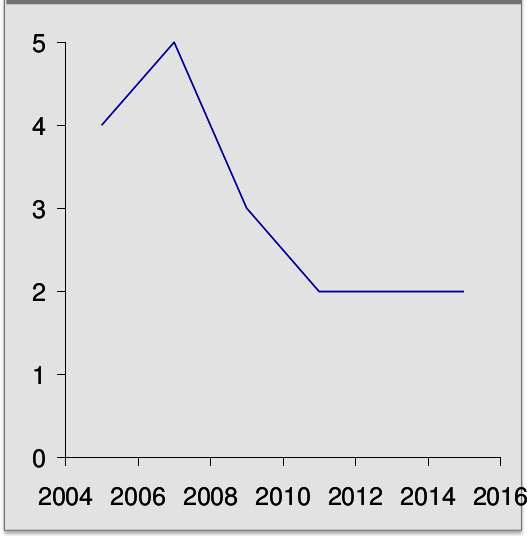
Exhibit #1 Analysis:
* Graph on left (Exhibit #1 A) illustrates the number of new startups being created each year, showing an upward trend in recent years.
– If needed, clarify that angel investors and venture capital investors are wealthy individuals.
* Graph on right (Exhibit #1 B) shows a decline in successful startup exits, followed by a plateau.
– If asked, share that successful startup exits are defined as IPOs or acquisitions where startup investors recouped their investments and made at least a modest return.
* The main takeaway from this Exhibit is that number of startups being created is not the issue, startups are simply not getting to successful exits.
– If the interviewee starts to crunch numbers, stop them. Prompt the interviewee to return to their framework or do a new brainstorm on root causes of this lack of successful exits.
* Either expanding on their framework, or through a new, structured brainstorming exercise, the interviewee should identify root causes of lack of successful startup exits.
* Potential root causes might include:
– Lack of funding to achieve scale
– Lack of customers
– Lack of experienced managerial talent
– Insufficient access to/visibility for would-be acquirers.
* The interviewee should come up with at least two sub-root causes under each branch.
* The interviewee should walk through brainstorm and identify their hypothesis of the major cause.
Prompt #3: Guide the interviewee towards funding as the main issue; when asked for data, provide exhibit #2.
Exhibit #2: Startup investors in Alphabet City vs. benchmarks
A. Number of angel investors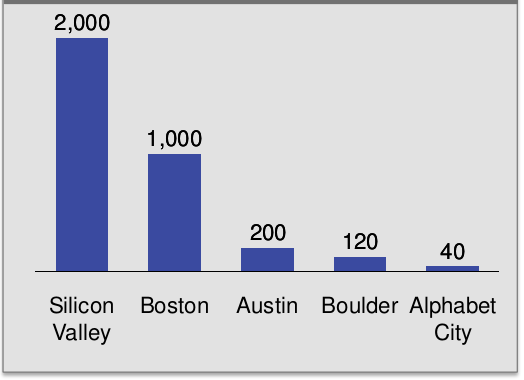
B. Number of venture capital investors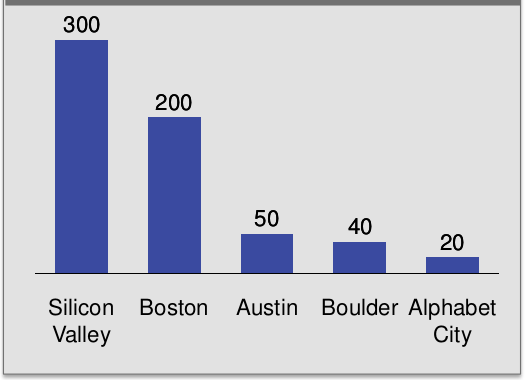
C. Number of wealthy individuals (in ‘000′s)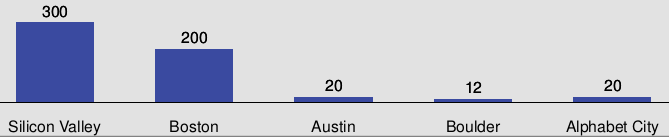
Exhibit #2 Analysis:
The interviewee should talk through exhibit and complete the following quantitative analysis:
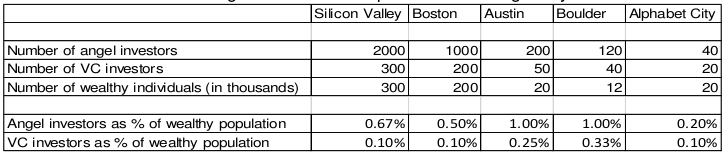
Main takeaway: Alphabet City has comparable VC investors as a % of wealthy individuals as top entrepreneurship hubs but lacks angel investors.
Note:
* Angel investors are early stage startup investors, generally the first investor outside of the entrepreneur’s immediate friends and family.
* VC investors are later stage investors.
* Prompt the interviewee to conduct analysis and identify lack of angel investors as root cause in failure of Alphabet City startups reaching successful exits.
* Depending on remaining time available, go to next prompt for brainstorming session or to recommendation guidance.
Prompt #4: What can be done to overcome the lack of angel investors in Alphabet City?
Possible Answer:
The interviewee should conduct a structured brainstorm of ways to increase the number of angel investors. Ideas might include outreach efforts, creation of angel investing groups to pool risk, education to increase comfort with what might be a new investment class for many of Alphabet City’s wealthy individuals.
* If interviewee creates a large list, encourage them to consider what might be the most effective.
* The interviewee may also consider ways to make current investors give more, which is fine, but not necessary. If they only do this rather than looking at increasing the number, guide them towards increasing the number, as this is more relevant given the provided data.
3. Recommendation
Prompt #5: We’re meeting with the Alphabet City Council later today and they would like an update on your recommendation so far. What would you say?
Possible Answer:
The interviewee should provide a final recommendation along the lines of:
“Alphabet City has seen huge growth in startup creation over the last decade. However, startups are not reaching successful exits. This is due to a lack of angel investors to provide the initial funding necessary for startups to scale. To increase the number of angel investors in Alphabet City, we could conduct outreach to wealthy individuals, create angel investing groups and provide education opportunities to orient investors to the investment class.”
The interviewee should also outline risks of the recommended approach and a general overview of next steps.
* Risks might include risk aversion by wealthy individuals in Alphabet City.
* Next steps might include identifying an experienced investor to run the angel group.
4. Performance Assessment
a. Average Candidate
* Brainstorming sessions are not thorough, structured or little creativity is shown.
* Struggles with math.
* Fails to drive case; seems unsure where to go next.
b. Good Candidate
* Meets some but not all criteria for excellent candidate.
* For example, does analysis easily but doesn’t come up with the ‘so what’.
c. Excellent Candidate
* Creates thorough and structured framework and brainstorms; shows creativity.
* Conducts calculations easily and arrives at the ‘so what’.
* Drives case, identifying where they want to focus and asking for needed data.