Board Game Distributor to Optimize Inventory Allocation
Case Type: reduce costs; operations strategy; supply chain optimization.
Consulting Firm: KPMG Advisory first round full time job interview.
Industry Coverage: sports, leisure & recreation; entertainment.
Case Interview Question #01177: Our client Board Games Company (BGC) is a small board game distributor in the U.S. A board game is a tabletop game that involves counters or pieces moved or placed on a pre-marked surface or “board”, according to a set of rules. Some games are based on pure  strategy, but many contain an element of chance; and some are purely chance, with no element of skill. Board games usually have a goal that a player aims to achieve. Early board games represented a battle between two armies, and most modern board games are still based on defeating opponents in terms of counters, winning position, or accrual of points.
The year is 2015. As board games like Settlers of Catan and Monopoly recently have made a resurgence in the market place, so has BGC. However, recent financial reports show that BGC’s profit have declined over the last three years (2012-2014), and they’ve hired our consulting team to diagnose the issue. How would you go about it?
Possible Answers:
1. Information Gathering
Additional Information: to provide if asked by candidate
* The client BGC sells to boutique gaming retailers.
* The client BGC sells 5 SKUs.
* BGC has 3 distribution centers (in Georgia, Nevada, and New York).
* Financials (Interviewer should wait to provide to interviewee until after framework)
– BGC’s sales were $20M in 2012, $22M in 2013, and $25M in 2014.
– BGC’s profits were $2.0M in 2012, $1.8M in 2013, and $1.4M in 2014.
2. Suggested Framework
The candidate should recognize this as a profitability case. Profits = Revenues – Costs. Their framework will most likely have three columns (revenue, costs, market/other)
3. Detailed Analysis
Exhibit 1.
A. Historical Financials ($M)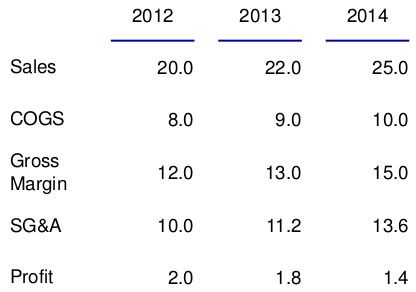
B. Sales & Profit Graph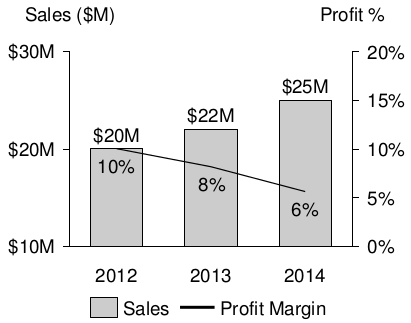
Prompt #1: What insights can you draw from Exhibit 1?
Analysis:
* Exhibit #1 represents high-level three-year financials for BGC.
* The interviewee should want to dig deeper into SG&A costs (see Exhibit #2 below) — the interviewer should help them get to that point.
* The interviewee should draw the following insights:
– Sales are rising steadily (10% in 2013 and 14% in 2014)
– COGS are rising with sales, so no issues there.
– SG&A rising faster than sales is the MAIN insight from this exhibit.
Exhibit 2. SG&A Historical Financials Deep Dive ($M)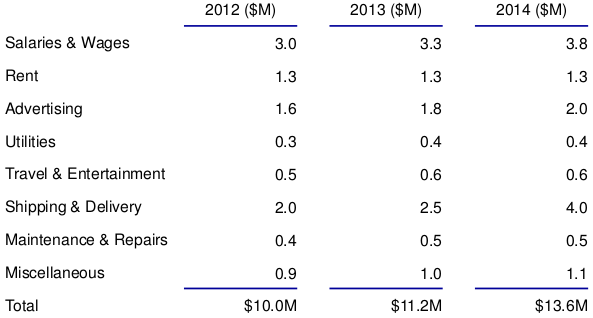
Prompt #2: What insights can you draw from Exhibit 2?
Analysis:
* This exhibit is the line-item SG&A breakout — the interviewee should have pointed out SG&A costs as being the main profitability driver and now wants to look at the deep dive.
* The interviewee should recognize that shipping and delivery costs are rising much faster than sales.
Exhibit 3. 2014 Forecast, Actual Demand, and Fill Rates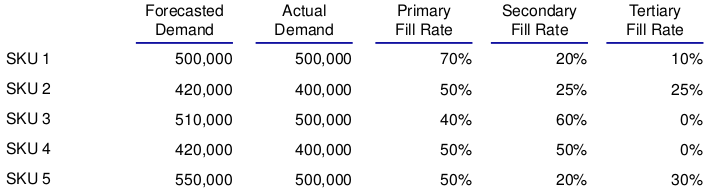
Note 1: Fill rates refer to the ability of the supply chain to fill and deliver the product from the nearest distribution center to the customer (e.g., primary fill means the product was delivered from the closest DC, secondary means 2nd closest DC, tertiary means 3rd closest DC).
Note 2: It costs the client BGC $1 (per item shipped) for primary fill, $2 for secondary fill, and $4 for tertiary fill.
Prompt #3: What insights can you draw from Exhibit 3?
Analysis:
The interviewer should now provide insight that shipping and delivery costs have been an increasing concern, mainly because of low primary fill rates from the three distribution centers.
* There are two main take-aways:
– The client company actually does a good job with forecasting, which means inventory holding costs are not the issue.
– The client company has poor inventory allocation (e.g., they’re holding the right amount company-wide, but not allocating it correctly across its distribution centers — leading to poor primary fill rates) — which is costing a ton of money.
* To analyze the additional costs from not having all orders ship from the primary distribution center, the interviewee should:
– First, calculate the number of units going secondary and tertiary for each SKU.
– Second, calculate the savings from filling an order primary vs. secondary, and primary vs. tertiary.
– Third, multiply units by savings.
– Fourth, get a maximum savings possible of ~$1.7M.
(See Exhibit 4 below for filled in chart plus calculations)
Exhibit 4. 2014 Forecast, Actual Demand, and Fill Rates Calculations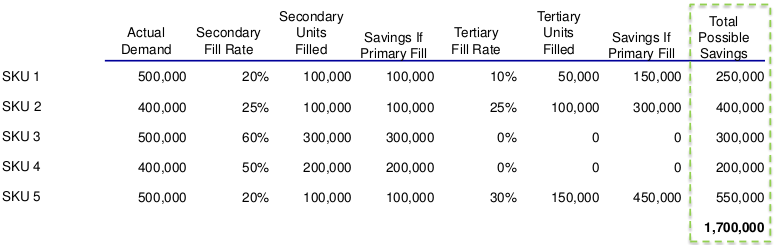
Conclusion: the interviewee should recognize there are possible inventory allocation savings of ~$1.7M which would nearly double current 2014 profit (from $1.4M to $3.1M).
4. Recommendation
Prompt #4: The CEO of GBC just walked into the room. What would you tell him?
Possible Answer:
The interviewee should make a recommendation that states:
* The client company BGC is having a profit issue due to rising costs.
* The main reason for rising costs is due to poor fill rates driven by poor inventory allocation (leaving ~$1.7M on the
table).
* Recommendation should be to take another look at the inventory allocation process to understand whether or not inventory could be allocated in a more efficient manner.
* Additional recommendation would recognize the trade-offs between holding more inventory at each distribution center versus simply re-allocating — which would increase inventory holding costs, but ultimately might be a better idea.
5. Performance Assessment
a. Average Candidate
* Framework may be weak (e.g., revenue and costs suggestions may not be broken out)
* Candidate may understand the need to calculate savings after prompted and math may be weak.
b. Good Candidate
* Concrete framework (e.g., revenue and costs broken out separately with examples)
* Candidate will draw insights regarding SG&A costs being the basis for profitability issues.
* Recognition of the need to calculate savings, but may stumble through setting up the problem.
c. Excellent Candidate
* Solid framework (see bullet 1 in “Good”)
* Few math errors
* Concrete summary
* Will suggest the company is good at forecasting, but poor at inventory allocation — will suggest follow-up supply chain inventory deep dive.