NASA to Launch New Mission to Find Habitable Planets
Case Type: operations strategy; math problem.
Consulting Firm: Arthur D. Little first round full time job interview.
Industry Coverage: aerospace, defense.
Case Interview Question #01174: The National Aeronautics and Space Administration (NASA) is an independent agency of the executive branch of the United States federal government responsible for the civilian space program, as well as aeronautics and aerospace research. Most U.S. space exploration efforts 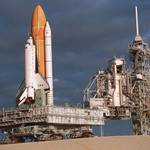 have been led by NASA, including the Apollo Moon landing missions, the Skylab space station, and later the Space Shuttle. The agency is also responsible for the Launch Services Program (LSP) which provides oversight of launch operations and countdown management for unmanned NASA launches.
Your client, NASA, has recently learned of a giant asteroid heading towards the Earth. Scientists at NASA have determined that there is a 10 percent probability that this asteroid makes landfall. If it hits, the asteroid will create a large dust storm blocking out sunlight and preventing photosynthesis in plants. This will ultimately destroy the rest of the earth’s ecosystem for the next 100 years. NASA needs help determining whether they should launch the Eternity Mission, a space exploration mission to find a suitable planet for the human population to live on in the event of the catastrophic asteroid impact. What would you recommend?
Possible Answers:
1. Additional Information
The following information can be provided to the candidate if requested:
* NASA’s goal is to safely evacuate at least 20% of the world’s population in the event of impact.
* The Asteroid would hit earth in 25 years. NASA estimates it will require 15 years to build enough space vehicles and safely evacuate 20% of the world’s population. Therefore, Mission Eternity needs to be completed within 10 years.
* Assume NASA has had major breakthroughs in space travel and spacecraft can now travel at the speed of light.
* Other international space agencies are looking to NASA to make a decision. Their budgets are unavailable to aid this mission.
* NASA has already weighed other options to salvage the earth’s population, such as hitting the asteroid to break it into smaller pieces, and determined that is not possible. Additionally, other efforts to live underground are being researched separately.
* Cost of the Eternity Mission will vary by planet(s) selected for exploration, we do not have specific figures.
* Assume NASA has figured out a way to use therapeutic hypothermia hibernation to enable humans to travel very long distance in space.
2. Potential Framework
* Budget Issues
– Cost of spacecraft
– Cost of fuel — renewable technology, fuel
– Astronauts — salary, life insurance, family support, training
– Staff on ground
– Upkeep of tracking devices
– Cost of test runs
– Outside fundraising possible: Business, nonprofit, donation support
* Timing Issues
– Distance to potential planet
– Duration of the project affects cost
– Timing of receiving planet data to make plans prior to asteroid impact
* Public Relations Issues/Liability
– Public response to expense
– Public reaction to disaster if an accident with the mission occurs
– Loss of credibility for future missions and existing projects if there is a failure
* Available Planet Data
– Accuracy of currently available data regarding potential planets
– Determining which metrics to prioritize
3. Detailed Analysis
Prompt #1: If not already provided to the candidate, inform them that the asteroid is set to hit earth in 25 years. At least 15 years is needed to build enough space vehicles and to safely evacuate 20% of the world’s population. Therefore, Mission Eternity can only take 10 years from start to finish.
Additionally, NASA’s Eternity spacecraft can travel at the speed of light. The closest four potentially habitable planets are Planet W, Planet X, Planet Y, and Planet Z. Once the Eternity spacecraft arrives to a planet, it will take on average 18 earth months to collect data sufficient to determine if the planet can support human life.
NASA has also discovered a way to send signals carrying the data back to earth faster than the speed of light. It will take three months per light year in distance for signals to reach earth. (Assume one month is 30 days.)
Exhibit #1. Planets W, X, Y, and Z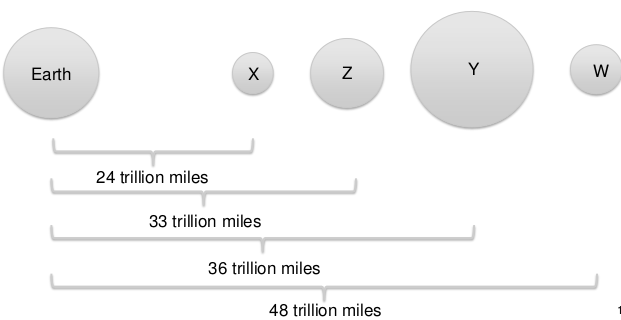
Note: A light-year is how astronomers measure distance in space. It is defined by how far a beam of light travels in one earth year — a distance of six trillion miles.
Exhibit #1 Analysis and Insight:
The candidate should realize that distance is related to timing and will impact the decision to explore certain planets within the allotted 10 year timeframe. The candidate should convert distances in Exhibit #1 into light years and add the additional time for data collection and receipt of the data signal to determine the total time it will take to make a decision about whether a planet is suitable for human life.
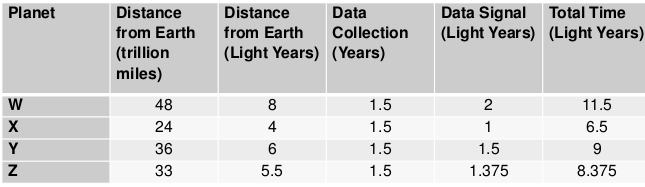
Conclusion: The candidate should determine that Planet W will not return information in time for NASA to build evacuation spacecraft, and therefore should be eliminated from consideration.
The candidate should drive the case and ask for additional metrics regarding water, atmospheric conditions, etc. to determine which planet would be most suitable to sustain life.
Prompt #2: Brainstorm: How should NASA determine which planet to explore first? What metrics would you want to look at when comparing Planets X, Y and Z?
Possible Answer:
Qualities/metrics of a suitable planet:
* Distance from earth:
– Feasibility of transferring population with less risk
– Space travel timing issues
* Food/Water:
– Farming capabilities
– Water purity and quantity
– Ability to raise livestock, sources of protein
* Atmospheric Conditions
– Air Quality – Breathable? Does it require a head mask?
– Presence of harmful gases
* Natural resources
– Energy resources — light, fuel sources, etc.
– Geography – Buildable terrain, Safety of terrain
– Gravitational pull
* Climate
– Temperature
– Natural weather forces
– Length of days/nights
Prompt #3: (The candidate should drive case and focus on prioritizing one or two key metrics and ask for available data, then provide Exhibit 2) NASA only has the manpower and financial resources to visit one planet. Prior robot missions returned the following results (Show Exhibit 2). Which planet should NASA pursue?
Exhibit #2. Percentile Location in Habitable Zone vs. Earth Similarity Index (ESI)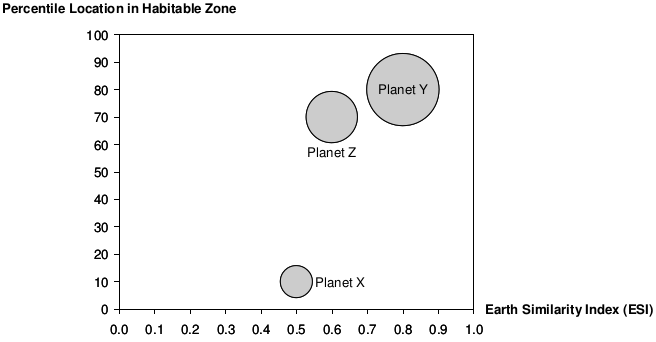
* In astronomy, the habitable zone is the region around a star within which planetary-mass objects with sufficient atmospheric pressure can support liquid water at their surfaces. In other words, this indicates the likelihood of water.
* Earth Similarity Index, ESI, is a measure of how physically similar a planetary-mass object is to Earth. It is a scale from zero to one, with Earth having a value of one.
Possible Answer:
The candidate should determine that Planet Y has the best indicators for supporting human life.
Additionally, NASA’s goal is to safely evacuate at least 20% of the world’s population in the event of impact. Planet Y provides the best option for safely sustaining life.
4. Recommendation
Example of a good final recommendation:
The client NASA should launch the Eternity Mission to Planet Y because it will return data before the 10 year deadline and has the highest indicators to sustain human life — with an ESI of 0.8 and a location in the 80th percentile of a habitable zone.
* Risks: Planet Y is the furthest away from earth, making the trip and hibernation riskier. It is also more costly, and a higher proportion of NASA’s annual budget.
* Next steps: Prepare the mission to Planet Y, and (depending on costs) consider launching another mission to Planet Z since it would still return data in enough time.
5. Performance Assessment
a. Average Candidate
* Has two or fewer math mistakes.
* Provides risks and next steps in recommendation.
* Buckets the brainstorm in prompt #2.
b. Good Candidate
* Creates a table for exhibit #1′s calculations.
* Drives case and asks for the appropriate information.
* Asks for explanation if they do not understand habitable zone and ESI.
c. Excellent Candidate
* Pulls in data from the initial prompt that with 10% probability of impact, there’s more need to be budget conscious.
* Takes shortcuts when calculating Exhibit #1: without calculating realizes Planet W will be outside of the 10 year deadline and Planet X will safely fall inside the deadline.