Whiteboard Maker to Keep Trucking Services In-house
Case Type: operations strategy; math problem.
Consulting Firm: American Express first round full time job interview.
Industry Coverage: office equipment; freight delivery, shipping services.
Case Interview Question #01168: Our client SuperWhite Inc. is an American manufacturer of a variety of visual communications products such as white boards. With its main manufacturing factory and corporate headquarter located in Menomonee Falls, Wisconsin, SuperWhite sell quality white boards with a network of  retail stores throughout the United States.
The client SuperWhite ships the white boards from its factories to its distribution center and then from the distribution center to all of its retail locations. To meet their shipping needs, the client presently uses in-house trucking services. They have approached our consulting team asking for advice as to whether they should look to outsource their trucking services instead. What would you recommend?
Additional Information:
* It does not matter whether the client company’s retail outlets are their own or franchises.
* The logistics of how the trucking industry works is not important.
* If the candidate asks for any more information, do not provide any further information.
Possible Answers:
1. Suggested Framework
This is an operations strategy case. The basic question boils down to doing a cost-benefit analysis to compare in-house trucking services with outsourced trucking services. The candidate could come up with a structure similar to as shown below:
Exhibit 1. Suggested Framework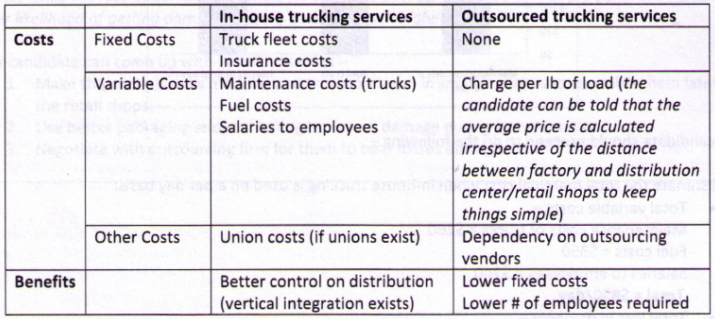
2. Detailed Analysis
When the candidate comes up with this structure, push him/her to think further about the costs. There is a key cost component that is left out. Let him/her try to figure it out for a couple of minutes. If he/she does not get it, then give it to him/her. This is the “damage to goods during transit”. During transportation some of the white boards get damaged. These need to be included in the equation.
After giving the candidate this information, push the candidate to find out why these need to be included. After all if transportation damages stem in both cases, they need not be included in the costs on both sides.
The key here is that when outsourced. the external contractors/contracting company will not be as careful while loading/un-loading, thus changing the ratio of the whiteboards that get damaged.
Once the candidate has gotten this, give him/her the below information:
* The transit damage is 15% of the load when in-house trucking services are used. On the other hand the transit damage is 25% of the load when outsourced trucking services are used.
* The company ships 50 lbs of white boards a day to the distribution center and the distribution center ships the same amount to the retail stores every day.
Then, provide the candidate with the following graph and let him/her do some math and do the cost-benefit analysis.
Exhibit 2. Costs per day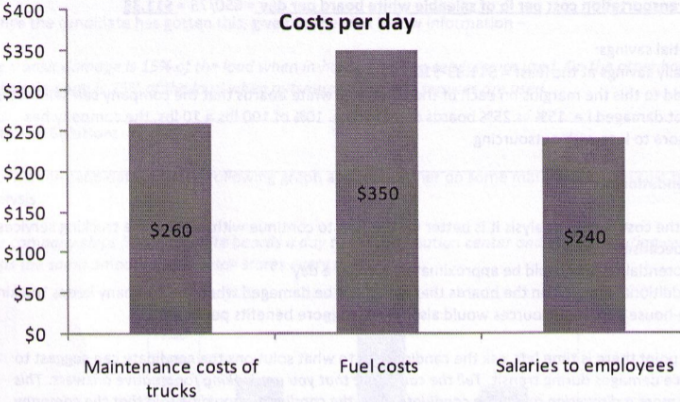
The candidate should proceed to do the following calculations:
a. Estimate the total marginal cost when in-house trucking is used on a per day basis:
* Total variable costs
– Maintenance costs of trucks = $260
– Fuel costs = $350
– Salaries to employees = $240
– Total = $850/day
* Total loss in damages
– # of lbs of white board transported daily = 50 + 50 = 100 lbs
– # of lbs of white board damaged (in-house trucking) = 15% of 100 lbs = 15 lbs
– # of lbs of white board that can be sold = 100 – 15 = 85 lbs
* Transportation cost per lb of saleable white board per day = $850/85 lbs = $10/lb
b. Estimate the total marginal cost when trucking is outsourced:
* Total variable costs
– Price charged by vendor = $8.50 /lb
– Total cost per day = $8.50 * 100 lbs = $850
* Total loss in damages
– # of lbs of white board damaged = 25% of 100 lbs = 25 lbs
– # of lbs of white board that can be sold = 100 – 25 = 75 lbs
* Transportation cost per lb of saleable white board per day = $850/75 lbs = $11.33/lb
c. Potential savings
* Daily savings at the least = $11.33 – $10 = $1.33/lb
* Add to this the margins on each of the additional white boards that the company can sell that is not damaged, i.e. 15% vs. 25% boards damaged, i.e. 10% of 100 lbs = 10 lbs, the client company has more to lose with outsourcing.
3. Recommendations
Based on the cost-benefit analysis it is better for the client to continue with keeping the trucking services in-house because:
* Potential savings could be approximately a dollar/lb a day.
* Additional margins on the white boards that would not be damaged when the company keeps trucking in-house versus outsources would also results in more benefits per board.
4. Bonus Question
If at this point there is time left, the interviewer could ask the candidate as to what solutions the candidate can suggest to help reduce damages during transit. Tell the candidate that you are looking for creative answers. This should be more a discussion and if the candidate asks, the candidate should be told that the company makes boards in three sizes – small, medium and large. The small boards are rarely damaged during transit while the rate of damage is highest for the large boards. The large boards are bulky and hence their likelihood of getting damaged during transit is much higher.
The candidate can come up with answers such as:
* Make the white boards modular and transport them in smaller parts and assemble them later in the retail shops.
* Use better packaging and cushioning to reduce damage during transportation.
* Negotiate with outsourcing firm for them to bear losses during transit.