HBS Student to Finance His MBA by Selling Startup
Case Type: operations strategy; pricing & valuation.
Consulting Firm: Arthur D. Little first round full time job interview.
Industry Coverage: small business, startups.
Case Interview Question #01155: Harvard Business School (HBS) is the graduate business school of Harvard University in Boston, Massachusetts, United States. The school offers a large full time MBA program, doctoral programs, HBX and many executive education programs. It currently enrolls more  than 2,000 students in its degree granting programs.
It is May 1, 2017. Your client is Mr. Dmitry Orslov, who recently accepted his offer of admission to join the MBA program of Harvard Business School’s class of 2019. Mr. Dmitry Orslov is from the country of Georgia in Eastern Europe and currently owns a startup there. Dmitry is looking for your advice on what to do with his startup company once he leaves for Boston. What would you recommend?
Possible Answers:
1. Case Overview
The purpose of this case is to let the candidate think from the viewpoint of the client. This case is intended to be open ended and there are multiple possible solutions.
2. Additional Information
The following information should be provided upon request:
* The startup company’s business is in the outdoor advertising space. The company owns 8 advertising billboards in the city of Tbilisi, the capital and largest city in Georgia and rents them out.
* Your client Mr. Dmitry Orslov started the company 2 years ago and it has been profitable since then.
* The company has no full-time employees except for Mr. Dmitry Orslov himself. Short-term contractors are hired from time to time.
* Dmitry wants to stay and work in the US after his MBA.
* Your client Dmitry owns 80% of the company and other 20% is owned by his partner.
3. Suggested Framework
A good framework should cover and assess two main possibilities: (1) running the business from the distance while doing MBA or (2) selling it. If the framework is not addressing these possibilities, ask your interviewee to brainstorm about it. Let the interviewee decide which opportunity he/she wants to assess first and proceed accordingly.
4. Detailed Analysis
(1) Running Business Distantly
If the candidate wants to assess the idea of running the company distantly while doing an MBA, push the candidate to think about major decision making factors.
Based on the information already provided, a strong candidate should be able to understand this is not a good option. If needed guide the candidate towards this conclusion. Reasons leading to this conclusion could include:
* Dmitry is the sole employee and runs the business himself, and has limited time and money to find a replacement.
* Distance would imply a challenge in maintaining relationships with customers, and even if Dmitry tries, managing relationships over the phone is hard.
* Dmitry needs money and financial security to cover his tuition, and has taken a loan to finance his MBA.
Additional Information: to be provided upon request
* Dmitry does most of the work at the startup company. He does everything from generating sales to maintaining the billboards.
* Dmitry does not have enough savings to cover the tuition at HBS.
* His partner has a full-time job and is not interested in running the company on his own.
(2) Selling the Business
Prompt #2: Your client Mr. Dmitry Orslov agrees that it is a good idea to sell the business. He wants you to suggest an appropriate price for the company that allows him to finish the transaction until he has to move to Boston.
Possible Answer:
First, ask the candidate to brainstorm potential buyers of this business, if not already discussed . Possible answers: his partner, competitors, company’s major clients, etc.
Provide the following information upon request (let the candidate brainstorm what’s needed):
* All 8 billboards are rented out for the whole year (100% occupancy).
* The typical contract lasts 6 months.
* The size and price are the same for all 8 billboards as shown in Exhibit 1.
* All the costs are covered by the first month’s revenue from the contracts. Ignore all the other costs including depreciation.
* Income tax is 20%.
* Discount rate — see next part of the case.
Exhibit 1. A typical billboard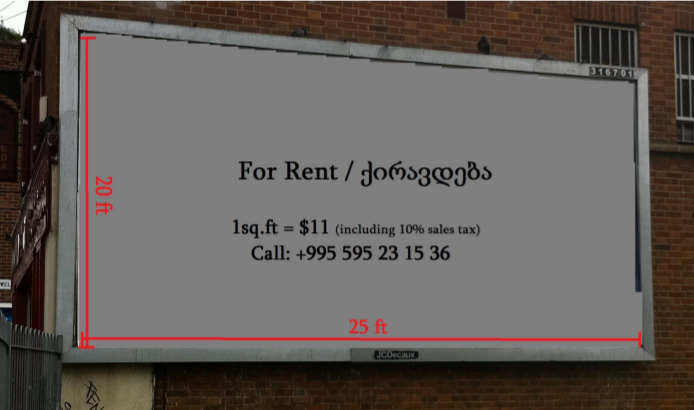
Note: price displayed is monthly rent
(3) Discount Rate
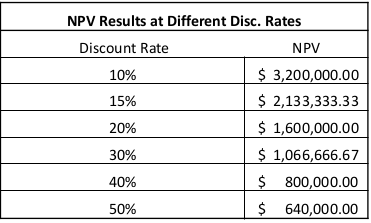
Prompt #3: Your client Dmitry does not know what discount rate would be appropriate to use. He is a future Harvard student and he can take a student loan at 8.5% interest. He wants you to determine an appropriate discount rate.
Possible Answer:
There is no correct or incorrect discount rate for this case. Let the candidate qualitatively assess the situation and come up with the rate he wants to use.
This question is meant to be ambiguous and is aimed at testing a candidate’s ability to make an independent decision quickly in this ambiguous context.
The 8.5% interest rate is unrelated to his startup business and is meant to anchor the candidate. Question the interviewee why, if he/she wants to use that rate.
Some of the factors that should be considered in analysis include:
* Business is mature and asset-driven, so has been predictably profitable since the beginning and the company has 100% occupancy rate (low risk).
* Business depends entirely on Dmitry and is questionable without him (high risk).
* Dmitry needs to sell the business fast, so using a higher discount rate makes sense.
(4) Valuation
NPV Calculations:
* Calculations below assumed 6 month contracts (i.e. costs = 1/6 of revenue).
* After the candidate gets the NPV, ask him/her to do qualitative analysis and give deeper insights about the results.
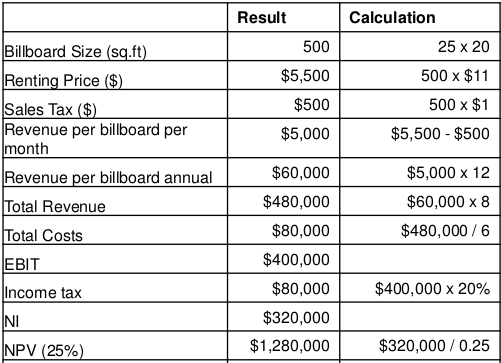
Because Dmitry owns 80% of the company, your client Dmitry’s Share = $1,280,000 x 80% = $1,024,000
(5) Wrapping up the case
The candidate will understand that the startup company is worth a lot more than funds needed for Dmitry’s MBA.
A strong candidate will understand that selling a company in a short timeframe will result in a lower valuation, and the candidate will suggest some alternative options.
In the end ask the candidate for 30-second wrap-up.
5. Performance Assessment
* Average Candidate
Average candidate will need assistance to go through the case.
* Good Candidate
Good candidate will be able to independently solve the case from the MBA student perspective
* Excellent Candidate
Excellent candidate will not only be able to come to final conclusion independently but also give high level insights. Such a candidate will understand that the startup company is worth a lot and would even question Dmitry’s decision to do an MBA and work for large company in the U.S. Why not just work on the startup full-time and grow the business?