Texas Oil Company to Prioritize Land Development
Case Type: operations strategy, optimization, prioritization.
Consulting Firm: Schlumberger Business Consulting (SBC) first round full time job interview.
Industry Coverage: oil, gas, petroleum industry.
Case Interview Question #01152: Your client, Texas Oil Company, is a large, integrated oil and gas company which competes with the likes of ExxonMobil, BP, Shell, and Chevron. They have assets in 72 countries, on 5 continents, and own one-quarter of the US oil market. They recently purchased a large area  of land from a small, independent oil company and are attempting to integrate it into their portfolio in West Texas. The client Texas Oil hired your consulting firm to help them determine how to develop the purchased land.
While the client company is large, it is “capital constrained”. This is because of low crude oil prices and an over-budget refinery in Angola. As a result, the company cannot develop all of the purchased land in the coming years.
How would you frame this problem for the client?
Additional Information (to provide if requested):
* All of the purchased land has proven oil and gas reserves (with 90% confidence)
* Other major competitors are also in West Texas.
* Oil and Gas are commodities, and traded on an international, liquid market (meaning the quality of the reserves is not important for the case)
* The client Texas Oil does not have enough market share to influence the price of oil/gas.
* The purchased lease will expire in 3 years.
* The total amount purchased is 320,000 acres.
Possible Answers:
Prompt #1: How would you frame this problem for the client?
Possible Answer:
The ideal candidate should frame this case as a optimization and prioritization problem. The key value measure for prioritization is a cost/benefit analysis:
Costs: Land development (building roads, infrastructure), appraisal costs (geological analysis), construction and drilling costs, labor costs, production costs (pipelines, etc.)
Benefits: Revenue, market share, production.
Prompt #2: The land on which the drilling rights were purchased is owned by the government and leased to companies on a five-year timeline. If a lease holder does not develop that land in that time, the lease expires and the lease holder can no longer develop it. Texas Oil’s purchased land has only three years remaining on its lease agreement.
How many acres can Texas Oil develop before their lease expires? What percentage of their purchased land does this represent?
Possible Answer:
This is a short, back of the envelop calculation. The candidate should ask for figures, but if they are having difficulty you can start from the top with information.
Historically, the company has been able to develop (drill and produce) land at a rate of 100 square miles per year. 640 acres = 1 square mile
* The client Texas Oil has three years remaining on the lease, so 3 * 100 = 300 square miles
* 300 * 640 = 192,000 acres can be developed in 3 years
* Company purchased a total of 320,000 square acres
* 192,000 / 320,000 = 60% of its purchased land
Prompt #3: OK, now that we’ve determined how much of the land can be developed, we need to prioritize. The company has categorized the land into five “focus areas”, each with 64,000 acres (show Exhibit 1 to candidate).
Exhibit 1. Focus Areas of Texas Oil’s purchased land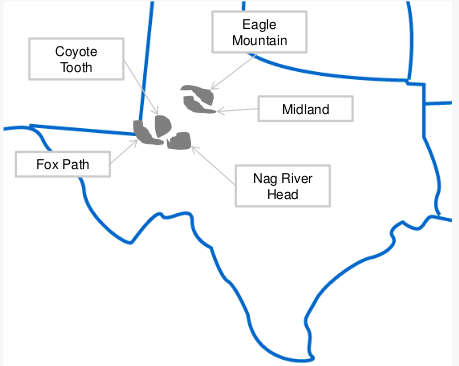
How would you go about prioritizing focus areas?
Possible Answer:
This is purely a brainstorming question, and if the candidate asks for specific figures, you can indicate that they are forthcoming.
Net present value (NPV) is the base answer (i.e. prioritize land based on expected revenue from reserves minus expected costs of development), but you should push the candidate to be a bit more creative.
2nd Level Insights:
* Capital efficiency (some areas may have slightly higher profits but cost much more to develop)
* Total cost of development (the prompt indicated that the client company is “capital constrained”)
* Total production
– Some companies may be more production focused than profit because it boosts stock price and/or valuation of the company
(e.g. independent oil companies looking to sell)
Prompt #4: Each one of these areas can be developed independently, but not at the same time. The firm has provided you with Exhibits 2 and 3 and asked you to determine its optimal course of action. According to the head of the West Texas Business Unit, the company has USD $300 million available to spend.
Exhibit 2. Focus Area Figures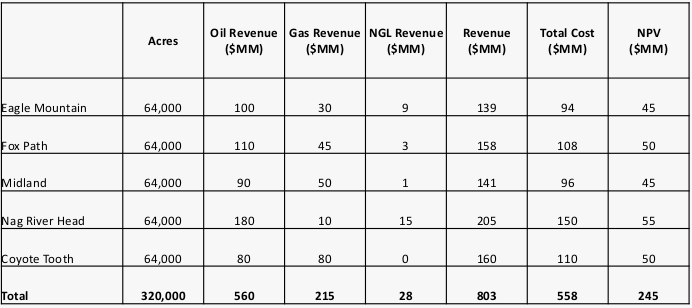
Exhibit 3. Focus Area Capital Efficiencies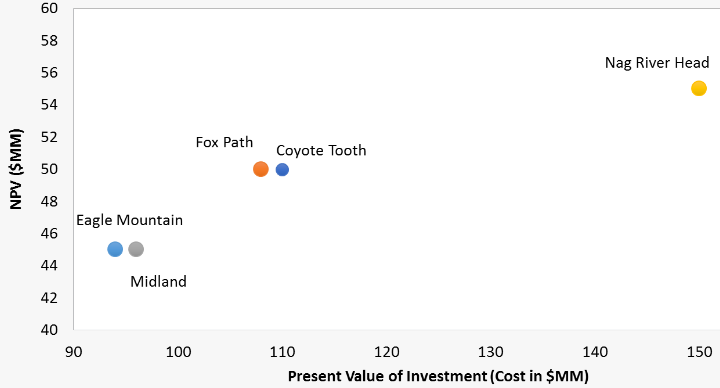
How should Texas Oil develop its purchased land?
Possible Answer:
The Oil, Gas, and NGL (natural gas liquids) figures are a distraction here, and feed directly into revenue. If the candidate asks about priorities, suggest that the company wants to “maximize profitability given its capital constraints”
The key to answering this question is capital efficiency.
The correct answer is: Eagle Mountain, Midland, and Fox Path.
Coyote Tooth can also be substituted for Fox Path, but it spends more money and gets the same amount of revenue. Nag River Head is attractive because it has a higher NPV, however, it violates the 300 million limit set by the business unit head (when developed with any 2 other areas), and is not capital efficient. If the company decides to develop Nag River Head, then, it must give up developing a third segment, thus forgoing profits on that segment as well.
2nd level insights:
* Texas Oil could re-categorize land within those segments and achieve higher portfolio efficiencies (i.e. not all land in one segment is equally profitable)
* Texas Oil should sell the excess acreage to other competitors, rather than sitting on the lease and allowing it to expire.