Fitness Center Chain to Target Gen X and Gen Y
Case Type: growth strategy; business turnaround.
Consulting Firm: McKinsey & Company first round full time job interview.
Industry Coverage: sports, leisure, recreation.
Case Interview Question #01148: Your client is Heavy Things Fitness, a small fitness center chain with 15 locations in a minor metropolitan area in the United States. The chain was first established during the fitness boom in the late 1970s. After decades of continual growth, Heavy Things Fitness has seen membership  decline by alarming rates. Over the past 5 years, it has seen total membership numbers decrease an average of 6% annually.
The client Heavy Things Fitness has asked us to determine what is causing this trend and how they can reverse this trend to begin growing again. Based on what you know about the fitness industry, what do you believe is causing this membership attrition?
Possible Answers:
The focus of this case is on market segmentation and determining/targeting the optimal segment. The candidate should demonstrate an understanding that profit is the ultimate goal. Various strategies will have different implementation costs and potential revenues, and the candidate should return to these numbers at every step.
If they ask for more information on the specific city/metropolitan area, tell them it has a population of about 1-1.5M, similar to Providence, RI; Milwaukee, WI; or Jacksonville, FL. No other information is relevant (such as location within the US), as this is not the focal point of the case.
Relevant Additional Information:
* Gym memberships in this city have been growing 3% each year, both in this city and in all regions of the country.
* Heavy Things Fitness gyms offer cardio rooms, free weights, and weight machines.
* Membership prices and payment plans are in line with their closest competitors.
* Heavy Things Fitness targets serious fitness enthusiasts, believing that these are the most loyal customers.
Question #1: Based on what you know about the fitness industry, what do you believe is causing this membership attrition?
Possible Answer:
Potential Causes:
* Changing fitness trends, such as towards class-based fitness or high intensity training
* Negative attributes of Heavy Things Fitness, such as poor customer service or deteriorating facilities
* Competitors offer better services, such as personal trainers or basketball courts
* Shifts in city or industry demographics, away from Heavy Things’ target demographic
Unlikely Causes:
* Decreasing city population (as the rest of the city’s gyms are seeing increasing memberships)
* Competitors offer lower cost (already established that Heavy Things’ costs are comparable to competitors
When interviewee asks for industry or client customer demographic information, provide Exhibit 1 and 2, respectively.
Exhibit 1: Local Interest in Gym Memberships, Demographic Segmentation
A. Local Interest in Gym Memberships, by Age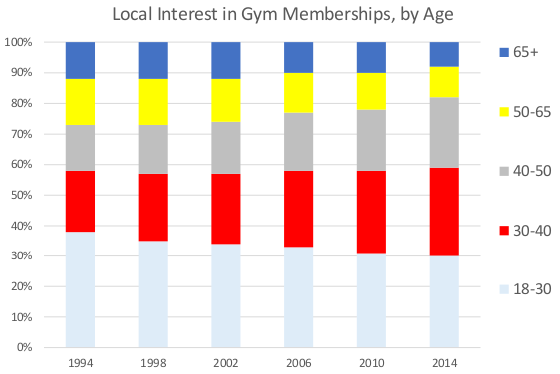
B. Local Interest in Gym Memberships, by Gender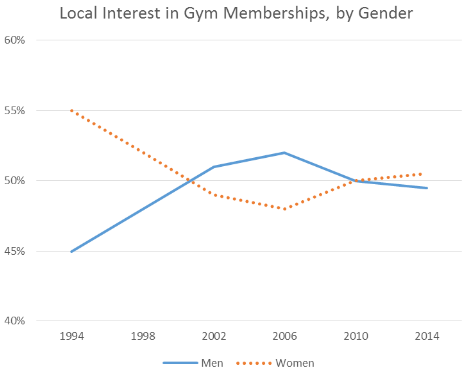
Exhibit 2: Client Customers, Demographic Segmentation
A. Client Customers by Generation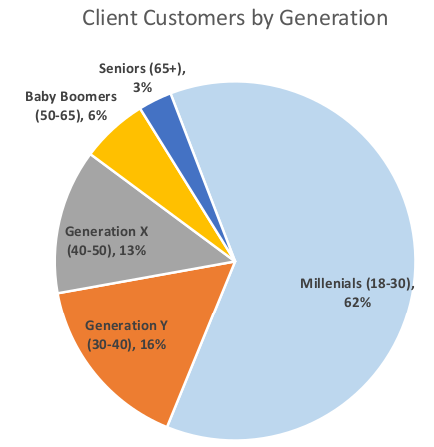
B. Client Customers by Gender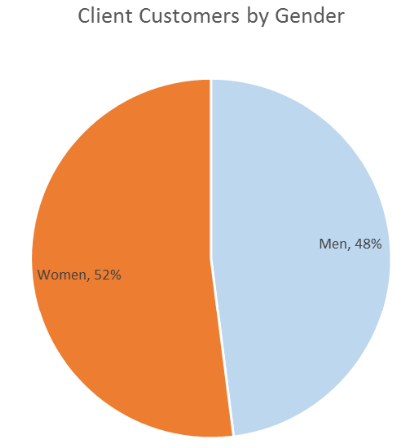
Question #2: Given the information in Exhibits 1 and 2, what do you believe is the source of Heavy Thing’s declining membership?
Clarifying Note: The legend order corresponds with the Generation graphic in Exhibit 1. In other words, the top portion of the chart represents Seniors, and the bottom represents Millennials.
Possible Answer:
Extractable Facts:
* Local gym memberships are trending towards Gen X and Y and away from Millennials, Baby Boomers and Seniors.
* Genders seem to have shifted towards men, then back to women.
* Heavy Things’ membership is heavily concentrated in the Millennial generation.
* Heavy Things’ membership is evenly split between men and women.
Key Takeaways:
* Heavy Things’ membership gender profile parallels local industry gender profile
* Heavy Things’ membership generation profile is focused on the declining Millennial population rather than the growing Gen X and Y populations.
Potential Conclusions:
* Target Gen X and Y customers
* Become more of a niche gym for declining millennial customer segment
Question #3: After reviewing this data, Heavy Things Fitness leadership agrees that they should target Gen X and Y customers. What are some possible ways that Heavy Things Fitness can target these growing demographics? What would be the risks of each of these solutions?
Possible Answer:
Good Potential Solutions:
* Marketing campaign targeting consumers aged 30-50
– Spokesperson in that age range
– Ads run in areas of interest for these consumers
– Explanation that this gym is for these consumers (a la Planet Fitness ads)
* Offer new services more to the liking of middle aged customers
* Make prices more appealing to middle aged customers
– If price is believed to be a primary concern, lower prices
– If not, raising prices would help offer more services and prevent younger customers with less disposable income from joining.
* Make the gym an exclusive club where only those members can join.
Top level candidates will address the inherent risk of cannibalization when switching from one target demographic to another, and include solutions that will minimize such cannibalization. If the candidate does not mention cannibalization, lead them to it. Some such solutions would be:
* Convert some existing locations to more Gen X and Gen Y-friendly establishments, while keeping the rest the same, enabling current customers to go to another Heavy Things Fitness gym if theirs gets shut down.
* Develop a brand extension in brand new clubs that target these customers.
* Divide the physical space of each gym into two distinct gyms (like a combination Pizza Hut and Taco Bell)
Question #4: We presented your findings to the client at a recent status meeting, and Heavy Things Fitness leadership liked the idea of a brand extension of 5 facilities targeted at Gen X and Y customers, called “Fast Class Fitness”, which will focus on the class-based fitness programs that our client’s research has shown appeals to Gen X and Y customers. They want us to determine whether it is more profitable to convert existing Heavy Things properties into Fast Class properties, or to expand into new properties in which to open Fast Class centers. How would you go about it?
Pertinent Information (let the candidate brainstorm what information is necessary to calculate revenues and costs before providing):
Revenues
* Membership dues at Heavy Things facilities = $50 per month
* Membership dues at Fast Class facilities = $75 per month
* Average memberships at Heavy Things facilities = 300
* Average memberships at Fast Class facilities = 400
Costs
* Rent of all facilities (including cost of fitness equipment), Heavy Things and Fast Class = $10K per month
* Labor at Heavy Things facilities = 2 employees at $36K per year each
* Labor at Fast Class facilities = 4 employees at $48K per year each
* Retention of members from converted Heavy Things gyms = 33% of each gym’s membership
– This is a small city, so when a club is converted, members can simply move to a neighboring location
– In other words, when a gym is closed, 1/3 of the members will join a different Heavy Things Fitness gym, but 2/3 of the members will leave Heavy Things for a competitor.
* Assume Heavy Things can maintain these membership levels
Possible Answer:
Sample Calculations: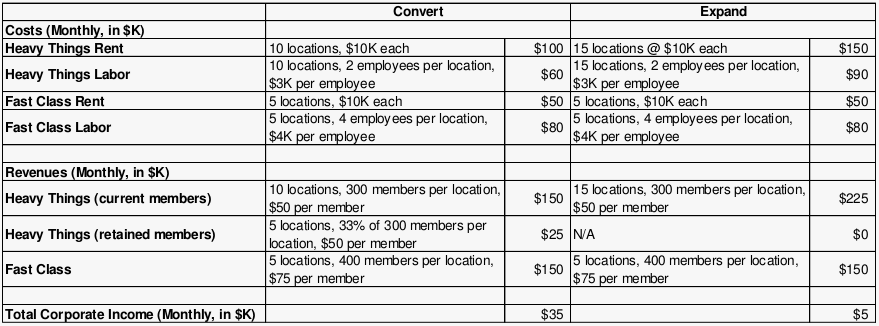
However, the fastest way to calculate this is to realize that the revenues and costs from Fast Classes are constant, so the only necessary calculation is subtracting the additional cost to maintain the 5 heavy things locations ($80K) from the revenue gained by keeping all 15 Heavy Things locations ($50K).
Either way, the correct conclusion is that it is more profitable to convert the 5 locations rather than expand.
Question #5: Mr. Olaf Dungren, the CEO of Heavy Things Fitness, is about to walk into this office, and he’d like to hear our recommendation. How would you summarize our findings?
Possible Answer:
Answers may vary, but should include:
* Recommendation to convert five Heavy Things fitness centers to Fast Classes fitness centers.
* Justification based on the ability to attract new members and increase profitability at a more efficient rate than by expanding to new properties.
* Potential risks to this suggestion that include five not being the optimal number to convert, increasing properties serving as advertising that would generate additional memberships, the 33% estimate of retention being inaccurate.
* Next steps, such as hiring class teachers for the new gyms, developing an advertising campaign to build the Fast Class brand, and hiring contractors to convert the Heavy Things gyms to Fast Class centers.