Russia’s Shipbuilding Industry to Undergo Major Reform
Case Type: organizational behavior; strategy.
Consulting Firm: Deloitte Consulting first round full time job interview.
Industry Coverage: aerospace, defense; engineering.
Case Interview Question #01146: During the cold war, the Union of Soviet Socialist Republics (USSR) shipbuilding (SB) industry was based on programs. Each program was different (e.g. destroyers, submarines, patrol ships) and had its own organization, own technology, own engineers and own manufacturing facilities.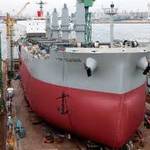
In the mid-90s, after the collapse of the Soviet Union, Russia was facing a strong recession, and decided to make public its shipbuilding industry. However, some of the States with manufacturing facilities (see Exhibit 1 below), were concerned about losing these facilities, and therefore, increasing the unemployment in the region (each State with facilities had an average of 50,000 direct employees and 150,000 indirect employees). To keep everyone happy, the federal government decided to give over 60% of the company to States ownership (3-8% for each State depending on the number of facilities and employees) and the remaining stake to public offering.
To make it more interesting for private investors, the company was restructured in 3 main divisions: naval, submarines and advanced technology (AT).
After 15 years, the company has doubled its employees and has become one of the biggest players in the shipbuilding industry. Revenues are $85B for naval, $10B for submarines and $12B for advanced technology. A new CEO has been appointed to manage the whole company. She is concerned about the effectiveness of the company, specially in the military segment. Her concern is based on three factors:
1. 80% of naval revenues comes from commercial products (e.g. light boats, ferries)
2. Within the naval program, military ships are just adapted from commercial ships (e.g. goods transport, tankers). See Exhibit 2 below.
3. The advanced industry division, has four programs (Electronic Defense, IT, Cyber Security and Missile Boats), where missile boats are less related to the other three programs.
The new CEO is thinking of creating a new division, called Military, to manage all ships with military purposes. She is hiring your consulting firm to evaluate if this is a good decision.
Is this the right choice? What should be her decision?
Exhibits
Exhibit 1: Map of Russian shipbuilding facilities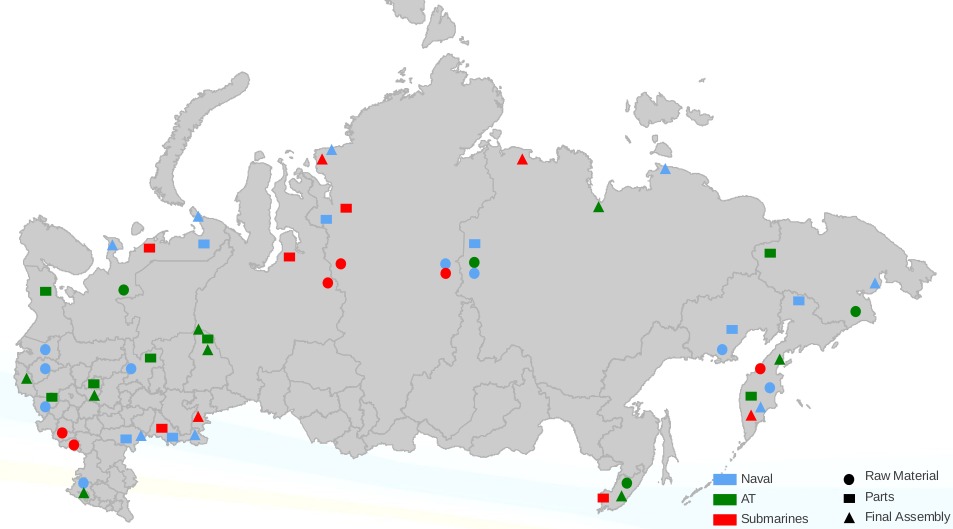
Exhibit 2: Confirmed military orders to deliver by type of product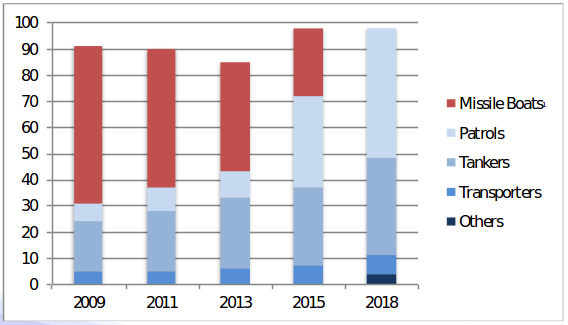
Red: products from advanced technologies
Blue: products from naval
Note 1: Missile boat don’t have a new product in the pipeline after 2015
Exhibit 3: (Interviewer copy) potential synergies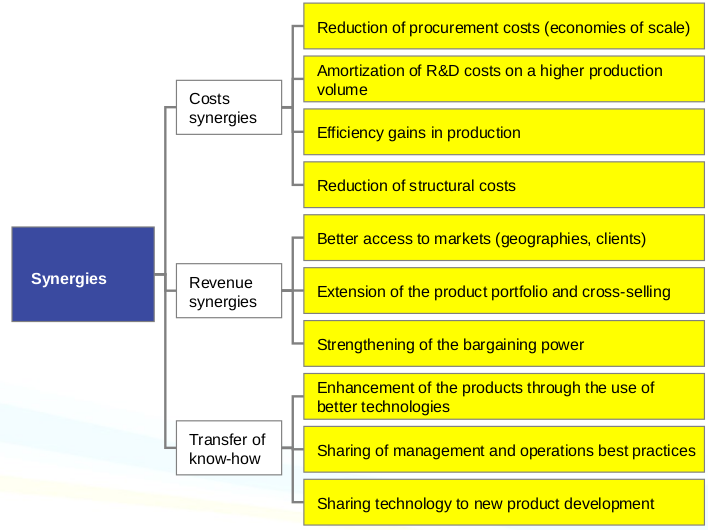
Exhibit 4: (Interviewer copy) political issues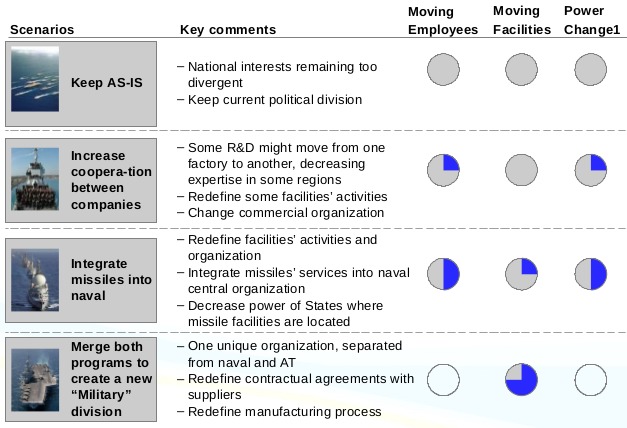
Note 1: Changes in the State’s stake might happen due to changes in employees and facilities
Exhibit 5: (Interviewer copy) potential scenarios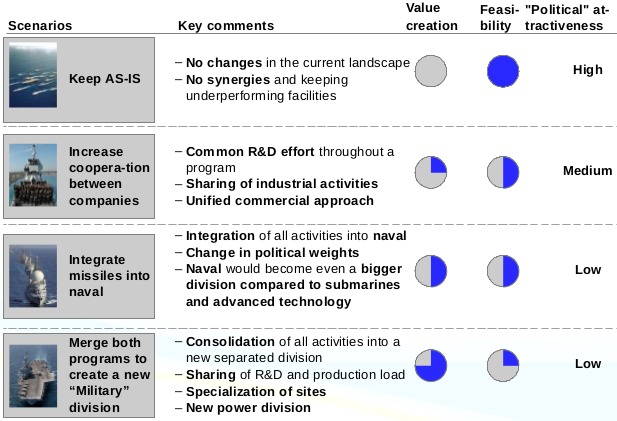
Possible Answers:
The goal of this case is to evaluate how the candidate analyzes the current and future situation, develop alternative scenarios for the new organization and provide a recommendation to the CEO.
The first thing that the candidate should be surprised by is that missile boats are not a part of Naval. This is a key question for the discussion. The initial reasons why missile boats were included under Advanced Technology are not valid nowadays, and are not needed to develop the case.
Please note that those employees who are directly related in manufacturing process are regarded as direct employees whereas there are several subsidiary services required like machine repairs etc. which are not directly related to production but are inevitable. Employees falling under this category are namely indirect employees.
Although many frameworks are possible, there are 4 main areas to discuss:
1. Market potential: any change in the organization will require a certain investment. We want to know if there are market opportunities that would justify this change.
2. Synergies: there might be synergy opportunities for each scenario.
3. Political issues: as stated in the case, politicians are wary of any change in the organization. Any change in the organization could affect the facilities distribution and power ownership, potentially going against the State’s interests.
4. Potential scenarios:
* M&A: creating a new division (Military) separated from the other two.
* Integration: integrating missile boats into Naval.
* Cooperation: increasing synergies between naval and missile boats.
* Current: keeping the company AS-IS.
If the candidate does not mention the 4 points above, ask him/her to analyze the market potential and list some synergies, political issues and potential scenarios.
1. Market potential
Provide Exhibit 2. The candidate should identify that deliveries of missile boats will stop in 2018, while naval deliveries will continue increasing in the future. He/she should conclude that the market for missile boats will stop and therefore it is not necessary to do a merger. This conclusion would be a trap, because:
* The average manufacturing length to deliver a naval ship is 10 years, while for missile boats it is just 5 years.
* The main interests for AT are electronics, so they have little interest on improving (sales and R&D) missile boats.
2. Synergies
The candidate should develop an extended list of potential synergies. It is important to list the 3 main synergies: revenues, costs, know-how (this is key, because it will affect the political issues and development of new products). A list with examples is shown in Exhibit 3. This is an orientation list; the candidate might come with other examples. No numbers are required. Share this with him/her once the analysis is done.
3. Political issues
The candidate should list different organizational scenarios and how political issues might affect each one. If he/she is stuck, the interviewer could provide some metrics (e.g. whether the scenario will affect employees, facilities and State power) to develop the discussion. A list with examples is shown in Exhibit 4. This is an orientation list, the student might come with other examples. No numbers are required. Share it with him/her once the analysis is done.
4. Potential Scenarios
The candidate should identify 4 possible scenarios (as-is, cooperation, integration, merge into a new division). The candidate should then highlight some aspects of each scenario, including ease of implementation, value creation, and political attractiveness. A table with the different options is given in Exhibit 5. Key aspects are examples; other could be possible. Once completed, the interviewer can share the table with the candidate. At the end of analyzing the scenarios, the student should perform a recommendation to the CEO. Any answer is possible and should be supported with good reasoning and information.
Performance Evaluation
Expected:
* Effectively summarizes the information given
* Identifies areas of discussion
* Arrives at some conclusion
Good:
* Completes all “Expected” requirements
* Works with the data to answer questions
* Asks good clarification questions
* Identifies most areas of synergies
Excellent:
* Completes all “Good” requirements
* Identifies all key recommendations with data to support
* Identifies all 4 key scenarios
* Summarizes all of the findings at the end of the case and provide a recommendation
* Provides additional creative ideas.