Contract Manufacturer to Predict Market Demand
Case Type: operations strategy; industry analysis.
Consulting Firm: Bain & Company first round full time job interview.
Industry Coverage: manufacturing.
Case Interview Question #01143: Your client is Contract Manufacturer Co., which produces components for a number of diverse products. They have grown quickly and had 2016 revenues of $19 billion. They now serve 350 customers across nearly 20 industries, including consumer electronics, mobile phones,  healthcare, and defense. They are dependent on their end-markets, e.g. how many consumers buy mobile phones next year, but they only “see” this demand through their customers, e.g. Apple and Samsung.
They are therefore very vulnerable to changes in market demand but find it difficult to estimate this demand. Third party sources, e.g. financial analysts and market research organizations who follow the space, are also very inaccurate.
The CEO of Contract Manufacturer Co. has become increasingly frustrated by their vulnerability to the market and their inaccuracy in predicting end-market demand. He wonders whether they should be better able to identify market trends and in particular, whether they could better utilize data they have accessible via their customer relationships.
How would you go about advising the CEO? Should Contract Manufacturer Co. be able to develop a proprietary view of their markets?
Possible Answer:
1. Case Overview
This is a high-level, strategy case that should lead to an interesting, open-ended discussion rather than a focused analysis. The objective is to test the candidate’s ability to quickly understand an industry that is not often discussed and think creatively and holistically about a business problem. The candidate should have most of the information needed in the prompt but may ask clarifying questions before beginning his/her framework.
2. Additional Information
Provide the following information upon request:
* Services: customers turn to Contract Manufacturer Co. or their competitors to provide parts quickly and cheaply. They are involved in some design and after-market services but most of their business (revenue) comes from simply manufacturing the parts requested. Customers will generally request parts 3-months in advance.
* Competitor landscape: Contract Manufacturer Co. is in a competitive space. Contract Manufacturer Co. is one of the leading players, with about 10% market share. Their largest competitors are Chinese and Taiwanese companies.
* Organizational structure: Contract Manufacturer Co. is structured by industry verticals, which it terms “sectors”, e.g. mobile phones or healthcare would be “sectors”. They have sales and account teams dedicated to customers in these sectors and a VP leads each sector. They have a strategic planning group at the corporate level, but it is quite new and not very mature.
* Profitability: Contract Manufacturer Co. is a profitable business but their margins are only 3-5% so they depend on sales volume.
* Geographic scope: Contract Manufacturer Co. is based in the US but has operations worldwide. Their customers are also global.
* Costs: Contract Manufacturing Co.’s costs include procurement of supplies, manufacturing costs, and labor costs. When customer request parts, Contract Manufacturer Co. needs to invest significant sums in machinery and technology.
3. Detailed Analysis
Ideal recommendations should touch on some of the areas below. The candidate should be measured against the quality of the questions posed and the level of the discussion overall. The candidate should sound interested in the potential for better market intelligence but realistic about the state of the company and whether this is feasible in their environment.
a. External best practices (What):
* The candidate may be curious to better understand whether other companies similar to Contract Manufacturer Co. (e.g. their competitors or proxy industries) are able to develop accurate views of their end-markets.
* Analysis indicates that in the contract manufacturing space, companies are not very mature at market intelligence. Their competitors do not appear to be any further along in this process.
* Best-in-class companies, however, have established market intelligence functions that capture market data, including publically available data (financial statements, research reports, etc.)
b. Motivation and justification (Why):
* The candidate should be curious about the benefits of developing a more accurate view of their markets. The candidate may postulate a few reasons or ask for guidance.
* While it is difficult to quantify the benefits of better market intelligence, overall it is clear this is beneficial because of the strategic decisions and risks the company is able to take.
* Specifically, a sophisticated business is able to do the following:
– Accurately forecast revenues.
– Improve account planning, e.g. revise production, capacity and resource plans.
– Develop long-term strategy, e.g. identify capability gaps and evaluate need for M&A or R&D to fill the gaps.
– Build credibility with the investor community by communicating an accurate annual view of the market and corresponding strategy.
c. Customer willingness (How):
* The candidate may be curious to understand whether customers would be willing to share their strategy and plans with their suppliers, since that is ultimately what a proprietary view of the market will depend on.
* Our research indicates that most customers were open and willing to discuss their strategies with Contract Manufacturer Co. since they understand that it furthers both organizations’ objectives.
* Customers in certain industries/sectors, however, remain reluctant to share much.
d. Sector applicability (Where):
* One vital insight is that the ability for Contract Manufacturer Co. to develop an accurate view of the market differs across sectors; that said, there is the potential to improve their market intelligence gathering in all sectors.
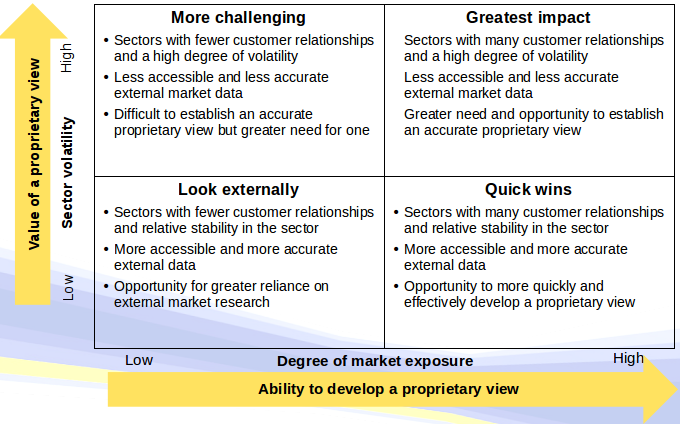
* One way to determine applicability is to use a matrix (see Exhibit 2), plotting need for market intelligence on one dimension and ability to accurately develop a view of the market on the second dimension; the recommendation would then be for the client to first focus on sectors where there is the greatest need and ability to improve market intelligence, in order to get the biggest wins first.
e. Roles & responsibilities (Who):
* The candidate may consider who in the organization would be best suited to improve market intelligence gathering.
* The organization has a centralized strategic planning team that could be responsible for gathering and tracking publicly available data; ultimately the sales and account teams will need to be trained to listen and engage their customers in discussions about market direction.
* There is no right answer about who should own this process.
f. Next steps (When):
* The candidate should attempt to think through immediate next steps. There is no right answer here but the candidate should understand that this is a capability that will take time to develop and will not transform over night.
* Some next steps might include:
– Getting buy-in for this idea across the organization.
– Performing analysis to understand in what sectors to prioritize efforts.
– Consider running a market intelligence “pilot” in a few sectors.
– Evaluate the systems in which they currently capture customer data and ensure they will allow for more mature data gathering.
– Begin to more comprehensively track publicly available data.
As the discussion progresses, the interviewer should give the following two exhibits to the candidate:
Exhibit 1: Annual revenue forecast errors
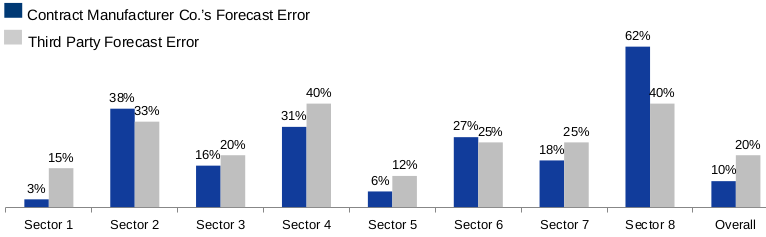
Note: Contract Manufacturer Co. is forecasting each sector’s revenue for the next year; the third party source is forecasting the size of the overall market (sector) next year.
* Exhibit 1: the first insight here is that third party forecasters are just as inaccurate and indeed in most cases, more inaccurate than Contract Manufacturer Co. at forecasting the market. The taller the bar, the greater the forecast error and therefore the less accurate the forecast. The second insight is that the accuracy differs across sectors, so the candidate should begin to think about the applicability of this work to specific sectors.
Exhibit 2: Level of effort required Differs across sectors
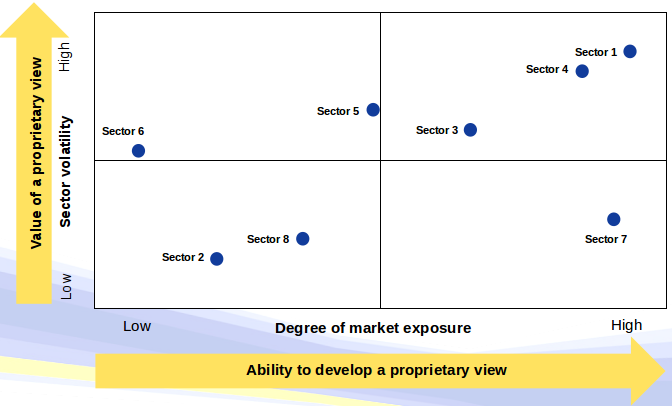
* Exhibit 2: this is one way to prioritize the sectors (the candidate may have recommended an alternative approach). The insight is that the client should focus their efforts on the top right quadrant (see Exhibit 2, for interviewer only)
Exhibit 2: Level of effort required Differs across sectors (For Interviewer Only)
4. Performance Evaluation
Expected:
* Understands the client situation and question at hand
* Develops a framework that addresses an overview of the issues at play.
Good:
* Completes all “Expected” requirements
* Asks some of the clarifying questions to narrow the focus of their framework (or after developing the framework, as part of the discussion)
* Leads a good discussion around the issues
* Reaches a conclusion with minimal prompting.
Excellent:
* Completes all “Good” requirements
* Raises most issues listed and suggests some other, creative areas not mentioned in the case
* Provides a high level overview of next steps the client should take to implement some of the suggestions and risk mitigation.