Dairy Queen to Drop Underperforming Products
Case Type: operations strategy, product portfolio optimization.
Consulting Firm: Alvarez & Marsal first round full time job interview.
Industry Coverage: agriculture, farming, aquaculture.
Case Interview Question #01133: Uour client Dairy Queen, Inc. (DQI) is a leading producer of dairy, ham and sausages in the United States. The company’s corporate offices are located in the Minneapolis suburb of Edina, Minnesota. Currently, it produces more than 1,000 different products. DQI and two other  competitors dominate this market.
The client DQI wants to increase its profits. It has hired your consulting firm to help on this matter. How would you approach the problem?
Possible Answers:
1. Suggested Framework
The main idea in this case is to bring the graph into discussion and analyze it. Do not share this information with the candidate. The case should be a fast paced conversation and he/she must structure the case like any profitability case:
* Profits = Revenues – Costs
* Revenue Streams
* Respective COGS
* SG&A
Considering market trends, the economic environment and competitors’ moves are not wrong, but the candidate must include the above-mentioned topics. It is a profitability case. If asked, tell the candidate that the client DQI is not interested in acquiring a competitor or expanding overseas.
2. Detailed Analysis
Interviewer: Another team in your firm is already working on costs and expenses. Your team is focusing on DQI product portfolio. Your role is to analyze which, if any, products DQI should stop producing/selling. How would you do that?
Possible Answer:
The candidate must consider that DQI has a portfolio of 1,000+ products.
That being said, the candidate should understand that, in the real world, it would be spreadsheet with 1,000+ lines, and columns describing the product and one of the following options:
* Revenue and COGS
* Price, Cost/unit and Volume
* Margin and Volume
* Margin and Revenue
The last one is easier to work in this case, but we will use margin vs. volume, and considering that there is no relevant difference in prices among the products. Therefore, a scatter plot is the best option. Once the candidate asks for it, show him/her the graph below.
Exhibit 1: Profit Margin vs. Sales Volume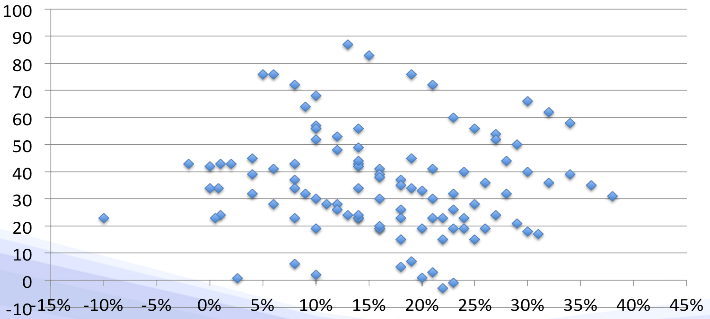
If the candidate asks, provide the following additional information:
* SG&A is not affected by the potential changes
* Average Sales Volume (y-axis) is 35K tons
* Average Profit Margin (x-axis) is 16%
The candidate must do his/her own graphs: Pareto (80/20) or dividing the prior graph into four squares, using the averages as axis. If the candidate does not realize it, show him/her the next two graphs.
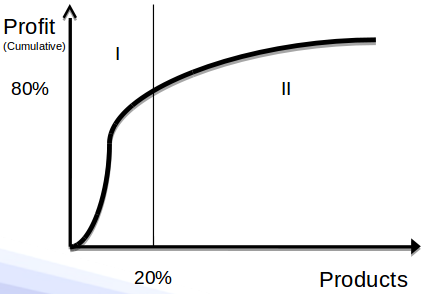
In the first graph, the idea is “all the products in the category I is important for the company. The problematic products will be in the category II”. There are ~200 products in category II.
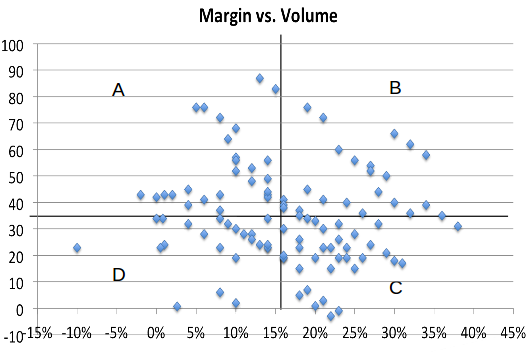
In the second graph, consider that there are at least 200 products in each zone. The idea is: “the products in the zone D should be considered our targets to be no longer in DQI portfolio”.
Finally the candidate should arrive at a conclusion along the lines of: “Based on our analysis, there are at least 200 products that are not bringing relevant contribution to DQI profit. The client DQI should consider selling these products to minor competitors or simply stop its production, if selling these products to competitors represents a major risk.”
3. Performance Evaluation
Expected:
* Structures a sound profitability framework
* Figures out the graph analysis is the best method
* Suggests the scatter plot or the 80/20 chart.
Good:
* Complete all “Expected” requirements
* Suggests both analyses methods
* Quickly asks for information to understand the goals of the company (desired/undesired margins).
Excellent:
* Complete all “Good” requirements
* Suggests more than one alternative to deal with the problematic products (stopping, selling, empowering, analyzing potential growth, etc.)
* Analyzes risks of suggested solutions (e.g., selling to major or minor competitors may jeopardize DQI businesses)
* Could solve the case without much help from the interviewer.