Clothing Retailer to Divest Brand and Focus on Core Business
Case Type: operations strategy; organizational behavior.
Consulting Firm: Deloitte Consulting first round full time job interview.
Industry Coverage: apparel, clothing, textiles.
Case Interview Question #01129: Deloitte has been asked to help the client, Coffee Inc., evaluate the hold or sell decision. Coffee Inc. is a large multinational woman’s clothing retailer with worldwide revenues of over $3 Billion in calendar year (CY) 2011. They sell sports, formal and casual apparel. The company  as a whole has been performing strongly and has emerged out of the financial crisis with strong sales growth and many investment opportunities. Despite the company’s strong performance overall, its American operation has an under-performing brand that they have put up for review and have also closed some of the brand’s associated stores.
The American operation has two major umbrella brands: a formal wear brand bearing the same name as the company, “Coffee”, and a casual wear brand named “Tea”. The brands are sold through the following channels:
* Coffee branded retail stores: $200M in annual revenues
* Tea branded retail stores: $20M in annual revenues
* Coffee branded outlet stores: $150M in annual revenues
* Wholesale sales to major retail chains (e.g., Macy’s): $600M in annual revenues
The Tea brand has historically been neglected because management has focused its resources on the core business — the Coffee brand. Nonetheless, the Tea brand has consistently put up a profit with minimal management attention and capital re-investment. Essentially, the management of Coffee Inc. wishes to understand whether they are better served by divesting the Tea brand and refocusing their attention on their core Coffee brand business or holding the Tea business and simply “milking the cash cow”.
Deloitte Consulting has been approached by the management of Coffee Inc. to assess whether Coffee should hold or sell the Tea brand. Specifically, there are 5 questions for you to address:
1. Using the “terms of the sale” from the data sheet, find the associated revenues for 2012 that the buyer would receive from buying Tea and compare that to the associated revenue that Coffee could maintain by not selling Tea.
2. How would you value the sale scenario and hold scenario? Present your findings.
3. If Coffee Inc. decides to hold the Tea brand, how long will it take for the cash flow from Tea to equal the amount of money that Coffee would have received through selling Tea? Note: Please use $50M as the sales price.
4. Based on your analysis, what would you recommend to Coffee?
5. Are there any other relevant issues that may affect the valuation or the divestment decision?
Additional Information: (to provide as data sheet)
* Management has decided that the terms of the sale will be as follows:
‒ Sale of Tea brand will include only Tea’s branded product sales in Tea’s retail channel and Tea’s wholesale business.
‒ Buyer will not have access to Coffee’s Outlet stores or Coffee branded retail stores for distribution.
Exhibit #1. Brand vs. Channel Sales in CY2011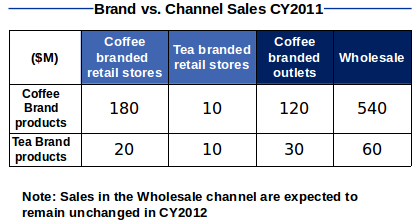
Exhibit #2. Number of Retail Stores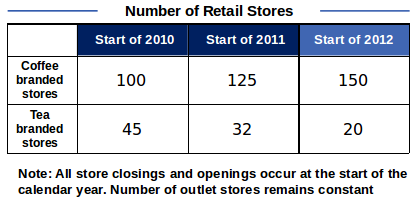
Exhibit #3. Revenue Multiples: Consumer Product Transactions in the U.S.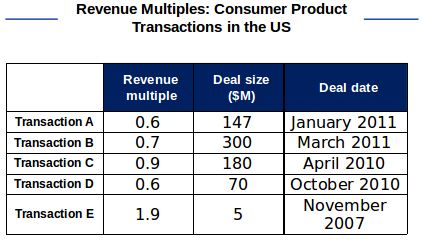
Exhibit #4. Tea Brand Business Historical Performance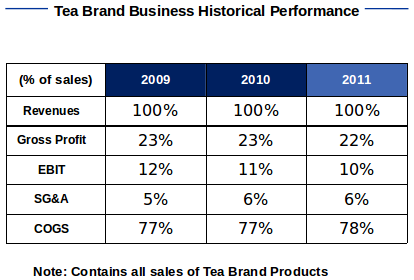
Possible Answers:
1. Isolate Revenues for Sell & Hold Scenarios
Question #1a. Using the terms of the sale from the data sheet, find the associated revenues for 2012 that the buyer would receive from buying Tea? (Note to interviewer: Please provide candidate with data sheet)
General Approach: (Interviewer can mention that the terms of the sale are available on the data sheet given their importance)
Candidate should do the following:
* Isolate the revenues of the part of the business being put up for sale
* Scale the Tea retail revenues by the proportion of stores that will remain open at the beginning of 2012 (20/32 = 0.625)
A good answer will isolate the likely revenues based on the terms of business for sale and scale the retail stores by the amount of stores open at the beginning of 2012:
| ($M) | Coffee branded retail stores | Tea branded retail stores | Coffee branded outlets | Wholesale | Total Revenues |
| Tea Revenues | - | $10M * 0.625 = $6.25M | - | $60M | $66.25M |
Question #1b. Using the terms of the sale from the data sheet, find the associated 2012 revenue that Coffee could maintain by not selling Tea.
General Approach:
Candidate should do the following:
* Isolate the revenues of Tea sales through all channels
* Scale the retail revenues by the proportion of stores open at beginning of the year: number of Tea retail stores goes down (20/32 = 0.625); number of Coffee retail stores goes up (150/125 = 1.2)
| ($M) | Coffee branded retail stores | Tea branded retail stores | Coffee branded outlets | Wholesale | Total Revenues |
| Tea Revenues | $20M * 1.2 = $24M | $10M * 0.625 = $6.25M | $30M | $60M | $120.25M |
2. Value Hold & Sale Scenario
Question #2. How would you value the sale scenario and hold scenario? Please use available data to support your argument (Note to interviewer: Please provide candidate with data sheet)
General Approach:
Candidate should do the following:
a. Take revenues calculated from previous question
b. Refine revenue multiple to adjust for outliers and dated information (e.g. Transaction E in year 2007)
c. Apply revenue multiples to value the two scenarios
a. Revenue Calculation
* Tea Sale Scenario: total revenue = $66.25
* Tea Hold Scenario: total revenue = $120.25
b. Revenue Multiples Calculation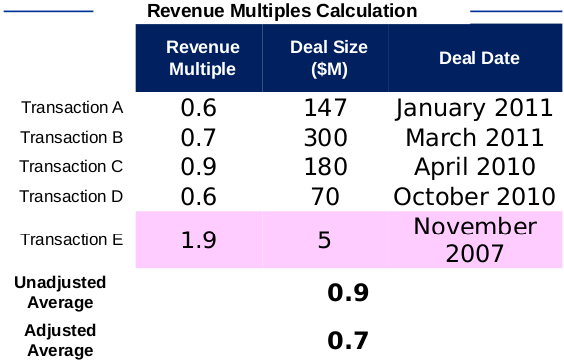
c. Valuation:
Good Answer:
* Sale Scenario — Take $66.25M and capitalize by revenue multiple of 0.9 to value the company for sale at ~$60M
* Hold Scenario — Take $120.25M and capitalize by revenue multiple of 0.9 to value the company for sale at ~$108M
Better Answer: Candidate suggests Transaction E be removed because it is dated and reflects inflated, pre-crash asset prices
* Sale Scenario — Take $66.25M and capitalize by revenue multiple of 0.7 to value the company for sale at ~$46M
* Hold Scenario — Take $120.25M and capitalize by revenue multiple of 0.7 to value the company for sale at ~$84M
Great Answer: will include the above, but the candidate would also mention the following points and how each may affect the valuation:
Sale Scenario:
* The ability to capture some of the existing demand for the Tea brand currently satisfied through Coffee branded retail stores and coffee branded outlets (i.e., a portion of each of the $20M and the $30M).
– Buyer may have existing channels that can satisfy the dormant demand; or buyer can build channels from scratch.
* Buyer is also purchasing the remaining store leases as part of its purchase price, so ability to fill up space in Tea stores currently filled by Coffee branded products may also attract a slight premium.
* Coffee’s ability to replace the lost revenue streams associated with the sale will improve the attractiveness of the sell scenario but should be wary of the buyer seeking a discount for having to replace the lost revenue streams.
Hold Scenario:
* Candidate should compare Coffee’s return on investment to Tea’s to determine if there is any merit in investing money into Tea to turn it around.
Question #3. If Coffee decides to hold the Tea brand, how long will it take for the cash flow from Tea to equal the amount of money that Coffee would have received through selling Tea? Note: Please use $50M as the sales price in the calculation, ignore time value of money
Good Answer:
* Using $120.25M of revenue from question #1b, candidate will need to use the 10% EBIT margin.
* 10% * 120.25M = $12M per year
* Breakeven would occur $50M/$12M or slightly past 4 years
Better Answer:
* Candidate should realize that EBIT is not the true cash flow and should take taxes out
* Assuming 40% tax rate, net earnings % would be 6%
* 6% * $120.25M = $7.2M per year
* Breakeven would occur $50M/$7.2M or about 7 years
3. Recommendation & Other Issues
Question #4. Based on your analysis, what would you recommend Coffee do?
The candidate should compare the value of the sale scenario (~$46M) to the hold scenario (~84M). Based on the analysis, the conclusion should be to hold onto the Tea brand. The candidate should at minimum recommend that Coffee pursue the scenario with the higher valuation.
A good answer will draw the following conclusions from the data provided:
a. If candidate chooses to hold Tea, the candidate should mention:
* Its value to Coffee exceeds the sell case
* There may be an opportunity to improve the performance of Tea that may require extra investment:
* Open more Tea retail stores
* Enterprise cost reduction program
* Take brand international
* Take brand to a broader range of potential wholesale clients (e.g. independent retailers)
* Holding Tea could allow the retail business to continue to leak value. The combined effects of store closures and steady decline in EBIT margin (12% in 2009 to 10% in 2011) has resulted in a significant reduction in Tea’s retail profits. The bulk of Tea’s value increasingly lies with the wholesale business.
* Mention the declining trend in the Tea retail outlets and have Coffee assess whether that is potentially harmful to the overall business.
b. If candidate chooses to sell Tea, the candidate should mention:
* Some revenue streams from Tea branded goods are likely to be readily replaced by Coffee’s operations
* Allows Coffee to gain as much as possible for the Tea retail business before it loses more value
* Mention the fact that as long as the trend continues to close the Tea stores, the valuation for Tea may go down.
Question #5. Are there any other relevant issues that may affect the valuation or divestment decision?
A good answer will be logically structured to address various business considerations including:
* Overall business strategy for woman’s apparel: Does Tea’s brand, product mix, and styling fit within the overall strategy of Coffee’s vision? This is potentially an overriding factor in the decision to buy or hold the business.
* Ability to Change: In a hold scenario, does Coffee have the appetite to fully implement the changes required to halt the slide of Tea?
* Impact to Remaining Revenue Streams: Candidate should explore the impact that a divested business unit will have on the portions of the business that remain.
* Potential Buyers: Who are the prospective buyers for the business, and what are the potential issues with making a deal with each one? E.g., Private Equity: Potential carve out experience, but unlikely to overpay for asset. If they do not have other similar businesses in their portfolio, will need to set up their own back office functions. Strategic buyer: May take brand up or down market; an existing retail buyer may want to close the rest of the Tea retail stores; lack of back office will make it difficult for some buyers to do a “bolt-on” business.
* Transaction Costs:Banker costs and potential loss of management focus on the core business during deal will make sale scenario less attractive.
* Stranded Costs: there may be services across the two brands that are shared and may be stranded upon sale.
4. Wrap Up
Divestitures are often an effective tool for a business to sharpen its focus on its core activities and free up proceeds to invest in areas of high growth. The client needed to understand whether the decision to sell a brand was a good idea, which required a thorough understanding of what a sell scenario or hold scenario would look like financially.
In this situation, Deloitte was brought in to help the client to evaluate the hold or sell decision.
The Deloitte team assisted the client by:
* Carving out the brand and determining the value of the brand to the company in both the hold and sell scenarios.
* Conducting commercial diligence to maximize the value of the sale for the client
* Working with Deloitte’s Financial Advisory Services Practice to conduct sell side transaction advisory and execution services.
* Implementation planning to minimize any stranded costs left with sell-side post -transaction
Deloitte is viewed as a trusted M&A strategy advisor to the client and has conducted numerous projects to execute the transaction.