Heartworm Drug Maker to Change Sales Contracts with Vets
Case Type: increase sales; operations strategy.
Consulting Firm: ClearView Healthcare Partners final round full time job interview.
Industry Coverage: healthcare: pharmaceutical, biotech, life sciences.
Case Interview Question #01091: Our client is Petvascent, a pharmaceutical company that makes drugs for pets such as dogs and cats. One of the client’s leading products is Clean Heart, a drug that is given to dogs with heart worms. Dog heartworm is a parasitic roundworm that is spread from host to host through the bites of  mosquitoes. The parasite is commonly called “heartworm”; however, adults often reside in the pulmonary arterial system (lung arteries), as well as the heart, and a major effect on the health for the animal is a manifestation of damage to the lung vessels and tissues.
The year is 2012. Our client Petvascent’s leading drug Clean Heart has recently suffered declining sales. The CEO of Petvascent has hired our consulting firm to determine what the problem is and how to restore sales growth. How would you go about it? What recommendations would you give to the CEO of Petvascent?
Additional Information: (to be provided upon request)
* Once prescribed, Clean Heart is taken weekly for one year.
* The client Petvascent has a patent on Clean Heart that will expire in year 2020 (current year is 2012).
* There are other medications on the market for dog heart worms, but none is as effective as Clean Heart.
* There have been no changes in the proportion of dogs diagnosed with heart worms.
* Petvascent has an exclusive distribution agreement with PetCo, a national chain of pet stores, and also sells to vets so they can provide an initial dose to patients, who are then 95% more likely to purchase Clean Heart in pet stores.
* However, PetCo has recently complained that Clean Heart is available at other pet stores at a lower price, a clear violation of the exclusive distribution agreement.
* The Interviewer should begin by showing Exhibit #1, and ask the candidate to analyze the chart.
Possible Answers:
1. Case Overview
The candidate will ultimately discover that some vets are making large purchases of Clean Heart at wholesale prices and selling them to other pet stores. While this is a grey area in the law, it is ultimately not illegal and the candidate must determine a creative way to restrict this practice. In addition, the candidate must consider the implications of their method for preventing the redistribution of the drug.
2. Suggested Order for Case
* Read prompt & answer clarifying questions
– Candidate should lay out framework
* Guide candidate to investigating competitors
– Hand out Exhibit #1
– Ask Question 1
* Steer candidate to what could possibly cause a decline in revenue
– Price decrease vs. unit sales decrease
* Give Exhibit #2 to discuss unit sales
– Ask Question 2
– Candidate should calculate profit and % change in profits
* Why would vet purchases increase so much?
– If necessary, remind the candidate of lower priced Clean Heart available in stores outside of exclusive agreement with PetCo.
* Knowing that vets are re-selling to other pet stores, what steps should Petvascent take?
– Re-selling is not illegal if box is not clearly labeled
– Besides changing label, the client could: (1) Limit purchases by vets; (2) Change purchase agreements
* What are the risks of those steps?
* Recommendation
3. Suggested Framework
(1) Vets
* Prescription rate
– Alternative treatments
* Relations with Petvascent
(2) Pet Owners
* Trends in pet ownership
– Frequency at vet: # diagnosed, # undiagnosed
– Fewer dogs
* Affordability
– Seeking cheaper drugs
– No treatment
(3) Pet Drug Companies
* Marketing
– Quantity
– Type
* New entrants
– Pricing
– Differentiators
(4) PetCo
* Pricing
– Increase in real price
* In store
– Change in displays
* Retail competitors
– Online
– Other pet stores
(5) Petvascent
* Unit sales
– Patent?
* Wholesale pricing
* Marketing
4. Detailed Analysis
Question #1: (Give the candidate Exhibit #1) What does this chart indicate about Petvascent’s position in the market?
Exhibit #1: Revenues from heart worm drugs by Competitor ($ millions)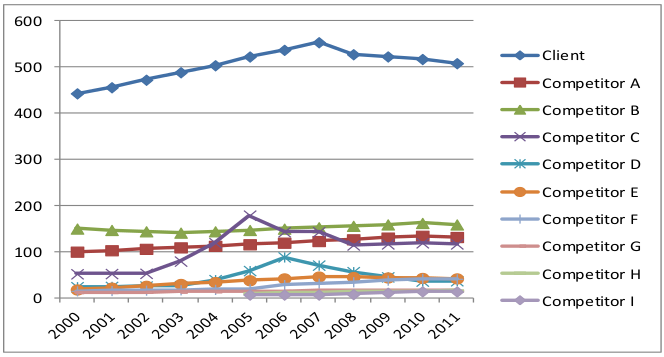
| Growth Rate | 2000 | 2001 | 2002 | 2003 | 2004 | 2005 | 2006 | 2007 | 2008 | 2009 | 2010 | 2011 |
| Market | n/a | 2.40% | 2.74% | 5.72% | 8.81% | 12.20% | 2.70% | 1.23% | -4.36% | -0.09% | 0.10% | -1.66% |
| Client | n/a | 2.97% | 3.57% | 3.43% | 3.11% | 3.76% | 2.76% | 3.07% | -4.69% | -0.91% | -1.06% | -1.76% |
Possible Solution:
* Our client Petvascent is the clear market leader.
* From 2008-2011, Petvascent’s revenue declines faster than the market and is dragging the market size down.
* Two new entrants (Competitor H and I) appeared in 2005, neither appears to have grown significantly.
* Bonus: Other players in the market appear to be fairly stable, indicating that no one is stealing share from Petvascent.
The candidate should now investigate other reasons that sales may have declined.
Potential Areas for Analysis
(1) Vets
* Have slightly increased recommendations of Petvascent.
* Most vets continue to order the same amount, a few have vastly increased their orders.
* View Petvascent positively
(2) Pet Owners
* Continue to own dogs at similar rates.
* Continue to take pets to vets at same rates.
* Continue to follow instructions from vets with same variety.
* Continue to spend money on pet medication.
* Trust in Clean Heart as best medication.
(3) Pet Drug Companies
* There have been new entrants.
* However, no new drugs have made significant improvements and remain low-level players.
* No changes in marketing quantity or type.
* No changes in price
(4) PetCo
* Observed declining unit sales.
* Orders replacements to replace sales.
* Has continued to price at $20/unit.
* Angered by presence of Clean Heart in other stores.
* Other stores charging $17/unit.
* Maintains online store presence that is comparable with industry leaders.
* Same marketing and display.
(5) Petvascent
* No changes to marketing, in quality or type.
* No changes to wholesale pricing.
* Unit sales have actually increased (show Exhibit #2)
* Charges $17/unit to PetCo.
* Charges $10/unit to vets.
* Continues to only distribute Clean Heart through PetCo and Vets.
* No change to packaging.
Exhibit #2: Petvascent’s Unit Sales of Clean Heart by Distribution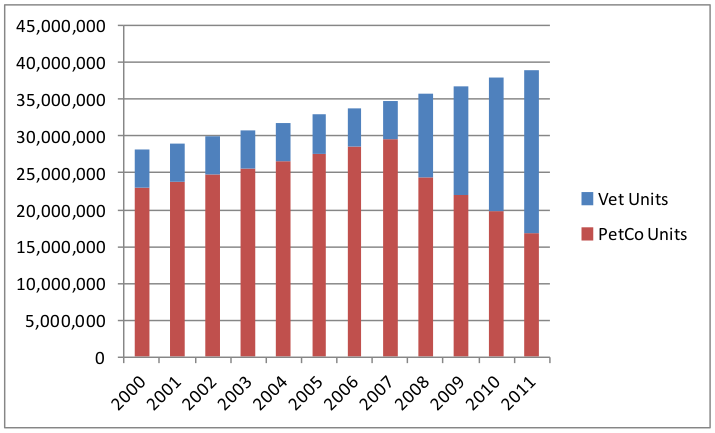
Question #2: Estimate 2009 & 2010 profits. What is the % change in profit level?
Vet Price: $10
PetCo Price: $17
Raw materials: $5/unit
Packaging: $0.5/unit
Transportation: $1/unit
Marketing Cost: $100M (2009) and $110M (2010)
SG&A: $50M (2009) and $55M (2010)
Possible Solution:
* The candidate must estimate units and revenue in each year from Exhibit #2; allow any reasonable estimate.
* The candidate should sum the variable costs to find a single figure.
* If the candidate asks, allow reasonable rounding.
* Subtract points if the candidate fails to find the % change in profit level without prompting.
| Year | 2009 | 2010 |
| Revenues | ||
| Vet Units | 15M | 18M |
| Vet Price | $10.00 | $10.00 |
| PetCo Units | 22M | 20M |
| PetCo Price | $17.00 | $17.00 |
| Total Revenues | $524M | $520M |
| Costs | ||
| Total Units | 37M | 38M |
| Variable Costs | $6.50 | $6.50 |
| Total VC | $240.5M | $247M |
| Marketing | $100M | $110M |
| SG&A | $50M | $55M |
| Total Costs | $390.5M | $412M |
| Profit | ||
| Total Revenues | $524M | $520M |
| Total Costs | $390.5M | $412M |
| Profit | $133.5M | $108M |
| % Change | -19% |
5. Conclusion
a. Sample Recommendation
* Revenues have declined because vets are reselling Clean Heart to competing retailers at a lower price, which undercuts sales at PetCo.
* To combat this, the client Petvascent can
(1) add “Not for Resale” label to packaging;
(2) change sales contracts with vets;
(3) limit purchases by vets.
b. Potential Risks
* New sales contracts may alienate vets who are good customers.
* Customers may have grown used to lower priced Clean Heart.
c. Next Steps
* Re-evaluate price elasticity of demand
* Discuss sales contracts with vets.