Chocolate Bar Startup to Source Cocoa Beans from Madagascar
Case Type: new business; operations strategy.
Consulting Firm: Bridgespan Group final round full time job interview.
Industry Coverage: food & beverages; startups; non-profit organization.
Case Interview Question #01086: Madagascar, officially the Republic of Madagascar, is an island country in the Indian Ocean, off the coast of Southeast Africa. The nation comprises the island of Madagascar (the fourth-largest island in the world), and numerous smaller peripheral islands. In 2012, the population of Madagascar was  estimated at just over 22 million. As of 2014, the economy of Madagascar had been weakened by the then recently concluded political crisis, and quality of life remains low for the majority of the Malagasy population.
Two entrepreneurs have just launched a non-profit chocolate bar manufacturing company called Madecasse Inc. The goal of Madecasse is to improve conditions for people in Madagascar by selling chocolate bars to consumers in the United States. Our consulting firm is working with Madecasse on a pro bono basis to determine: (1) where to source raw materials cocoa beans (Venezuela, Madagascar, Columbia) (2) how to market the chocolate bars in the United States.
Possible Answers:
1. Case Overview
This case examines a relatively straight-forward business question from a non-profit prospective. A strong candidate will recognize that maximizing profit for Madecasse is not the best result and will instead focus on maximizing impact for people in Madagascar.
2. Additional Information: (to be provided upon request)
* If asked to clarify the goal of Madecasse, the interviewer should emphasize that the mission of Madecasse is to improve the economic welfare of people in Madagascar.
* Assume that Madeccase will be able to sell as many chocolate bars as it makes.
* Manufacturing will take place in the same location as the cocoa.
3. Suggested Framework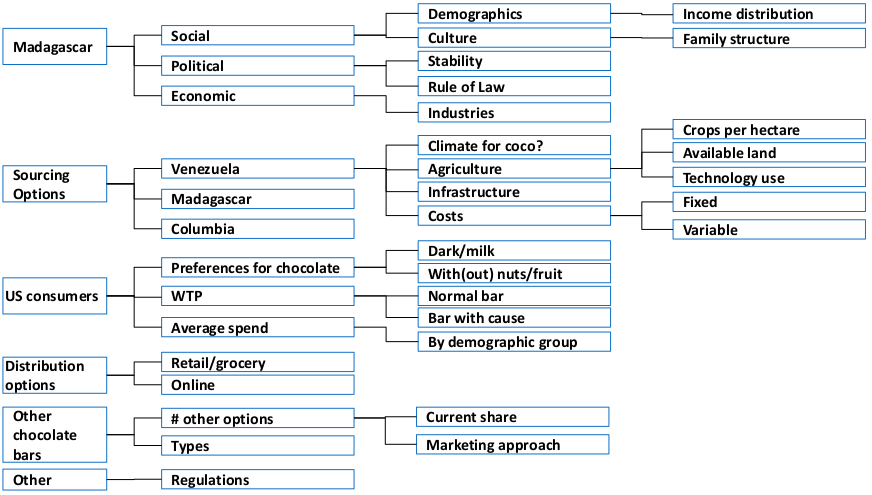
a. Madagascar
* Social
– Demographics: Income distribution
– Culture: Family structure
* Political
– Stability
– Rule of Law
* Economic
– Industries
b. Sourcing Options
* Venezuela, Madagascar, Columbia
* Climate for cocoa?
* Agriculture
– Crops per hectare
– Available land
– Technology use
* Infrastructure
* Costs
– Fixed Cost
– Variable Cost
c. US consumers
* Preferences for chocolate
– Dark/milk
– With(out) nuts/fruit
* Willingness to pay (WTP)
– Normal chocolate bar
– Bar with cause
* Average spend
– By demographic group
d. Distribution options
* Retail/grocery
* Online
e. Other chocolate bars
* # other options
– Current share
– Marketing approach
* Types
f. Other
* Regulations
4. Analysis
a. Madagascar
* Population of 22M
* Literacy: 70%
* GDP/capita: $900
* GDP is 30% agriculture
* Population below poverty line: 50%
* Fairly stable government now, recent history of instability.
b. Sourcing Options
* Labor costs are highest in Venezuela and lowest in Madagascar
* Venezuela employs more technology and thus can harvest more rapidly
* Fields yield more crops per hectare in Venezuela and least in Madagascar
* Colombia has most available land, Madagascar the least.
c. US Consumers
* Growing taste for dark chocolate
* Typically buy chocolate bars as impulse buys at and grocery store or convenience stores
* Generally willing to pay $2/bar
* Top 25% of income earners willing to pay more for high-end chocolate bars
* Growing tendency to pay more for items associated with a cause
d. Other chocolate bars/Distribution
* 3 primary brands with multiple products.
* Typically have ingredients outside of chocolate (e.g. nuts, caramel)
* Sold through grocery stores, convenience stores, and gas stations.
Question #1: Where should Madecasse source its cocoa beans? They are considering three options: (1) Madagascar (2) Colombia (3) Venezuela.
Questions:
A. What subjects would you consider in comparing these 3 sources?
B. (Show Exhibit 1) Which market should they source from?
Exhibit 1: Comparison of three sources
| Country | Madagascar | Colombia | Venezuela |
| Pounds/hectare | 3,000 | 5,000 | 6,000 |
| Available hectares | 12,500 | 20,000 | 17,000 |
| Manhours to harvest a pound of beans | 6 | 5 | 3 |
| $/man hour | $1.50 | $1.75 | $2.25 |
| Bars/pound of beans | 2 | 2 | 2 |
| Price per bar | $5.00 | $5.00 | $5.00 |
Possible Solution:
* The candidate should quickly brainstorm a way to compare the markets or can build on work from the initial framework. Potential subjects include: Costs (labor, transportation, equipment, etc.), quality, harvest size, export issues, tariffs, local government issues, environmental concerns.
* See “Exhibit 2 Calculations” below for math explanations.
Exhibit 2: Calculations
| Country | Madagascar | Colombia | Venezuela |
| Pounds/hectare | 3,000 | 5,000 | 6,000 |
| Available hectares | 12,500 | 20,000 | 17,000 |
| Total Harvest (pounds) | 37.5M | 100M | 102M |
| Manhours to harvest a pound of beans | 6 | 5 | 3 |
| Total Time to Harvest (hours) | 225M | 500M | 306M |
| $/man hour | $1.50 | $1.75 | $2.25 |
| Total Labor Costs | $337.5M | $875M | $688.5M |
| Cost/Pound | $9.00 | $8.75 | $6.75 |
| Cost/bar | $4.50 | $4.38 | $3.38 |
| Bars/pound | 2 | 2 | 2 |
| # of Bars | 75M | 200M | 204M |
| Price per bar | $5.00 | $5.00 | $5.00 |
| Revenue | $375M | $1,000M | $1,020M |
| COGS | $337.5M | $875M | $688.5M |
| Profit | $37.5M | $125M | $331.5M |
| Spending in Madagascar | $337.5M | - | - |
| Impact to Madagascar | $375M | $125M | $331.5M |
* The candidate should find that greater profit is available by producing in Colombia or Venezuela.
* However, the overall impact on Madagascar that Madacasse can make is greater by producing in Madagascar because all of the labor costs are actually contributing to local well-being. Therefore, the company can have the greatest impact by sourcing cocoa beans from Madagascar.
Question #2: What considerations should Madacasse take into account when selling chocolate bars to American consumers?
The goal of this section is to have a discussion with the candidate. The candidate should brainstorm ideas and can use initial framework. Guide the conversation to cover (1) the target demographic (2) probable distribution channels (3) how to position the chocolate bar vs. competitors.
Possible Solution:
* Target demographic: should include wealthier individuals who tend towards purchasing higher-end foods.
* Distribution channels: higher-end grocery stores and convenience stores in wealthy neighborhoods. Could include partnerships with wine stores, coffee shops, etc.
* Positioning: Various solutions are possible, but should include (1) proceeds to charity and (2) emphasize quality
5. Conclusion
a. Sample Recommendation
The client Madacasse should source its cocoa beans from Madagascar, which will result in an impact of $375 million. The chocolate bars should target wealthy American consumers and be sold through high-end stores and partnerships with coffee shops.
b. Risks
* Even wealthy consumers in U.S. may not be willing to pay $5/bar, especially after a recent economic recession.
* A resurgence in instability in Madagascar would disrupt operations.
c. Next Steps
* Interview American consumers about willingness to pay (WTP) for chocolate bars.
* Find reliable suppliers in Madagascar.