How to Solve Traffic Jam Problem in an Austrian Town?
Case Type: operations strategy, optimization.
Consulting Firm: Simon-Kucher & Partners (SKP) first round full time job interview.
Industry Coverage: government, public sector; transportation.
Case Interview Question #01079: Mistelbach is a small town with a population of 10,000 people in rural Austria. A river divides the town. There is only one bridge with two lanes over this river and this is the only crossing point for several hundreds of kilometers. A factory stands on one side of the river and the entire population of the 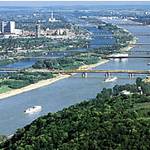 town lives on the other side of the river.
The mayor of the Mistelbach village approaches you and tells you that the bridge presents a bottleneck to the village during rush hour when people are going to work (i.e. there are severe traffic jams). He wants you to solve the problem without spending a lot of money. How would you go about it?
Possible Answer:
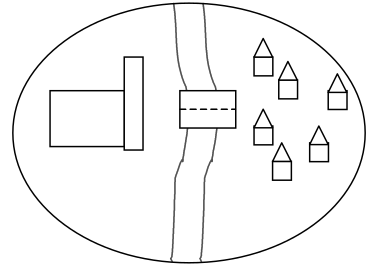
Candidate: (The first thing I did was to draw a picture of the village, as shown below.) I just want to make sure I understand this case correctly, all villagers live on the right-hand side of the river, only the factory stands on the left-hand side of the river and only the villagers from the right-hand side work in this factory?
Interviewer: Correct.
Candidate: Is it possible to build another bridge?
Interviewer: No. We want to keep this as cheap as possible.
Candidate: Well, let’s start out by identifying when these traffic jams occur. What time do the villagers go to work?
Interviewer: There are two shifts; the first begins at 8am and the second starts at 9am. Each worker works 8 hours. Then they go home.
Candidate: Okay. That implies that the traffic jams occur roughly between 7-9am, and 4-6pm. Do all men and women work at the factory?
Interviewer: No. Only the men.
Candidate: Assuming 20% of the population is children, we are left with 8,000 adults. Assuming that the gender split in a typical Austrian village is 45% men – 55% women, we are left with 3,600 men that commute over the bridge. Does anyone besides the men have a reason to cross the bridge?
Interviewer: No.
Candidate: This means that, given a constant travel rate amongst all the men, roughly 1,800 men pass over the bridge in one hour (3,600 men / 2 hours). This translates into 30 men per minute (1,800 men / 60 minutes) and if each drives one car, 30 cars per minute.
Interviewer: Okay. So now that you know when and why the traffic jams occur, what suggestions do you have to solve this dilemma? And please be as creative as possible.
Candidate: (I could tell that I was on the right track. The interviewer was mainly looking for how creative I could be.) Well, given that most men travel over and back at approximately the same time, the mayor could give incentives to those men that car-pooled. The town could build car-pooling meeting points. This would eliminate a lot of traffic on the bridge. For example, if 3 men car-pooled every day, only 600 cars as opposed to 1,800 would pass over the bridge per hour (10 cars versus 30 per minute).
Interviewer: Good.
Candidate: A second suggestion would be to open both lanes to traffic. Between 7-9am, all traffic traveling west to the factory would be allowed to use both lanes. The opposite would apply to the afternoon rush hour period from 4-6pm.
Interviewer: Good.
Candidate: A third suggestion would be to subsidize those commuters that walked, used motor scooters or bicycles to get to work.
Interviewer: Good.
Candidate: (I could tell that the interviewer still wasn’t all too impressed. I sat there and thought for a moment about my personal life and what experiences I had witnessed. Then it hit me.) My final suggestion resembles something I saw in Santiago de Chile when I lived there. The city had a serious problem with smog and as a result restricted the use of motor vehicles on certain days. But instead of restricting everyone’s use, the city gave motorists different colored license plates that could only be used on a specific day of the week. So for example, if your car had a red license plate, you could only drive the vehicle on Mondays, Wednesday and Fridays. If you had a green license plate, you could only drive on Tuesdays, Thursday and Saturdays.
Interviewer: Excellent! I have never heard that answer before. Good job!
Candidate: (After the last comment, I left the interview with a good feeling. I was lucky that I realized early on that the interviewer was more interested in the creative solutions I could come up with rather than just generic ones.)