US Cellular to Investigate High Customer Churn Rate
Case Type: operations strategy, marketing; organizational behavior.
Consulting Firm: ZS Associates 2nd round full time job interview.
Industry Coverage: telecommunications & network.
Case Interview Question #01033: Your client United States Cellular Corporation (NYSE: USM), doing business as U.S. Cellular, is a telecommunications company that owns and operates the fifth-largest wireless network in the United States. U.S. Cellular serves 4.9 million customers in 426 markets in 23 U.S. states as of the first quarter  of 2016. The company has its headquarters in Chicago, Illinois.
U.S. Cellular has a customer acquisition cost of $400 per customer, which is on a par with other U.S. wireless providers such as Verizon, AT&T, T-Mobile, and Sprint. Off late the client has started facing a customer churn ratio of 3% which is significantly higher than the industry average of 2%. Your consulting firm has been hired by U.S. Cellular to investigate the issue. Specifically, there are two main tasks for you:
(1) In real life how would you go about collecting data to investigate such problems?
(2) Find the reason for the increase in customer churn ratio.
Additional Information:
Churn ratio or churn rate (sometimes called attrition rate), in its broadest sense, is a measure of the number of individuals or items moving out of a collective group over a specific period of time. It is one of two primary factors that determine the steady-state level of customers a business will support.
The term is used in many contexts, but is most widely applied in business with respect to a contractual customer base. For instance, it is an important factor for any business with a subscriber-based service model, including mobile telephone networks and pay TV operators. Churn rate is an important input into customer lifetime value modeling, and can be part of a simulator used to measure ROI using marketing mix modeling.
Churn rate, when applied to a customer base, refers to the proportion of contractual customers or subscribers who leave a supplier during a given time period. It is a possible indicator of customer dissatisfaction, cheaper and/or better offers from the competition, more successful sales and/or marketing by the competition, or reasons having to do with the customer life cycle.
Possible Answer:
1. Case Overview
This is a totally qualitative case which does not require any number crunching or calculations.
Let the interviewee come up with as many possible causes for the problem as possible. The interviewer can use the “what else” approach. Focus on how the interviewee structures the problem and whether he/she covers the main points.
A solid interviewee will try to bring his/her own experiences into the case. Like: If he/she were to buy a cellular phone then what factors will affect the decision making process.
2. Suggested Structure
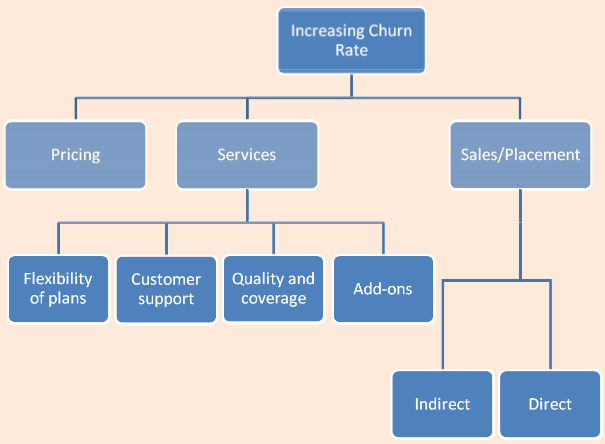
Increasing Churn Rate:
a. Pricing
b. Product/Services
– Flexibility of plans
– Customer support
– Quality and coverage
– Add-ons
c. Promotion/Sales/Placement
– Indirect
– Direct
3. Detailed Analysis
a. List of high level “pain areas”
Ask the interviewee to come up with potential sources of increase in customer churn ratio. Let him/her brain storm on the possible high level “pain areas”.
Possible questions to guide the interviewee:
â€- Have you ever shopped for a cellular phone? Where did you buy it from?
â€- What factors do you think affect the decision making process of a cellular phone customer?
Possible answers:
â€- The high level “pain areas” can either be Pricing or Product/Services or Promotion/Sales/Advertising
b. Explore each high level “pain area” in more details
Possible questions to guide the interviewee:
â€- How do you regard the competition in the wireless telecommunications industry in the United States? Is it fierce, mild or non-existent? (the interviewee should correctly guess that it is a fairly competitive industry even though there are only a limited number of players).
â€- Given that it is a fairly competitive industry, do you think Pricing can be a issue? (the interviewee should realize at this point that Pricing could not be a “pain area”)
â€- How would you further subâ€divide the Product/Services bucket? (possible subâ€divisions include flexibility of plans, customer support, voice quality and coverage area, addâ€ons like ringtones, picture messaging, etc. Once the interviewee starts hitting the wall, you can ask him/her to move on to the next “pain area”).
c. Explore “Sales” pain area in more details
Possible questions to guide the interviewee:
â€- What do you think are the major sales channels for wireless service providers? (possible answers include direct/company owned sales channels and indirect/third party sales channels)
â€- Which one do you think is more likely to have a problem? Why? (the interviewee should correctly identify the control problems in the indirect sales channel. He/she should question the incentive structure for this particular channel and ask questions about reward mechanism in place).
â€- What steps do you suggest to mitigate this problem? (possible solutions include: better incentive structure. Performance based reward system, better margins to sales people, etc.)
Conclusion: In this case, the problem is with the indirect sales channel (small shops which sell products and services from multiple providers). There are not enough incentives for the sellers to promote the product/services from our client. Hence, the indirect sales people tend to promote products from other providers to our customers leading to a higher churn ratio.
d. Data collection in real life
Possible questions to guide the interviewee:
â€- What are possible sources of data? (Customer surveys, research reports)
â€- Are customer surveys good enough? (they can be biased)
â€- How would you analyze the data and account for the bias? (use regression tools)