Coolarpess Adds More Shifts to Meet Surged Demand
Case Type: operations strategy; organizational behavior; supply chain optimization.
Consulting Firm: Roland Berger Strategy Consultants first round full time job interview.
Industry Coverage: food & beverages; tobacco & alcohol.
Case Interview Question #01032: our client Coolarpess Brewing Company is a North American brewing company located in the New England state of Maine, United States. Coolarpess is famous for over ten different brands of beer in North America. The beer company is headquartered and operates a brewery in Portland, Maine.
Recently, the demand for Coolarpess’ beers has unexpectedly propelled up when American actor Jason Segel featured in an episode of popular CBS sitcom “How I Met Your Mother” drinking a screw cap beer and helping Randy (Will Forte) to start a brewing company named Coolarpess. Beside company name identification, Coolarpess’ beers are sealed with screw caps, too. Coolarpess’ CEO wants your help to adapt to the increased demand. What recommendations would you give him?
Possible Answer:
The goal of the case is voluntarily unclear. The interviewer should first prompt the candidate to discuss case objectives. Explain to the candidate that due to the surged demand many customerâ€orders are being delayed, and that there is a problem with operations. In addition to quantitative components, this case refers to popular issues typical of operation cases: capacity constraint, bottleneck, scheduling. Solutions can come in many flavors: 8 “buckets” of solution are mentioned here.
1. Suggested Framework
* Supply chain optimization and operations strategies
* Demand versus capacity
* Analysis of bottlenecks
* Strategies to match supply with demand
2. Gathering Data
* How does the beer production process work?
* Has anything changed in the manufacturing process?
* What are the capacity constraints and bottlenecks?
* Compute queuing deficits
* List some specifics for standard approaches to solving capacity constraint operation issues: optimizing, expanding, outsourcing, price changes
* Proâ€actively gauge the impact of suggested solutions (e.g., pros/cons table)
3. Additional Information (to be given after relevant questions)
Exhibit 1. Before the episode of How I Met Your Mother aired on TV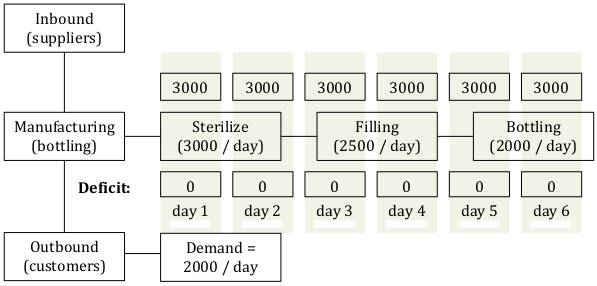
Exhibit 2. After the episode of How I Met Your Mother aired on TV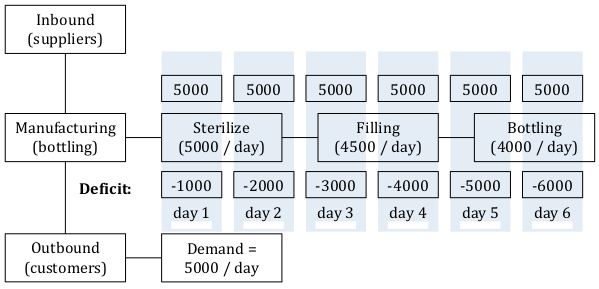
Supply Chain: Brewing, filling, bottling in-â€house every day nonâ€stop from 8am to 6pm, empty bottles are delivered every morning from manufacturing facility across the street, caps are ordered every month from a supplier located in Florida.
Before the episode of How I Met Your Mother aired on TV: Demand = 2,000 bottles / day
After: Demand = 5,000 bottles /day
Capacity: 5,000 bottles can be imported per day maximum.
Candidate should brainstorm and propose the following hypothesis: Bottlenecks create inventory buildâ€up and manufacturing shortâ€fall.
Sterilizing: 5,000 / day
Filling: 4,500 / day
Capping (putting a cap): 4,000 / day
Quality control: 95% (consider only quality control of bottling to simplify in the case)
Conclusion: See Exhibit 1 and 2.
5,000 bottles imported per day lead to dramatic queue = deficit of 1,000 bottles per day.
4. Solutions
Here is a menu of solutions ranked by speed of implementation: (the candidate should suggest at least three options)
(1) Add more shifts: Implement a continuous production process (24/7)
(2) Fix/Reduce the bottlenecks: Analyze production line and see if we can squeeze more bottles out of each shift
(3) Raise beer prices
(4) Move quality assurance (QA) before the bottlenecks: 5% out of 4,000 is 200. If quality control is shifted before the bottlenecks, then bottlenecks can operate at 100% (or close to it). This solves for 200 bottles per day.
(5) Look for labor-saving technologies that can boost production.
(6) Outsource production (or part of it) to manufacturing facility across the street.
(7) Outsource production (or part of it) to a bottler.
(8) Build another production line.
5. Additional Questions for good candidates
Question 1: What are the factors to consider when choosing the optimal inventory order size (shipment) for screw caps?
(1) Carrying Costs: costs associated with storage, insurance, and financing the inventory.
(2) Ordering Costs: costs associated with accounting, labor…when placing an order.
Question 2: Given an optimal inventory order size for screw caps given by the EOQ formula (Economic Order Quantity), how many screw caps should be shipped per order?
In corporate finance, Economic Order Quantity (EOQ) is the order quantity that minimizes the total holding costs and ordering costs. EOQ = sqrt(2*R*O/C)
R = Annual Unit Requirement (consider 360 days per year)
O = Cost of placing an order (here O = $100),
C = Cost of carrying a unit of inventory per period (here C = $0.10)
The candidate might compute R (360 * 5,000 = 1.8m) and solve for EOQ. But an astute candidate will see that 5,000 is 10,000/2, which simplifies the numerator.
One gets EOQ = sqrt(2*360*5,000*$100/$0.1) = sqrt(3,600,000,000) = 60,000 units per shipment (= 1 shipment every 12 days).
Question 3: You have presented your recommendations to the CEO. He opts for extra shifts. What are the pros and cons of adding more shifts using current workers?
Pros: Save on hiring and training cost of new employees, and flexibility to get back to former production levels if demand softens.
Cons: Possible worker burnout, might lower quality control rate, lower profit per bottle.
6. Recommendation
We identified the root cause of the problem. As demand exceeds supply due to capacity constraints, bottlenecks create deficit build-up and manufacturing shortâ€fall.
We identified short and long term solutions. I recommend adding more shifts, which will notably allow our client to easily get back to prior production levels if needed.
Finally I recommend optimizing production by adding a quality assurance (QA) before the sterilizing phase, and optimizing inventories by ordering 60,000 screw caps every 12 days.