USAID to Focus on Developing Cure for Diarrheal Disease
Case Type: operations strategy, optimization; new product.
Consulting Firm: Boston Consulting Group (BCG) 2nd round full time job interview.
Industry Coverage: healthcare: hospital & medical; pharmaceutical, biotech, life sciences.
Case Interview Question #00944: Our client The United States Agency for International Development (USAID) is the US Government agency that is primarily responsible for administering civilian foreign aid. The “technical” offices of USAID design and manage the technical and financial assistance that USAID provides to their local counterparts’  projects. This case concerns one particular USAID technical office — Health and Family Planning.
Examples of projects assisted by USAID Health and Family Planning offices are projects for eradication of communicable diseases, strengthening of public health systems focusing on maternal-child health including family planning services, HIV-AIDS monitoring, delivery of medical supplies including contraceptives and HIV vaccines, and coordination of Demographic and Health Surveys.
One of the ongoing projects conducted by USAID Health and Family Planning Office is trying to incentivize pharmaceutical and biotech firms to develop treatments and vaccines for diseases that are prevalent in developing countries. However, the technical challenge is to identify where to focus as there are many possible diseases. How would you go about helping the client?
Additional Information:
Show the candidate the following graph
Exhibit 1. Disease in the Developing World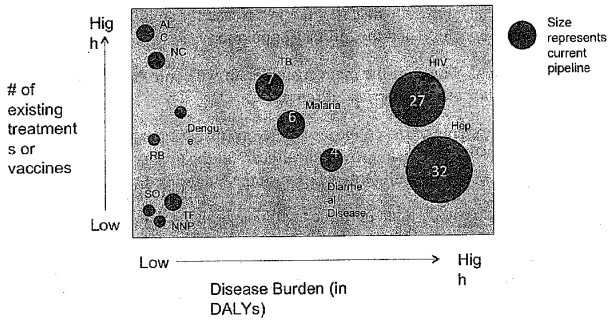
When asked, provide the following details:
* DALY stands for disability-adjusted life year and is a measure of how much impact a disease has on people’s productivity. Diseases, which cause people to die young or which cause disability starting in childhood, have the highest DALY scores.
* Pipeline indicates the number of drugs that are currently under development.
* All these data are made up, as are some of the disease names.
Possible Solution:
Question #1: Which diseases represent the best opportunity for our client?
Possible Answer:
HIV and Hep represent the greatest disease burden for developing countries, but there are also many treatments already under development for these diseases, so our client probably doesn’t want to focus there. (It’s hard to incentivize more development, as the competition looks tough.) It probably makes more sense to focus on the three diseases with the next-highest disease burden: TB, Malaria, and Diarrheal Disease. Of these, I would recommend focusing on Diarrheal disease as there are the fewest products in the pipeline.
Question #2: You’re right about diarrheal disease: that is where the client decided to focus. What does this tell us about diarrheal disease? (Show the candidate the second graph)
Exhibit 2. Etiology of Diarrheal Disease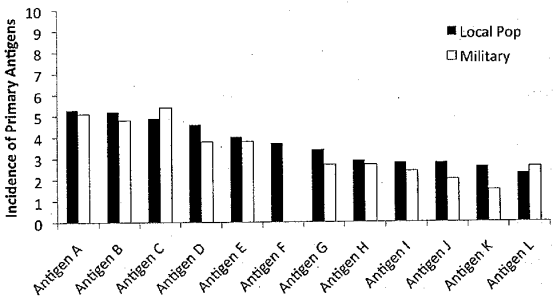
Source: Local population data (black bars) from field study surveys by a medical nonprofit in 7 developing countries. Military population data (white bars) from a sample of US soldiers stationed in Egypt.
If asked, provide the following details:
* Etiology means the causes of the disease.
* Antigen is a general term that can refer to anything which provokes an immune response, whether bacteria, virus, etc.
* The Y-axis scale, incidence, indicates that 5% of cases are caused by Antigen A, and so forth. If someone adds up all the bars, he or she will realize that they don’t sum to 100%. This is because some cases are caused by antigens that have not yet been identified — so the picture is even worse.
* Data are recent (last year) and the sample sizes are large: n = 1,500 for the local population data and n = 256 for the military data. Subjects in the local population data are children under the age of 18 years old. Subjects in the military data are soldiers of all ages.
Possible Answer:
It is not caused by a single primary antigen, but can be caused by a large number of different “bugs”. This means that developing a treatment or vaccine will be difficult because it can’t just attack one of the antigens, it will need to be effective across a large number of them. This helps explain why there are so few current treatments and vaccines available to treat diarrheal diseases. It’s like the flu or the common cold – similar symptoms but really not just one single pathogen that causes the disease, like is the case for small pox, for example. This is true both for the local population and the military population.
Question #3: Who do you think would be the main customers if we could induce someone to produce a treatment or a vaccine for diarrheal disease?
Possible Answer:
* Governments of the countries where this disease presents a major problem.
* Probably also some nonprofits who help provide healthcare in those areas.
* International organizations, such as the World Health Organization (WHO) of the United Nations, International Red Cross.
(Keep asking who else and provide hints until the candidate realizes that foreign tourists and the military would also provide significant sources of revenue for such a product.)
Question #4: What are some of the issues or risks that the drug maker would face with each of these customers?
Possible Answer:
Both governments and the military are attractive customers because they buy in large volumes, but because of that they have significant negotiating power. If the military decides not to buy, that single loss of a sale could cause the whole project to become unprofitable. The drug maker and the client should consider trying to set up pre-commitment contracts with the governments and the military.
(Show the candidate Exhibit 3)
Exhibit 3. Prescribing Patterns in Market 1 vs. 2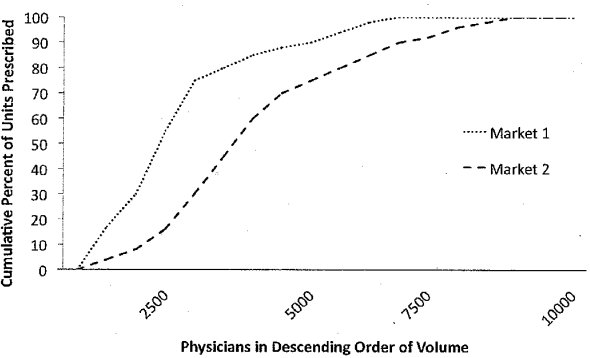
Question #5: Assume that this is the prescribing data for a product like the one that our client is considering helping launch for diarrheal disease. Assume that market 1 and market 2 are two different geographic markets. What does this show and which market seems like a better target?
Possible Answer:
The chart shows the physicians in each market arranged by their prescribing level of this product horizontally in descending order. So the physician who prescribes the most is on the left, and those who prescribe the least are on the right. The height of the line represents the cumulative total of all the units they have prescribed.
The candidate should recognize that Market 1 is basically more consolidated than Market 2. 80% of the units of this product are prescribed by about a third of the physicians in Market 1, but in Market 2 to account for 80% of the units we have to include more like 60% of the physicians. One implication of this is that it is probably easier to start selling a product that is similar to this one in Market 1 because fewer physicians would have to be informed about the new product. This means it’s an easier task to get penetration in Market 1, and we might want to start there.
Question #6: So, what is your recommendation?
Any well thought out recommendation based on the data presented will be fine.