Cereal Manufacturer General Mills to Partner with Walmart
Case Type: operations strategy.
Consulting Firm: Boston Consulting Group (BCG) first round full time job interview.
Industry Coverage: food & beverages.
Case Interview Question #00909: Your client is the sugar cereal division of General Mills Inc. (NYSE: GIS), an American multinational distributor and manufacturer of packaged foods. Headquartered in the Minneapolis suburb of Golden Valley, Minnesota, the General Mills company markets many well known North American brands, 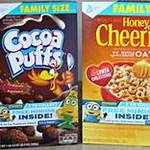 such as Betty Crocker, Yoplait, Colombo, Totino’s, Pillsbury, Green Giant, Old El Paso, Häagen-Dazs, Cheerios, Trix, Cocoa Puffs, and Lucky Charms.
According to the sugar cereal division president, General Mills Inc.’s traditional strength has been with grocery stores, which still account for the majority of its $1.1 billion in sugar cereal sales. But Walmart (NYSE: WMT), a discount chain, has been growing at a healthy rate of almost 15% per year and has now become General Mills’ largest customer. Your client is not sure how to react, and has asked Boston Consulting Group (BCG) for assistance with its distribution strategy. What would you recommend?
Possible Answer:
1. Establish understanding of the case
Candidate: First, let me make sure I understand the problem. Our client General Mills specializes in sugar cereals traditionally distributed through grocery stores. Sales to Walmart, a discount chain, have been growing at 15 percent per year, and the chain has recently become the largest distributor of the client’s product nationwide. We are here to help evaluate the distribution strategy in light of Walmart’s growth.
Interviewer: That is correct.
Candidate: Could you explain to me how grocery stores differ from discount stores?
Interviewer: Sure. Grocery stores generally specialize in food, as well as selling some household goods and over-the-counter pharmaceuticals. Discount stores such as Walmart, Target, etc, on the other hand, offer food alongside a wide variety of merchandise, including clothing, home electronics, and housewares.
Candidate: Does Walmart market its food products differently than do grocery stores?
Interviewer: Discount stores advertise lower prices for a wide variety of foods, particularly staple, nonperishable foods.
Candidate: Could I take a moment to write a few notes to myself?
Interviewer: Please feel free.
2. Set up the framework
Candidate: Before making recommendations, I think we would need to evaluate whether sales growth at Walmart is good or bad for General Mills. To do that, I would first look at how its sugar cereal performance at Walmart compares with that in other distribution channels. Second, I would look at its performance at Walmart in relation to competitors’ performance. Next, I would determine what drives customer purchases. Finally, I would want to understand the supply chain.
Interviewer: That certainly sounds like a reasonable approach. Let’s proceed.
3. Evaluate the case using the framework
Candidate: First, I would like to get a better sense of where Walmart stands in relation to our client’s other distribution channels by examining the client’s sales data and margins, by distributor.
Interviewer: The marketing department does not have margins by channel, but tracks sales and volume for its top five distributors.
| Sales ($M) | 2013 | 2014 | 2015 | 5-Year CAGR |
| Walmart | 142 | 162 | 246 | 14.7% |
| R.J.’s | 157 | 185 | 200 | 6.2% |
| Bozo Mart | 143 | 175 | 189 | 7.3% |
| Ace Grocery | 101 | 109 | 153 | 11.0% |
| Shoppers Mart | 57 | 62 | 67 | 4.0% |
| Total Top 5 | 600 | 693 | 856 | 9.3% |
| Total All Distributors | 1,000 | 1,079 | 1,150 | 3.6% |
| Volume (M boxes) | 2013 | 2014 | 2015 | 5-Year CAGR |
| Walmart | 65 | 74 | 113 | 14.7% |
| R.J.’s | 72 | 81 | 85 | 4.2% |
| Bozo Mart | 65 | 77 | 80 | 5.2% |
| Ace Grocery | 46 | 47 | 64 | 8.8% |
| Shoppers Mart | 26 | 27 | 28 | 2.0% |
| Total Top 5 | 274 | 307 | 370 | 7.8% |
| Total All Distributors | 450 | 468 | 487 | 2.0% |
What does this imply about Walmart as a distribution outlet?
Candidate: It looks as if the top distributors have been growing more important, but particularly Walmart, which is growing faster than all the others. This is particularly true when we look at volume, where Walmart’s growth is much higher than that of the other four channels.
Interviewer: And how could you interpret what these data says about margins?
Candidate: While the client’s sales through other distribution channels are growing faster than volume, Walmart volume and sales growth are the same, so the average price paid by Walmart has remained constant. That implies that sales growth at Walmart could have negative implications for our client’s margins.
Next, I would like to look at how our client is doing in relation to the competition within Walmart. Have they been gaining or losing market share?
Interviewer: How might you find that out?
Candidate: I would try to interview Walmart’s purchasing personnel, since they would probably track those data for their own purposes.
Interviewer: Why would they want to talk to you? How might you approach such an interview?
Candidate: I would approach the purchasing personnel and suggest that our client and Walmart work together to identify best practices to reduce costs and increase sales of sugar cereals at Walmart.
Interviewer: Let’s say in a perfect world you could get a breakdown of Walmart sales for the four largest competitors (see market shares below).
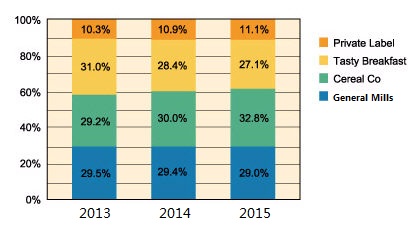
What can we infer about our client’s competitors within this channel? Who should they be worried about?
Candidate: It looks like our client is losing market share, as is Tasty Breakfast, while Cereal Co. and Private Label are gaining share. Private Label, however, looks to be growing from a very small base.
I would like to explore why our client is losing market share to Cereal Co. at Walmarts. Are their prices better than those of our client?
Interviewer: After a period of price wars six to seven years ago that lowered industry margins, the cereal companies have refrained from price competition within the same channel.
Candidate: If prices are not driving the difference, I would look at other factors such as brand selection, percentage of shelf space, product placement, and in-store promotions.
Interviewer: Visits to Walmarts indicate that each name-brand company holds 30 percent of the shelf space, while private label has 10 percent. Cereal Co. brands, however, tend to be placed lower on the shelf than your client’s products.
Candidate: Well, I suspect that children are a large target market for the sugar cereal manufacturers. The lower shelf placement could be especially important to children who are looking at the different types of cereals. Are there any other promotions?
Interviewer: Some Cereal Co. brands have sales promotion tags, and the team notes that store flyers advertise specials on Cereal Co. brands for Walmart customer cardholders.
Candidate: So, even if all the companies are maintaining product prices, maybe Cereal Co. is strategically discounting prices to gain market share.
Interviewer: It seems as if there is evidence of cooperation between Cereal Co. and Walmart. Do we know anything about their relationship?
During earlier discussions with Walmart, you discovered that your client’s competitors have 50 sales representatives dedicated to the Walmart account. Your client has seven.
Candidate: Cereal Co. appears to be dedicating more resources to its relationship with Walmart than our client is. This may explain its better product placement and promotion programs.
I think I have a good sense of distribution and competition. I would now like to look at the customers and understand why they select the products they do. One hypothesis I have is that shifting brand loyalties are hurting our client’s market share at Walmart.
Interviewer: That’s interesting. What do you think might motivate purchases of sugar cereals?
Candidate: There are lots of factors, such as the games in the boxes, the price of the cereal itself, how it tastes. To better understand consumer behavior, we might conduct market research, possibly through focus groups, customer observation, and price sensitivity studies.
Interviewer: BCG teams often do such research. Let’s assume your team conducts some analysis. Your research concludes that most buyers tend to fall into two categories. Approximately 60 percent of buyers go straight to one cereal and grab it. We can call this group the “brand-loyal” shoppers. Another 40 percent of shoppers look at all the cereals and then select one that interests them. Let’s call this group the “impulse” buyers.
Candidate: For the brand-loyal shopper, the priority would be product availability, while product placement would be important for consumers who like to shop around.
Within these groups, are consumers price sensitive such that one brand can lure shoppers loyal to another brand?
Interviewer: In general, your research indicates that consumers are not price sensitive and are extremely loyal to their preferred brand. But when the preferred cereal is unavailable, the brand-loyal customers will purchase discounted cereals approximately 35 percent of the time.
Candidate: Well, from that information, it appears that price is not a major driver of purchases unless the preferred cereal is out of stock. In these stock-out situations, you said, brand-loyal customers will purchase discounted cereals 35 percent of the time. What happens when the customer does not purchase a discounted cereal?
Interviewer: In approximately 25 percent of cases, the customer walks away without purchasing any cereal at all. In the remaining 40 percent of cases, the brand-loyal customer will act like an impulse shopper and select another brand.
Candidate: Interesting. It seems as if product availability could be a major driver of total cereal volume for Walmart. Of course, we would need to know how often stock-outs occur that cause consumers to walk away without purchasing cereal occur.
Since I have a pretty good understanding of customer motivation, I’d now like to ask a few questions about the client’s supply chain. I would want to talk to our client’s distribution personnel to understand the distribution process and to determine how often stock-outs occur. Can you describe how our client’s cereal is distributed at Walmart?
Interviewer: Cereals are distributed from the factory to the distributor’s warehouse twice monthly. The retailer then stocks the shelves itself.
Candidate: Do we have any knowledge about when the individual stores are out of stock?
Interviewer: No, we do not, since our client only delivers to the warehouses and has no direct access to in-store inventory information.
Candidate: Since we identified product availability as a key success factor earlier on, I would want to make sure that the stores were stocking the product correctly.
Interviewer: Let’s say that in your earlier in-store investigations, you found out that Walmart stores averaged 15 percent of sugar cereal brands out-of-stock, across all brands.
Candidate: Stock-outs would be a major problem for our client, since 60 percent of customers look for a specific brand of cereal and 35 percent of them would buy a discounted brand in a stock-out situation. Walmart would also have an incentive to reduce out-of-stock incidents, since 25 percent of the time, a brand-loyal customer will walk away without buying anything.
4. Summarize and make recommendations
Candidate: Walmart is our client’s leading customer, accounting for more than 20 percent of our client’s sugar cereal revenue. Although sales to Walmart are increasing on an absolute basis, our client’s margins there are lower than in its other channels and its competitive position is eroding in that channel.
At Walmart, our client faces competition from both private label and Cereal Co., although the latter appears to be the greater threat. There appears to be a relationship between Walmart and Cereal Co. as evidenced by their joint promotions, the superior placement of the Cereal Co. product, and the substantial resources that Cereal Co. has dedicated to the Walmart account.
We learned that 60 percent of customers are brand-loyal, implying product availability is most important. However, 40 percent like to try different kinds of cereal, indicating product placement is also important. Purchasers do not appear to be price conscious, unless the type of cereal they are looking for is out of stock, in which case there is a stronger tendency to base purchases on price promotions.
In terms of distribution, our client is making deliveries twice a month to Walmart’s warehouses. Walmart, in turn, is responsible for stocking the shelves. We currently have no direct knowledge of when our client’s items are out of stock at the individual stores, but there is evidence that stock-outs do occur with some frequency.
Interviewer: Well, it sounds as if you understand the situation. What would you recommend the client do?
Candidate: The sales through Walmart appear to have a negative impact on the bottom line, as they have lower margins than sales through grocery stores. The client could work with grocery stores to ensure that they are able to compete effectively with Walmart in the sugar cereal market. This strategy could be risky, however, since Walmart is a large and important customer. Therefore, I would recommend that our client work more collaboratively with Walmart.
To defend its current position at Walmart stores, the client should move toward a partnership with Walmart and dedicate more resources to the relationship. The customer and competitor data indicate that our client’s first priority should be to improve distribution to ensure better product availability. In addition, it should push for product placement equal to, if not better than, that of its competitors.
Interviewer: Why would Walmart be willing to enter into a partnership with General Mills?
Candidate: General Mills could offer to share its information about customer behavior to help increase revenues for both itself and Walmart. Stock-outs hurt Walmart in two ways. First, some brand-loyal customers simply walk away without purchasing cereal whenever their preferred brand is unavailable. Second, we know that other brand-loyal customers purchase lower-priced cereal whenever they encounter a stock-out of their preferred brand. Both of these instances lower Walmart’s revenue.
By eliminating stock-outs, Walmart could increase its sales by simply ensuring that customers don’t walk away without making a purchase. Converting these purchase occasions to sales would increase Walmart’s sales of sugar cereals by more than 2 percent (1).
Better availability also helps Walmart and our client increase their revenue by deterring the brand-loyal shoppers from trading down to lower-priced cereals. Recall that 35 percent of the brand-loyal shoppers purchase a discounted cereal if their preferred brand is not available. If improved distribution now makes the preferred brands more consistently available, the customers will pay a higher price for these products.
Finally, we could use the information about consumer purchase behavior to help persuade Walmart to share information about product availability in its individual stores. We could work with our client and Walmart to improve the current distribution system to allow for more economical deliveries, while at the same time ensuring that our client’s product is consistently available in the store.
Interviewer: Thank you. Those sound like solid recommendations, but I would suggest that you fully understand the root cause of the stock-out situations and the cost to eliminate them before moving ahead.
(1) 15% out of stock x 60% brand-loyal customers x 25% willing to forgo purchase = 2.25%