Loblaws to Review Their Customer Loyalty Program
Case Type: operations strategy, optimization.
Consulting Firm: McKinsey & Company 2nd round full time job interview.
Industry Coverage: retail.
Case Interview Question #00893: Our client Loblaws is a major supermarket chain headquartered in Brampton, Canada, with more than 2,000 stores in British Columbia, Ontario and Quebec. Loblaws is a division of Loblaw Companies Limited (TSX: L), Canada’s largest food distributor. The Loblaws stores carry a variety of goods, but the vast  majority of space is devoted to groceries and about a third of each store is set aside for consumer products, housewares, and clothing.
The client Loblaws is one of the three major players in this sector and the rest of the market is split amongst smaller, regional chains. About 10 years ago, in January 2005, they introduced a customer loyalty card scheme (run by a third party provider), but have not been able to make this scheme successful. The CEO of Loblaws has called McKinsey & Company in to review their customer loyalty program and suggest ways to improve it.
Possible Answer:
Part 1: Overall approach for review
Behind the scenes: If the candidate asks further questions, you should explain that the customer loyalty card works in the following way: For every $1 spent in store, the customer receives 1 point. These points can be redeemed for discounts at the store. 100 points can be redeemed for a 1% saving on every $100 spent.
Interviewer: What areas should we investigate to determine the performance of this customer loyalty scheme?
Possible Answers:
* What are the goals of the customer loyalty scheme? Profitability? Business intelligence?
* Benchmark the potential profitability of other customer loyalty card schemes (look at competitors’ schemes or grocery stores in other regions).
* Compare the profitability of this customer loyalty scheme – is there a gap? If so, why? What drives value for a customer loyalty card scheme? What improvements could be made?
* Consider alternatives – are there other pricing/promotion/customer loyalty schemes that can match or surpass the loyalty card scheme?
The profitability of a customer loyalty card scheme will be determined by
* Total customers * % customers with loyalty card * extra profits generated by scheme (per customer)
* For a given customer, extra profits generated by scheme depend on the increase in the frequency of their visits and the spend per visit.
Part 2: Cost structure
Behind the scenes: the candidate should keep in mind that the customer loyalty program is run by a third party provider.
Interviewer: What are the costs associated with running a customer loyalty card program?
Possible Answers:
* Discounts (largest cost)
* Software upgrades to registers
* Promotion of scheme
* Customer support
* Printing cards, maintaining data, etc – this will likely be borne by the third party provider and paid for on some kind of rate (e.g. per customer)
Part 3: Customer loyalty card vs. non-loyalty card transactions
Note to Interviewer: The candidate should bear in mind that the value they are calculating is on a per transaction, not a per customer, basis. Pause after question (a) below to allow them to talk before asking question (b). Before doing the calculation in (b), the candidate should request the total number of transactions. The total number of transactions is 10 million.
Interviewer: We received this data from the client Loblaws. (a) How would you interpret it? (b) Can you calculate the average revenue per transaction for loyalty card holders and for customers who do not hold a loyalty card?
Exhibit 1. Transaction data for loyalty card holders and non-loyalty card holders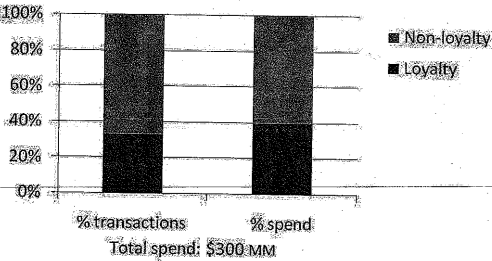
Possible Answer:
(a) A lot of transactions involve customers who do not have a loyalty card. This suggests that there may be a lot of customers do not know about the customer loyalty scheme (there is potential to grow it). However, this data tells us nothing about the number of customers with the card, simply the number of transactions.
If we look at the relative percentages it looks like loyalty card holders spend more per transaction. However, this could imply one of two things: (1) Customers who shop a lot at this chain are more likely to get the customer loyalty card and make the most of the discounts, OR (2) the card encourages customers to spend more each visit. There is insufficient data to determine causality.
(b) Spend per transaction = (Total money spend * % spend) / (Total number of transactions * % transactions)
For loyalty customer transactions, spend per transaction = ($300MM * 40%) /(10MM * 1/3) = $36/transaction
For non-loyalty customer transactions, spend per transaction = ($300MM * 60%) / (10MM * 2/3) = $27/transaction
What might explain this? This could be because the non-loyalty customers are not regular customers – they may be buying things like newspapers, milk, and other small purchases. Loyalty card customers are more likely to be doing a regular trip and may purchase more items in stores where they have discount schemes.
Part 4: Are customers really loyal?
Behind the scenes: Show the interviewee the following bar chart:
Exhibit 2. Number of customer loyalty cards in wallet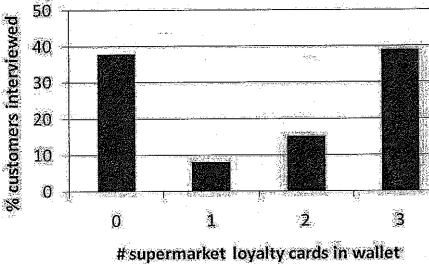
Interviewer: We interviewed customers in-store and asked them how many supermarket loyalty cards they had in their wallet. We found out that the distribution was bimodal. What does this information tell you?
Possible Answers:
Most customers either have no loyalty cards, or have cards for three supermarkets (probably our client and the other two major players). This suggests that loyalty cards do not in fact encourage loyalty to a particular supermarket chain. There is a portion of customers who do not care or aren’t informed about the customer loyalty scheme. The rest will carry a card for each supermarket and use the appropriate card wherever they go.
Key take-away: Customer loyalty cards will probably not determine where someone shops, but can affect what products, and how much, they buy at your store. The program should reflect this, e.g. by offering bonus points on high-margin products.
Part 5: Wrap-up
Behind the scenes: there are several ways that this data could be interpreted, so accept any reasonable answer that is well structured.
Interviewer: What would you recommend to the CEO of Loblaws?
Possible Answers:
* There is potential to grow the customer loyalty scheme, so run promotion campaigns to enroll more card members.
* Give additional loyalty “points” for high-margin products.
* Restructure customer loyalty card formula to give dollar-amount discounts on particular (high-margin) items to steer customers towards those items.