Two Sigma Research Team to Add 5 New Junior Analysts
Case Type: organizational behavior; operations strategy & optimization.
Consulting Firm: Boston Consulting Group (BCG) first round full time job interview.
Industry Coverage: financial services.
Case Interview Question #00823: Your client Two Sigma Investments is a New York City-based hedge fund that uses a variety of technological methods, including artificial intelligence, machine learning, and distributed computing, for its trading strategies. The firm is run by John Overdeck and David Siegel, and has $32 billion  assets under management (AUM). The company’s main office is in New York City. It also has branch offices in Houston, London, and Hong Kong.
Previously the hedge fund selected investments based on a complex mathematical model. However, about 2 years ago they started seeing lower returns. To address this problem they added a research team to help evaluate investments. If the mathematical model recommends an investment, then money is invested. If the model and the research analysts agree on an investment, then a larger percentage is invested than if only the model recommends the investment.
The research team of Two Sigma Investments currently consists of 4 Senior Analysts and 3 Junior Analysts. The CEO is extremely pleased with the new research team and the uplift in returns they have seen as a result of the new investment methodology. However, he does not feel that the research team is properly structured and has asked you to advise him on re-structuring the team. What issues would you consider and how would you structure the team?
Additional Information: to be provided after relevant questions
* The overall goal of the hedge fund is to maximize returns and they tolerate a high amount of risk.
* Individual investors invest between $20M-$100M.
* All seven research analysts currently report to the head of trading.
* When the trading department has a question on an investment, the head of trading will contact one of the Senior Analysts and ask him/her to evaluate an investment. The Senior Analyst will then prioritize the request and divide it between him/herself and the Junior Analysts.
* Investment research (even an individual request) can usually be broken into several discrete pieces.
* The CEO does not want to fire anyone.
Possible Answer:
Suggested Framework:
* Considerations
* How to compensate
* Reporting lines
* Appropriate leverage
After a brief discussion of compensation/rewards and reporting lines, the interviewer directed me to the issue of leverage. Upon asking if the research work could be broken up between Junior and Senior Analysts he provided the following data:
* Both Junior and Senior analysts feel that they are doing work that is beneath them.
* If investment research work was pushed down to the lowest competent level, the work could be divided as follows:
| Senior Analysts | Junior Analysts | Research Assistants | |
| Data Gathering | 25% | 25% | 50% |
| Analysis | 20% | 80% | 0% |
| Synthesis | 80% | 20% | 0% |
If there is 100 hours of research work to do, it would be broken up as follows:
Data Gathering: 20%
Analysis: 60%
Synthesis: 20%
Using data provided on work allocation, I calculated how many of each level of research worker would provide appropriate leverage to the senior analysts.
If a research project takes 100 hours it would be broken down between (in hours):
| total time | Senior Analyst | Junior Analyst | Research Assistant | |
| Data Gathering | 20 | 5 | 5 | 10 |
| Analysis | 60 | 12 | 48 | 0 |
| Synthesis | 20 | 16 | 4 | 0 |
| Total Hours | 100 | 33 | 57 | 10 |
Therefore, one Senior Analyst should have roughly two Junior Analysts and one Research Assistant can be shared between 3 Senior Analysts.
Based on the 4 Senior Analysts our client currently has, they should create the following organizational structure.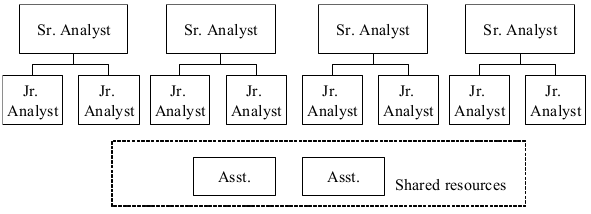
There are currently 3 Junior Analysts. Since the CEO does not want to fire anyone, the client Two Sigma should hire 5 more Junior Analysts for their research team.
The following additional implications/points provide additional insight:
* There will be additional capacity issue for the research assistants; however, because they are the cheapest resources you do not want them to be the bottleneck.
* There should be little resistance by any involved parties. While the Junior Analysts will no longer report directly to the Trading Head, they will no longer be doing work that is “beneath them” and will have a manager trained in their field.