Mountaintop Ski Resort to Lift the Ban on Snowboarders
Case Type: new business; operations strategy.
Consulting Firm: Bain & Company second round full time job interview.
Industry Coverage: sports, leisure & recreation.
Case Interview Question #00810 Cheyenne is the capital and most populous city of the US state of Wyoming, with a population of about 60,000 according tothe 2010 census. Mountaintop Ski Resort is a premier ski resort located outside of Cheyenne, Wyoming. It is one of the most popular ski locations for people in the  Cheyenne Metropolitan Area.
Snowboarding is a recreational activity that involves descending a slope that is covered with snow while standing on a snowboard attached to a rider’s feet. Snowboarding has been banned at Mountaintop Ski Resort since 1990 (just when snowboarding was starting to gain popularity) on the grounds that snowboarders represented an “undesirable element” and Mountaintop was better off just catering to skiers. However, as Mountaintop prepares for a new season they ask themselves, as they do every year, if they should lift the ban on snowboarders. This question seems especially relevant this year since Mountaintop’s growth has stagnated in the past two years after a decade of robust growth (see Graph A).
You and your case team have been asked to help the management of Mountaintop Ski Resort determine the best course of action. What would you do?
Graph A: Skiers per season (15 weeks) at Mountaintop Ski Resort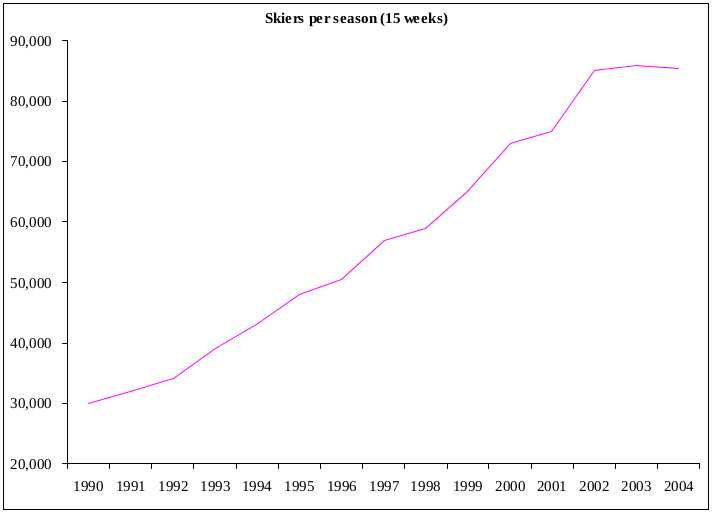
Possible Answer:
This is a typical Bain-style strategy case which presents a case up-front and then asks the interviewee to work out the best solution.
Candidate: I would like to understand more about the Mountaintop Ski Resort business in terms of what the customers look for, what Mountaintop offers and its competitive positioning and finally, if possible, do a quantitative comparison of the impact of allowing snowboarders vs. enforcing the ban.
Additional Information: Give this information as it is asked
1. Customers
Based on customer surveys the most important things to skiers (ranked from most important to least) are:
- the price of the ticket;
- the amount of time one has to wait in the lift lines; and
- the presence of ancillary amenities like restaurants on the mountain, ski schools for kids, and ski rental shops (see Graph B).
Graph B: Factors important in choosing Mountaintop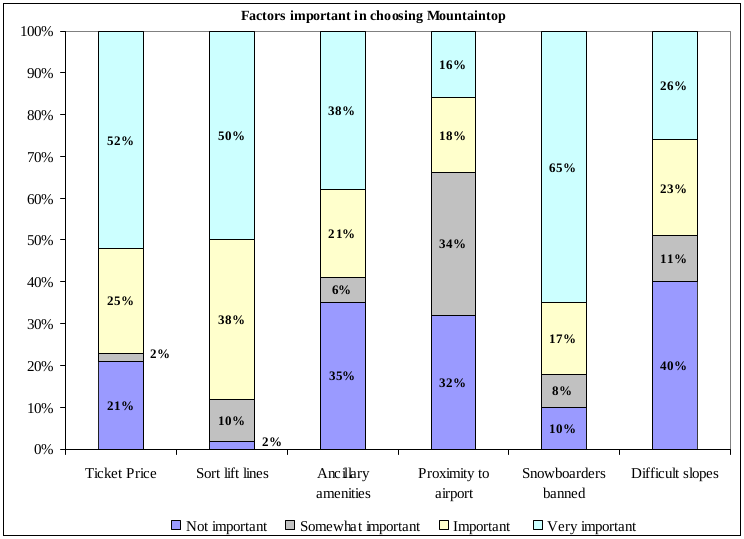
2. Company
- Mountaintop Ski Resort is undeniably the better mountain for skiing. If the prices were the same and there wasn’t the ban on snowboarders, everyone would go to Mountaintop. If Mountaintop reduced the price difference to less than $20, some skiers would want to go to Mountaintop.
- Three years ago Mountaintop upgraded its lifts to high-speed, four-seat lifts (this is the peak of technology). This increased the mountain’s capacity from 1500 skiers per day to 2000 skiers per day.
- Based on Mountaintop’s strategy it appeals to higher-end customers, mostly from Cheyenne or out-of-town. As such, it is busiest on the weekends where they average about 2000 skiers (which is the mountain’s full capacity) per day, but attendance drops to an average of 300 skiers during the week. This is likely due to the fact that this higher-end clientele works during the week and can only ski during the weekend (see Graph C).
Graph C: Average skiers per day at Mountaintop vs. Shredsville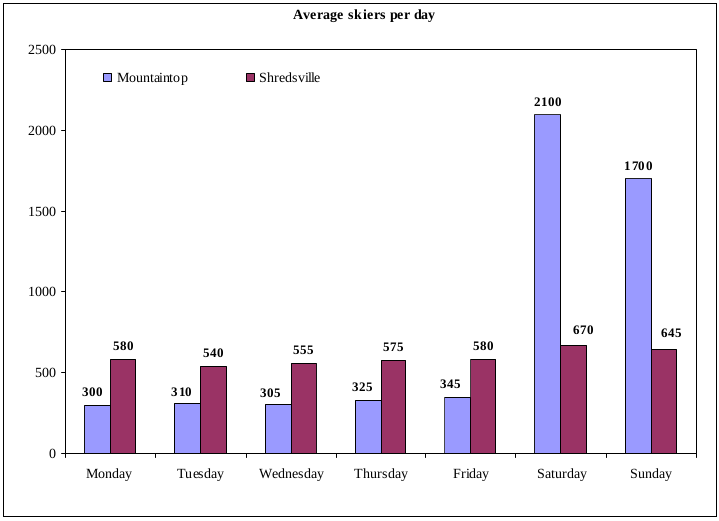
3. Competition
- There is one other ski resort in the Cheyenne area, Shredsville. Shredsville is Mountaintop’s only competition (some skiers come in from beyond Cheyenne but we will assume that any actions that Mountaintop takes will neither increase or decrease that out-of-town population which comes to Cheyenne to ski).
- A lift ticket at Mountaintop is $50 while a lift ticket at Shredsville costs $30.
- Shredsville is barely profitable right now. It is unlikely that it would be able to lower the prices of its lift tickets.
- Shredsville has an average of 600 skiers per day for every day of the week. This is likely based on Shredsville having a less-affluent clientele (a bunch of teenagers and twenty-somethings who just want to be ski bums). Additionally, snowboarders tend to be less-affluent and younger people.
- Shredsville is 60% snowboarders.
The first key insight is that skiers really don’t mind sharing the mountain with snowboarders; however, they do not want to have a more crowded mountain. As such, the mere presence of snowboarders would not drive many regular skiers away.
Second, the Mountaintop Ski Resort cannot expand anymore since it already has the fastest lifts available. This makes Mountaintop’s maximum capacity 2000 per day. However, it only has 300 skiers on the weekdays so it can grow by increasing the number of people who ski during the week. The key is determining how to increase the number of weekday skiers without hurting the weekend revenue.
Third, a ski resort has relatively large fixed costs. As such the incremental cost of an additional skier is minimal. Anything Mountaintop can do to increase the number of skiers that come during the week would flow straight to the bottom line.
Simply lifting the ban on snowboarders would not have maximum impact. Since Mountaintop costs more, it appeals to the weekend and vacationing skiers (Graph C). Plus it is probably pretty reasonable that snowboarding appeals to a younger, less-affluent demographic. There would certainly be some snowboarders who would come over during the week like vacationers, but not many; most of the snowboarders who would come to Mountaintop during the weekend when it is already at capacity.
The best solution might be to lift the ban and then have a tiered pricing approach based on the day of the week. The increased demand during the weekend would allow Mountaintop to raise its weekend prices. Simple microeconomics would tell at what price would allow an equilibrium with 2000 skiers.
During the week, Mountaintop could lower its prices to entice both skiers and snowboarders who ski at Shredsville because of the price differential (reason 3 says that Shredsville cannot respond to lower prices at Mountaintop with its own lower prices) to start skiing at Mountaintop. Again microeconomics would tell how many additional skiers Mountaintop would get if it lowered its weekday price by a certain amount. Since the costs will not be affected by these strategies, the break-even analysis will simply be based on revenue – How much can you raise ticket prices on the weekend before you drive skiers away, and how low can you bring the price of tickets during the week so the loss in ticket prices is made up by increased revenue.