National Semiconductor to Improve Equipment Utilization
Case Type: add capacity; operations strategy, optimization.
Consulting Firm: Siemens Management Consulting first round full time job interview.
Industry Coverage: electronics, semiconductors; manufacturing.
Case Interview Question #00809: National Semiconductor is a leading integrated design and manufacturing (IDM) provider of semiconductor chips to the consumer electronics, telecom and automotive industries. Headquartered in Santa Clara, California, United States, the company produced power management integrated circuits, display drivers,  audio and operational amplifiers, communication interface products and data conversion solutions. Its devices have been embedded in leading edge cell phones, televisions, DVD players and a host of other consumer electronics products. In the last few years National Semiconductor has been leading the introduction of automotive high-tech electronics including satellite navigation systems, vehicle systems monitoring, climate control and passenger comfort systems, etc.
The recent surge in demand for its products and the wave of new products under development requires additional manufacturing capability. Your consulting firm has been engaged to help the client determine how best to deploy additional capacity in one of its manufacturing facilities — FAB ALPHA23.
How would you begin to analyze the problem?
Possible Answer:
The candidate should first ask some clarification questions about the manufacturing process:
- What is the current manufacturing process and what are the key equipment in the process flow?
- Which equipment are the bottlenecks?
The candidate should put down a structure initially addressing the following questions. Possible high level structure could be:
a. Capacity Constraints
- What is the current throughput and how much additional throughput do we need to plan for?
- Can we increase throughput without new investments (i.e. by improving our operational effectiveness)?
- Competition capacity (probably acquire a company).
b. Demand
- Is it a short burst in demand or is it sustainable? What are the main drivers for this demand?
- What is the market size & growth rate — how much are we planning to capture, i.e. how did we arrive at the new throughput requirements?
c. Return on Investment
- Do we want to build the unit in U.S./India/China? What are the capital requirements and return on investment?
- What is the investment for each additional machine / what is our budget outlay?
- How will the investment to increase capacity affect our profit margins (economies of scale)?
d. Additional questions that separates a great candidate from a good one include the following:
- How soon are we planning to increase production?
- How long will it take to add new equipment?
- Are there other constraints such as availability of trained labor we need to factor?
- Are there any other options — like subcontracting the manufacture of the additional amount?
Based on the questions the candidate asks, the interviewer should provide the following details.
- Semiconductor manufacturing process overview: show Exhibit A.
- Not all devices follow the same manufacturing process. Hence the product mix will determine the actual capacity constraints.
- Current throughput of the fab is 5000 wafers/month. The plan is to ramp up by 20% by the end of this quarter.
Exhibit A: Semiconductor manufacturing process overview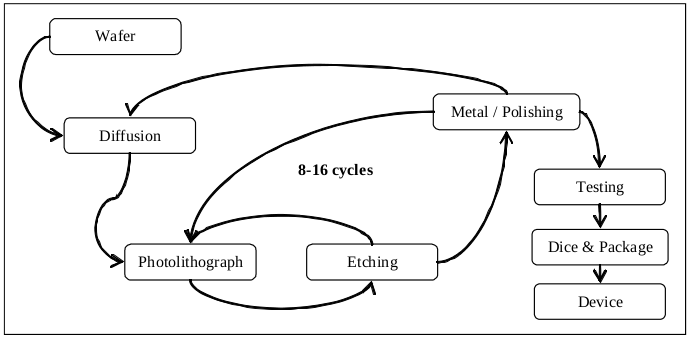
The candidate should note that a quick scan of the process flow in Exhibit A indicates more arrows leading to Photolithography (Photo) than any other processing stage.
At the current levels of utilization:
- Diffusion has 5 machines, each capable of processing 1200 wafers / month.
- Etch has 6 machines, each capable of processing 1000 wafers / month.
- Photo has 10 machines, each processing 500 wafers / month.
- All other stages have enough capacity to process 10,000 wafers /month.
If the candidate has not already pointed this out, the candidate should use the numbers to indicate that the bottleneck for our capacity ramp up is the ‘Photo’ stage of production, otherwise to confirm it.
In addition, the following financial data is available:
- 1 Photo machine costs $1,200,000. It is depreciated over 5 years (straight line).
- Each additional wafer/month adds $45 in revenues and $30 in direct costs.
The candidate should calculate the following:
- Annual depreciation of Photo Machine: $1,200,000/5 = $240K
- Profit from additional throughput: $45 – $30 = $15 per wafer per month
- Additional profitability from the increased throughput (1000 wafers/month), without new equipment: $15*1000*12 = $180K
- With the new equipment annual profitability change is $180K – $240K = -$60K
Therefore, it does not make sense to invest in a new photo machine for the desired level of output increase.
Interviewer: Ask the candidate at what level of output increase does it make sense.
The candidate should calculate the following:
- The new Photo equipment purchase at current utilization levels can be justified for a demand increase of $240k/($15*12) = 1334 wafers / month.
- Also, the candidate should ask if it is possible to increase sales to this level — the answer is no.
Interviewer: At this point, ask the candidate what else the client company can do.
The candidate should realize that the maximum throughput data was on the current level of utilization and should ask what the current capacity utilization is.
All equipment at the fab are running at sub-par utilization. Current equipment utilization levels are as low as 50%.
The candidate should ask why utilization is so low.
The key causes of under-utilization are shown in Exhibit B.
Exhibit B: Causes of under-utilization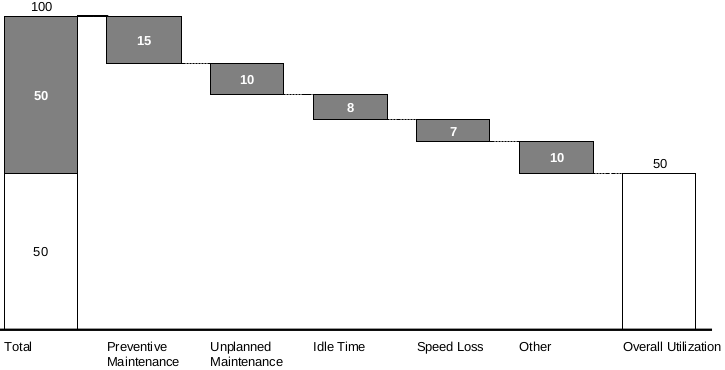
The candidate should draw the following inferences:
- Unplanned maintenance, idle time of operators and other losses account for 28% of the total time. Therefore, through better planning the utilization can be improved.
- While utilization lost to preventative maintenance and speed losses is harder to reduce, the other areas should be easier to improve. Therefore, a 10% improvement in utilization seems quite conservative.
- To increase the throughput from 5000 wafers/month to 6000 wafer/ month on the same set of equipment we need to increase equipment utilization level from the current 50% to (50% * 6000/5000) = 60%, this represents a 10% improvement in utilization.
Conclusion: The client National Semiconductor should invest in improving equipment effectiveness through better planning.