PCA to Improve Industrial Packing Profitability
Case Type: reduce costs; operations strategy, optimization.
Consulting Firm: Strategy& (formerly Booz & Company) first round full time job interview.
Industry Coverage: packaging.
Case Interview Question #00790: Your client Packaging Corporation of America (NYSE: PKG) is an American manufacturing company based in Lake Forest, Illinois. The company’s network consists of six containerboard mills, 94 converting facilities, two white paper facilities, eight creative design centers,  11 packaging and supply centers, two training and resource centers and one technical center. It has over 13,000 employees, with operations primarily in the United States and a converting operation in Canada.
The CEO of Packaging Corporation of America (PCA) needs help to improve the company’s industrial packing unit profitability. Industrial Packing (IP) is a business of manufacturing and selling of steel barrels. Barrels are cylindrical in nature and mainly used for packing liquid products for transportation or storage of products. How would you go about this case?
Question #1: What are the characteristics of Industrial Packing industry that help drive profitability?
Suggested Approach:
A good candidate should asses the drivers evaluating each of the elements that affects the profitability:
- Profit = Revenue – Cost
- Revenue = Price/Unit * Units
- Cost = Variable Costs + Fixed Costs = Cost/Unit * Units + Fixed Costs
a. Revenue:
- What is the current price comparing to the market (premium/average/low cost)?
- What is the demand elasticity? What drives the demand?
- Does the client PCA have any differentiated positioning/asset (patent/distribution channel)?
- Does PCA have any volume fluctuation? Why?
- How is the rivalry and entry barriers in this industry? Not a patented product, low capital expenditure requirements, easy access to raw material.
- Customers: Want suppliers with an ability to meet flexible demands? Tendency to shift to light weight substitutes (easily available)? Are customers willing to pay premium for superior quality?
b. Costs:
- Variable costs: What are PCA’s variable costs? Raw material (steel), shipping, energy?
- Fixed costs: What are PCA’s fixed costs? depreciation, depletion and amortization (DD&A), capital costs and R&D might be drivers.
- Supply: High fluctuation in steel prices, limited suppliers.
Thus, in Industrial Packing industry two of the main profitability drivers are:
- Ability to utilize capacity and manage demand peaks
- Provide high quality product and service
Question #2: Your client PCA agrees with these profitability drivers. Now what are the important aspects that should be considered in the supply chain to manage demand fluctuations and maintain quality?
Possible Answer:
Supply Chain: Inbound Logistics -> Production -> Outbound Logistics -> Sales & Marketing -> Customer Support
Inbound Logistics
- Strategic alliance with supplier: long term contracts to hedge price fluctuations
- Proximity to steel suppliers
Production
- Aim for product quality certification
- Spare Capacity for peak seasons
- Warehouse cost optimization
Outbound Logistics
- Own transportation vehicles to manage demand
Sales & Marketing
- Ability to manage short notices to lower customer switching
- Promote the PCA brand
Customer Support
- Develop customer loyalty programs to stabilize demand and price
- Involve customer in product development to increase loyalty
Question #3: PCA is particularly interested in prioritizing between costs of over stock to manage demand variability vs. reducing warehouse cost. Can you help them to decide?
Additional Information: only provide if asked:
- Average demand per week = 10,000 barrels
- Demand fluctuation = +/-20%
- Demand varies twice per month
- Barrel Price = $10
- Cost of production per barrel = $5
- Cost of storage per barrel = $5
Assume 60% out of lost customers (due to insufficient production) place the order next time (this means 40% orders that are not met are lost)
Suggested Solution:
Thus, the monthly demand projections are as follows
| Week | 1 | 2 | 3 | 4 |
| Demand | 10,000 | 12,000 | 10,000 | 8,000 |
Scenario 1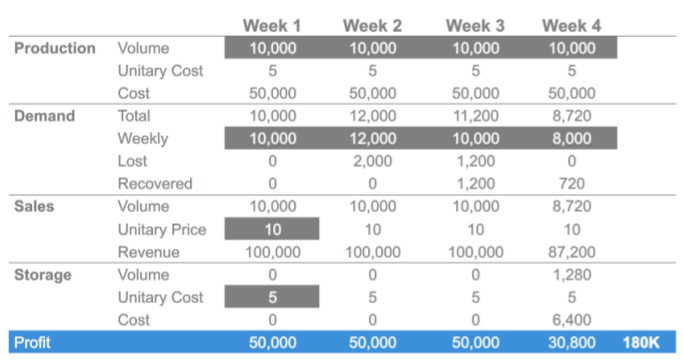
Risks: Loss of trust and reliability by customers, outperform by competitors
Scenario 2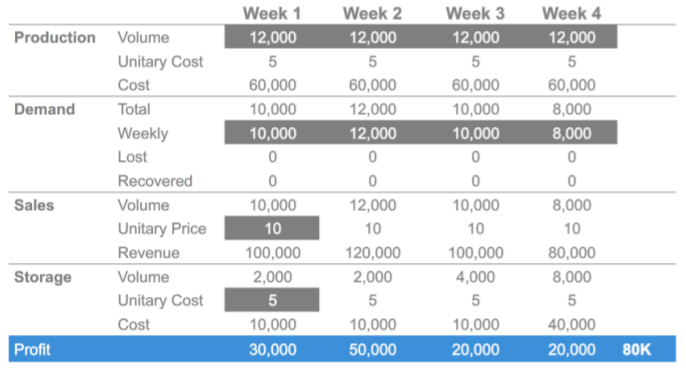
Risks: Production losses due to unsold stocks
Conclusion
Based on the above scenarios currently it costs PCA more to produce barrels at peak capacity and store in-house rather than opportunity cost of loosing sales.
Recommendation
- To produce barrels at average demand level and develop customer loyalty programs to stabilize demand.
- Cross-functional team – Marketing, Sales, IT and Operations to collaboratively forecast demand accurately.
- Aim to reduce the inventory storage cost. A $1 per barrel i.e. 20% reduction of storage cost makes it more favorable option.