Discount Store Chain Kmart to Cut Costs of Distribution
Case Type: reduce costs; operations strategy, optimization.
Consulting Firm: Accenture first round summer internship job interview.
Industry Coverage: retail; general merchandisers.
Case Interview Question #00752: Your client Kmart (sometimes stylized as K-Mart) is an American chain of discount superstores similar to Wal-Mart. The company was founded in 1962 and currently is the third largest discount store chain in the world, just behind Walmart (NYSE: WMT) and Target (NYSE: TG).
Headquartered in Hoffman Estates, Illinois, United States, the client company operates a total of 1,221 Kmart stores in 49 states, Guam, Puerto Rico, and the U.S. Virgin Islands as of 2013, including 1,196 discount stores averaging 94,000 sq ft, and 25 Super Centers averaging 168,000 sq ft. Each store receives one delivery per day from a distribution center. The CEO of Kmart has hired your consulting firm to investigate if the costs related to distribution can be reduced. How would you approach this case? What recommendations would you give to the CEO of Kmart?
Additional Information: (to be provided to candidate upon request)
The client Kmart owns multiple distribution centers (DCs) across the United States. (Show figure below) 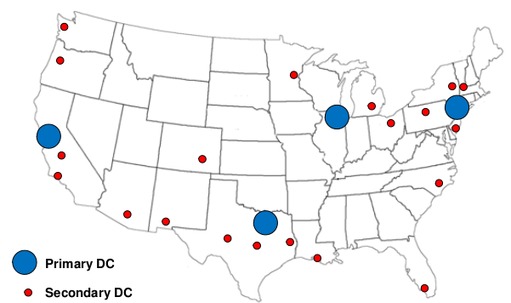
The 4 primary distribution centers are located in New York City, Chicago, Dallas, and San Francisco. The 20 secondary distribution centers are also spread out through the country.
All of Kmart’s products are imported from Asia and arrive daily at the San Francisco distribution center.
This case is mostly about qualitative analysis. Steer the candidate away from attempting any numerical calculations.
Possible Answer:
1. Analysis (Wait for candidate to specifically ask about these aspects.)
A. Current Distribution Routes
- Every day, trucks transport products from the San Francisco center to each of the primary and secondary distribution centers.
- Trucks from each of the primary DCs also make daily deliveries to the nearby secondary DCs.
- Each secondary DC makes one delivery per day to its assigned stores.
- All routes to and from the DCs are the same each day regardless of demand (static routing).
- Trucks are rented and are of uniform size.
B. Capacity
- Not all distribution centers (primary or secondary) are at full capacity. The three primary distribution centers (excluding the West Coast DCs) are well under capacity.
- Most trucks are NOT at full capacity.
- Demand for products is not the same at all stores.
2. Sample Recommendations
- Deliver from the West Coast DC to the other primary DCs and secondary DCs on the West Coast. Do not deliver from West Coast DC to other secondary DCs.
- Consolidate secondary DCs that are not at full capacity.
- Determine optimal routes to and from the DCs.
- Dynamic Routing — do not make daily deliveries to stores/DCs if there is low demand, or keep some extra inventory at the stores.
- Consolidate trucks:
- Use smaller trucks if it decreases the cost.
- Buy trucks instead of renting.
3. Sample Risks and Next Steps
A. Risks
- Other primary DCs may not have enough capacity to hold the additional inventory.
- By consolidating secondary DCs, capacity risks are magnified if demand increases drastically.
B. Next Steps
- Determine capacities of different DCs to see which trucks to consolidate.
- Determine differences in demand of different stores.
- Investigate trucking contracts and if using different truck sizes or buying trucks would save money.