Direct Relief to Increase Donation Made by General Public
Case Type: operations strategy, optimization; organizational behavior.
Consulting Firm: Bridgespan Group final round full time job interview.
Industry Coverage: non-profit organization; healthcare: hospital & medical.
Case Interview Question #00675: Our consulting firm is doing a pro-bono case for Direct Relief International, the largest non-profit medicine distribution network in the U.S. Founded in 1948, this organization focuses on improving the quality of life by bringing critically needed medicines and supplies to local healthcare providers  worldwide. Based in Goleta, California, the client Direct Relief’s network consists of 50 Medicine Banks that distribute drugs to more than 30,000 charitable Agencies, including homeless shelters and community hospitals. Medicine Banks are warehouses that store drugs received from donations and distribute them to Agencies, for example, not-for-profit hospitals.
Each year, Direct Relief’s network secures and distributes more than 2 million boxes of drugs, that in turn are provided to more than 700,000 Americans in need annually, like working poor, elderly, homeless, etc. Drugs are sourced from big pharmaceutical companies, and also from other corporations and the public in general, for instance, liquid asset and in-kind donations.
The flow chart below shows the simplified network structure of our client Direct Relief.
| Donors –> | Client’s network –> | Agencies –> | End users |
| Pharma companies corporations medicine drives public in general | Medicine banks | Hospitals shelters others | Homeless working poor others |
In a talk with the client’s President and CEO, and the Senior Vice President (SVP) of Strategy, two main concerns were raised. Those will be the focus of our team’s activities:
1. Although the organization has significantly increased its output over the years to End Users (in terms of the number of boxes of drugs), reported need of drugs by Hospitals and Community Service Agencies continue to escalate. Why?
2. What could Direct Relief do to improve the situation?
Note: This is a long introduction for a case. The interviewer or case giver should give the candidate enough time to take notes and understand the questions.
Additional Information: (to be given if asked by candidate)
1. Our client Direct Relief
Main Activities:
- Medicine Sourcing: Forge/maintain relationship with donors, acquire supplemental medicine using financial donations, centralize donations, distribute donations to members through its own fleet and transportation companies in-kind donations.
- Public Education and Advocacy: Research and studies, lobbying, public relations
Donation Trends:
- The number of boxes of drugs donated to Direct Relief has been increasing for the last 5 years with a CAGR (compound annual growth rate) of 7.2%
- Liquid asset donations and In-Kind donations (services such as transportation) have also been increasing with a CAGR of 10.1% in the same period
- Government programs dedicated to sourcing medicine to the needy have also increased their budget with a CAGR of 6.7%
Demand Trends:
- Total need for medicine to the needy has been growing at the rate of GDP for the last years.
2. Medicine Banks
- Medicine Banks are non-profit organizations that centralize and distribute drugs to Agencies.
- Those Medicine Banks are members of Direct Relief’s network, but Direct Relief does not control them because they are separate non-profit organizations.
- Direct Relief’s network currently has one Medicine Bank in each of the 50 USA states.
- Although Direct Relief is responsible for a significant portion of the total volume of drugs distributed by Medicine Banks, governmental programs and local donations also significant sources (65% and 25% respectively).
3. End-Users
Recently (Year 2006) the client Direct Relief surveyed end-users’ demographics for the second time in its history (first survey was in 2001). Some of the results are the following (show Exhibits 1-3):
Exhibit 1. End-User Household Income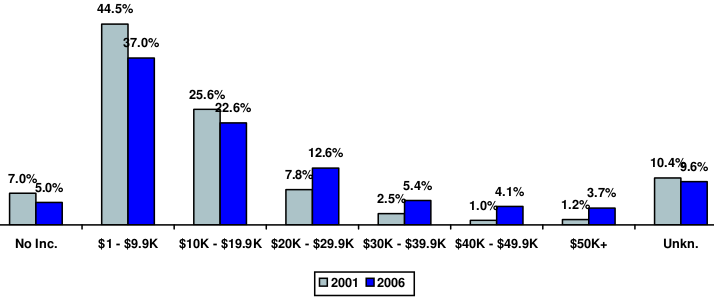
Exhibit 2. End-User Age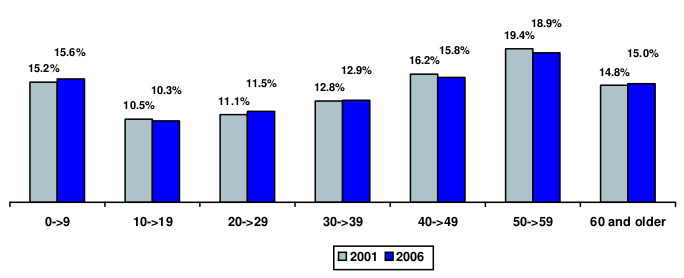
Exhibit 3. End-User Education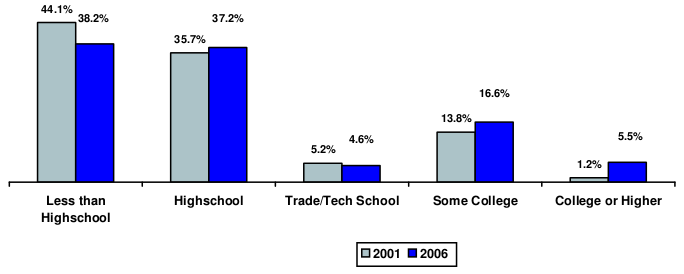
- (Note: Do not volunteer this information unless the candidate asks about the change in demographics of End-Users) In interviews with Agencies, it was discovered that processes to evaluate End-User eligibility to free medicines were banished due to the additional operational complexities that were perceived by many as unnecessary.
- It was also verified that some hospitals were using medicine sourced by Direct Relief’s network to fill regular inventory gaps.
4. Food Sourcing and Geographic Data
Criteria for Allocation of Medicine to Medicine Banks
- The current criteria to allocate drugs to Medicine Banks (and consequently states) is based on the number of boxes of drugs distributed to end-users in the previous month by that state/Medicine Bank
Exhibit 4. Top and Bottom 10 states by drugs sourced by the client (adjusted to eliminate differences in state population sizes)
| Top 10 States | Bottom 10 States |
| NY | NV |
| NC | WI |
| IL | UT |
| FL | PA |
| AK | CO |
| AZ | MO |
| KS | ND |
| MS | VT |
| SD | TX |
| CA | OH |
Exhibit 5. Need of Medicine by State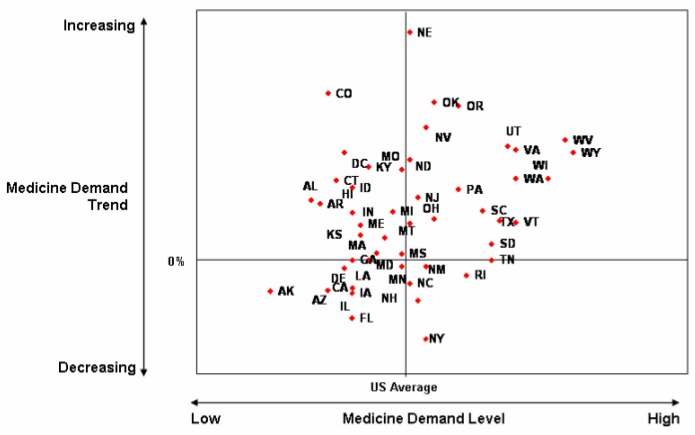
Prompt: If the candidate does not draw any conclusion from this chart, ask him/her which quadrant should receive more attention from Direct Relief.
Possible Answer:
The client Direct Relief’s drug allocation method to Medicine Banks is not adequate, as evidenced by the information that states in most need are also in many cases members of the bottom 10 states in terms of boxes of drugs received from Direct Relief.
The candidate might assume that since the top 10 states are performing well and the bottom 10 states are not, then Direct Relief’s donations are tilting the balance and influencing how states fare. That concept can be dismissed once the candidate finds out that Direct Relief sources only 10% of all donations to medicine banks.
A suggested allocation method would be to evaluate the state’s total demand for drugs and its trend, and supply according to that need.
Also, since agencies eliminated end-user screening processes, more medicine is being directed to end-users who don’t need that support (which can be seen in the change in end-user demographics)
A new screening process should be instituted to guarantee that agencies are not overburden with the new process, thus directing drugs to the needy
Finally, the client Direct Relief should implement inspections at hospitals to make sure that source medicine is not being used to fill regular inventory gaps and impose sanctions to hospitals that adopt such practice.
An outstanding candidate would evaluate that since Direct Relief is only responsible for 10% of donations to medicine banks, Direct Relief should focus in public education and advocacy targeting to increase donations made by the general public and to increase funds from government programs. Lobbying could play a much larger role and should be one of the uses of liquid assets available to Direct Relief.