Newmont Mining Corporation to Exploit Gold Mine in Peru
Case Type: math problem; operations strategy.
Consulting Firm: Schlumberger Business Consulting (SBC) first round summer internship job interview.
Industry Coverage: mining, metals production.
Case Interview Question #00641: The client Newmont Mining Corporation (NYSE: NEM, TSX: NMC) is a gold mining company based in Greenwood Village, Colorado, USA. The Company’s operating segments include North America, South America, Asia Pacific and Africa. As one of the world’s largest  producers of gold, Newmont has active mines in Nevada, Indonesia, Australia, New Zealand, Ghana and Peru. As of December, 2010, Newmont produced approximately 5.4 million equity ounces of gold annually. Other metals that the company mines include copper and silver.
Recently, Newmont is going to exploit a mine in Peru that is expected to be full of a very unique gold ore. The CEO of Newmont has asked us in which order his mining team should extract the gold ore from the field. The gold ore will then be sent to a nearby factory that his company already owns. How would you go about analyzing the case and coming up with a solution?
Additional Information: (to be given to candidate if requested)
- The field is divided in cells of equal size. Once you blow one cell there is no way the truck can pass through it to go to the factory.
- Each cell has different gold ore content and therefore each cell has a different cost of extraction.
- Trucks enter the factory with rocks containing 1% of gold ore. The output is 100% gold ore.
- For sake of simplicity, assume there will be no growth in population.
Below is a plan of the gold mining plant in Peru: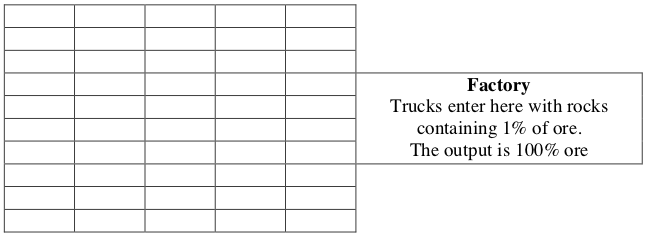
Recommended Approach:
The interviewer is testing whether the candidate can identify a useful algorithm to determine the best way to extract gold ore from this field. The candidate should not initially waste any time developing one idea too fully; instead he/she should come up with a few reasonable suggestions and test them for validity with the interviewer. The candidate should, like in most cases, be aware that he/she is missing critical information and should identify what he/she needs to solve the case and then ask the interviewer for this data.
Possible Solution:
Interviewer: So, tell me how we might approach this problem for our client?
Candidate: First, I would like to make sure that I fully understand our client’s needs. Let me repeat the key issues: our client wants us to provide him with a recommendation on what approach his mining team should take to extract the gold ore in order to maximize profits.
Interviewer: Yes, that pretty much sums it up. So, what’s next?
Candidate: I can imagine a number of different ways of prioritizing which cells to take out first, such as:
1. Profit: Profits = Revenues – Costs = Price * Volume — Costs.
2. Demand: Outlook of the price of the different types of gold ore. If the price is low (perhaps because demand today is lower), but we believe that this same ore will be sold for much more in the future (perhaps due to an increase in demand), it could make sense to begin extracting lower concentration cells.
I am imagining that this could be similar to the oil industry. Think for example about the price of oil. The oil is in the field anyway, so it’s better to exploit the places with the least of oil when the oil price in the market is at a low level. Unless, of course, we can store the gold ore for long periods of time without a large opportunity cost by tying up capital and space.
3. Capacity of the plant: Maybe there is a minimum level we need to provide to the plant as input. Maybe there is a maximum. This could determine how much we want to extract in any given time period, especially, if there are penalties for operating outside of this min-max range.
4. Operational issues: For example, if I dig a hole in the ground and the truck cannot pass through that cell, it may be wise to start at the cells that are further from the factory so that I do not block off routes.
Interviewer: OK, let’s assume that the points that you have raised are all reasonable. This is a complex business and I was pleased to hear you touch on many of the important points. But, first, let’s focus on profits. How would you define profit?
Candidate: OK, in this case profits would be (price of a ton of gold ore) * (expected content of ore in cell) — (the cost of extraction for that cell). I will then rank each of the cells based on its overall profit contribution and determine my extraction path from there. Of course, we need to consider that if we extract from one highly profitable cell, but it cuts off access to a lesser, but still profitable, cell, this is a cost of doing business under this assumption and should reduce my overall expected profits.
Interviewer: Let’s assume that we map the field and this is what we get: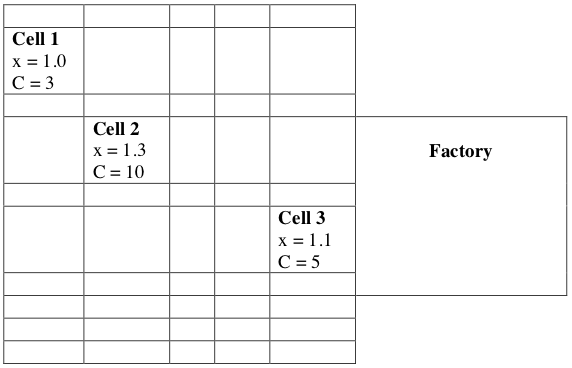
x = tons of gold ore in that cell
C = cost of extracting in that cell in thousand dollar
Candidate: Do we have any information on today’s price of the gold ore?
Interviewer: Yes, our client expects to get $10,000 dollars per ton of gold ore.
Candidate:
- For Cell 1 the profit will be: 1 * $10,000 — $3,000 = $7,000.
- For Cell 2 would be: 1.3 * $10,000 — $10,000 = $3,000.
- For Cell 3 would be: 1.1 * $10,000 — $5,000 = $6,000.
So I will start for Cell 1, then Cell 3 and finally exploit Cell 2.
Interviewer: OK. What if price changes? Does it change your decision?
Candidate: Yes.
Interviewer: Why?
Candidate: Let’s say price is now $30,000 per ton.
- For Cell 1 the profit will be: 1 * $30,000 — $3,000 = $27,000.
- For Cell 2: 1.3 * $30,000 — $10,000 = $29,000.
- For Cell 3: 1.1 * $30,000 — $5,000 = $28,000.
So I would recommend extracting Cell 2, then Cell 3 and finally Cell 1. This is based on the fact that the costs appear to be fixed and do not change despite the overall price fluctuations that we are discussing.
Interviewer: Let’s move on. Our client has told us that per ton Profit and Loss (P&L) statement is as follows…wait, perhaps you could tell me how you would construct it?
Candidate: I would try to find out the average price, the average cost of goods sold (COGS) and then assign some part of the SG&A (Selling, General and Administrative Expenses) costs.
Interviewer: OK. Here are the figures that our client provided. What is the company’s break-even point?
| Item | $1,000 per ton |
| Revenues | 1.0 |
| COGS | 0.8 |
| SG&A | 0.6 |
| Profit | -0.4 |
Candidate: OK. The company has $200 gross margin per ton of gold ore, before we factor in SG&A costs. So, if I divide SG&A by the gross margin I will find how much they have to produce. In this case, $0.6 / $0.2 = 3, which means they have to produce 3 times more to cover fixed costs.
Interviewer: How the same P&L would look like?
Candidate: Basically, we have to divide the SG&A by 3. We are in essence spreading the fixed SG&A costs across more units. However, we would need to make sure that SG&A does not increase with volume of gold ore extracted.
| Item | $1,000 per ton |
| Revenues | 1.0 |
| COGS | 0.8 |
| SG&A | 0.2 |
| Profit | 0.0 |
Interviewer: Good, can you summarize what we have identified so far?
Candidate: Sure. Our client was looking for a framework to identify the order in which he should extract cells of ore from a field. We chose to focus on profitability as the main driver. As mentioned, but not discussed in depth, profitability includes the core components of price per ton of ore, cost to extract the cell (which appears to be fixed), but also the cost of not being able to access a cell for extraction.
Once we have calculated the profits per cell our client can draw out a map to understand which cells to extract and when in order to maximize his P&L. Next we discussed the company’s P&L and identified that SF&A costs are relatively significant and appear to be fixed. This means that we would want to extract more ore in order to spread these costs across production and increase overall profitability.
Interviewer: Great. Thank you.