Cummins To Reduce Warranty Claims for Diesel Engines
Case Type: new product; operations strategy; supply chain optimization.
Consulting Firm: Siemens Management Consulting first round summer internship job interview.
Industry Coverage: industrial equipment.
Case Interview Question #00634: The client Cummins Inc. (NYSE: CMI) is a Fortune 500 corporation that designs, builds, distributes and services engines and related technologies. Headquartered in Columbus, Indiana, United States, Cummins sells in approximately 190 countries and territories through  a network of company owned and independent distributors and dealers. The company manufactures and markets a complete line of diesel and natural gas-powered engines for on-highway and off-highway use. Its markets include heavy and medium-duty truck, bus, recreational vehicle (RV), light-duty automotive and a number of industrial uses.
Recently, Cummins has designed a new diesel engine with significant new technology and significant new content. It will meet all federal guidelines for at least 10 years. The client has spent significant research and development (R&D) money on this new engine and expects to be able to charge a premium price to recoup the investment. However, the client’s largest customer, representing 60% of all sales, has been complaining about the quality of the new diesel engine.
Our preliminary research has shown that although our client Cummins promised their customers in terms of soot emissions less than 3,000 ppm, but they are currently seeing 20,000 ppm (1 ppm = 1 parts per million). What is wrong and what should the client do to rectify the situation?
Additional Information: (to be given to candidate upon request)
1. Product Design
The design process was unchanged for this new diesel engine. All testing was done the same as with historical products. However, the FMEA analysis (Failure, Modes, and Effects Analysis, used to identify and assess the ramifications of possible product defects) was skimped on. The significant new technological components of the diesel engine were developed according to the client’s standard process.
2. Manufacturing
Cummins’ manufacturing plant uses a highly skilled and educated workforce. There is no learning curve associated with the assembly of this new product.
3. Service
The client Cummins utilizes field technicians at the customer site. They are the ones reporting the warranty data to the client. They are all well educated on the product.
4. Sub-assembly procurement
Traditionally, the client Cummins used few suppliers who delivered large sub-assemblies. Now, in an effort to save costs, they have sourced many more suppliers to get the best price for each component and are choosing to do more of the assembly themselves. However, all of these suppliers are delivering products that meet the specifications delivered by engineering.
5. Defect Details: See the chart below detailing the frequency of top warranty issues (Figure 1).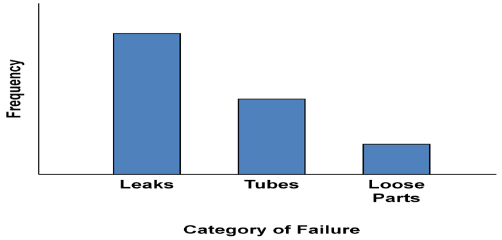
6. Customers
Customers are concerned mostly regarding the quality of emissions.
Possible Answer:
Interviewer: So, how would you go about this case?
Candidate: OK, so in order to identify the problem we need to assess all the stages that the new product is going through from the design to the moment it is ready to be sold to the customers.
We first need to understand what is changed in the design vs. the last model and if the new design is meeting the customer requirements.
Then we need to look at the manufacturing process in terms of technology used, labor, if there is something that was needed to be changed and was not.
We also need to investigate the parts supply for the product and understand if anything changed in regards to the components that we are using for the new engine.
Last but not least I would like to see the main symptoms that customers claimed and compare them with the previous engine.
Interviewer: Great. (provide chart and additional information)
Candidate: From the information provided it seems that there is nothing wrong with the new technology.
Interviewer: All right, so where do you think the problem comes from?
Candidate: I believe that one major change that the company made is in the base of suppliers, going from a limited number of suppliers to a bigger number of suppliers. Is the fact that they have more suppliers and are assembling the components in house a cause of the claims that we see in the warranty claim chart?
Interviewer: Yes. You are right. Although each supplier is delivering to specification, there are tolerances in these specifications.
Since the client is accustomed to specifying sub-assemblies, the tolerances were not tight enough for all of the individual components. Therefore, the stack-up of tolerances causes the parts to have poor fit resulting in leaks and lost parts.
Candidate: OK. So the root cause for the problems is the stack-up of tolerances.
Note: the interviewer needs to lead the candidate to identify this problem which is the stack-up of tolerances; all the other information given initially is a red herring meant to throw the interviewee off; after the interviewee has identified the problem, no matter how much help he/she gets, they need to come up with a list of recommendations and their risks on how to solve the problem.
Interviewer: So, what do you recommend the client Cummins to do now?
Candidate: The company can reduce its warranty claims by increasing tolerances on procured parts, increasing end product testing, or revising procurement agreement to order sub-assemblies.
The first opportunity is more expensive but we could look at ways to minimize costs. The second will increase manufacturing time but would definitely decrease our warranty claims. The third option is more expensive but we could perform a cost-benefit analysis between the 1st and the 3rd options.
Interviewer: Great! Thank you for your analysis.