Riva Group to Exit Hot Roll Commodity Steel Production
Case Type: operations strategy; math problem.
Consulting Firm: Capgemini Consulting second round job interview.
Industry Coverage: metals production; manufacturing.
Case Interview Question #00542: Your client Riva Group is a large European steel manufacturing company headquartered in Milan, Italy. The company had annual revenues of $6.8 Billion and operating profits of $650 Million last year. Currently it is the world’s eighteenth and the third largest steel producer in Europe. Its products include 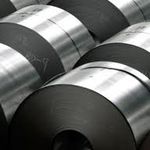 hot rolled flat steel, bars, iron rod and slabs.
The Riva Group operates integrated steel mills. Their competitors in Europe are 10 other integrated mills (IM’s), using 150 year old blast furnace technology and 30 mini-mills (MM’s), all of which are smaller than the IM’s. They use most modern technology, a method commercialized during the late 1970s. A process flow diagram for both the technologies and the end product of each stage is given below (Figure 1).
| Raw materials | Melt | Cast | Roll | Finish | Coat | |
| Integrated mill | Ore, Coke, Coal | Blast furnace -> Basic oxygen furnace | Continuous caster | Hot rolling line | Cold rolling line | Hot dipping line or Electro-galvanizing line |
| Mini-mill | Scrap | Electric arc furnace | Continuous caster | Hot rolling line | Cold rolling line | Hot dipping line or Electro-galvanizing line |
| Product | Melt | Slab | Hot roll | Cold roll | Hot Dip, Electro-galvanized |
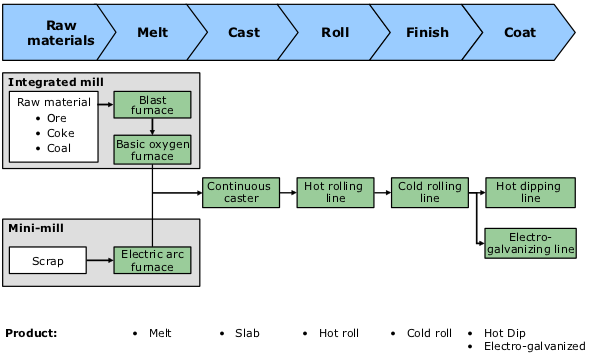
Question #1: Ask the candidate what he/she can understand from the flow diagram. (Guide if they don’t get there soon)
Possible Answer:
Only the melting process is different. All others are same for integrated mills and mini-mills. The basic product (hot rolls) feeds the upstream stage, gaining value at each stage.
Question #2: A new steel commodity exchange is under development in the European Union. The company will be able to buy and sell commodity steel (hot rolls) on the exchange. With the opening of the online exchange, should Riva Group continue to make its own commodity steel or should it buy commodity steel?
Additional Information: If the client decides to exit the production of commodity steel (hot rolls) and decide to buy from exchange, the bought steel will be used as inputs for manufacturing value added steel product.
Possible Answer:
How to solve this case? Let us use the hypothesis driven problem solving method. Say the hypothesis here is “Riva Group should buy commodity steel from the exchange”. To prove this we need to answer the following questions.
Hypothesis: Riva Group should buy commodity steel from the exchange
1. Savings from buying on commodity market will be more than profit lost from abandoning commodity steel production
- How much revenue and profit currently comes from commodity steel?
- How much would the company need to save by buying commodity steel on an exchange to make up for profit lost by not making it?
2. Riva Group’s cost disadvantage in commodity steel will make this an unprofitable business
- What are Rive Group’s production costs compared to mini mills?
- What will the market price for commodity steel be? – Candidate has to make assumptions
Additional Information: Provide the following data about Riva Group to the candidate when asked.
| Volume (million tons) | Price ($/ton) | Unit Cost ($/ton) | |
| Commodity steel | |||
| Hot roll | 13.0 | 275.00 | 260.00 |
| Value-added steel | |||
| Cold roll | 5.0 | 320.00 | 280.00 |
| Hot dipped | 2.0 | 410.00 | 360.00 |
| Electro-galvanized | 1.0 | 560.00 | 475.00 |
| Total | 21.0 |
To produce commodity steel the operating costs for mini-mills is $220 per ton, compared to $260 per ton for integrated mills.
The candidate is expected to perform the following calculations for Riva Group
| Sales in $m | Operating costs in $m | Operating profit in $m | Individual revenue as % of total revenue | Individual profit as a % of total profits | |
| Commodity steel | |||||
| Hot roll | 275 * 13.0 = 3575.0 | 260 * 13.0 = 3380.0 | 3575.0 – 3380.0 = 195.0 | 3575/6555 = 54.54% | 195/580 = 33.62% |
| Value-added steel | |||||
| Cold roll | 320 * 5.0 = 1600.0 | 280 * 5.0 = 1400.0 | 1600.0 – 1400.0 = 200.0 | 1600/6555 = 24.41% | 200/580 = 34.48% |
| Hot dipped | 410 * 2.0 = 820.0 | 360 * 2.0 = 720.0 | 820.0 – 720.0 = 100.0 | 820/6555 = 12.51% | 100/580 = 17.24% |
| Electro-galvanized | 560 * 1.0 = 560.0 | 475 * 1.0 = 475.0 | 560.0 – 475.0 = 85.0 | 560/6555 = 8.54% | 85/580 = 14.66% |
| Total | 6555.0 | 5975.0 | 580.0 | 100.00% | 100.00% |
Key Conclusion from the calculations: The profits and revenues contributed by commodity steel (hot roll) is significant to Riva Group, accounting for 33.62% and 54.54% respectively.
It is highly likely that the price of commodity steel on the exchange will drop below $260 per ton which is the variable cost per ton for integrated steel manufacturers. This means that our client Riva Group will make losses.
Question #3: How much should be the minimum saving from the ‘Buy’ decision so that we can maintain the same profits as now? (The steel bought will be used as inputs to the value added steel)
Possible Answer:
Calculations to be performed by candidate:
- If the client decides to stop producing their own commodity steel, profits that the client will give up = $ 195 million
- Number of tons produced after exiting commodity steel = 8 million tons (Only value added steel = 5.0 + 2.0 + 1.0 = 8.0 million)
- To keep the same profits extra savings needed = 195,000,000 / 8 million tons = $ 24.375 per ton
Therefore, buying commodity steel in the exchange should result in at least $24 to $25 per ton saving in order for the client to keep the same profits as now.
Recommendations: The numbers and environment suggest that Riva Group should exit commodity steel production and start buying from the exchange.
Question #4: What are the potential risks of such a decision to exit commodity steel production?
Possible Answer:
- Union and labor issues from laying off labor
- Pressure from the government
- Loss of control on quality of steel
- Competitive weakness
- Subject to fluctuations in the market price