GM Research Lab to Prioritize Products Development
Case Type: operations strategy.
Consulting Firm: McKinsey & Company 2nd round job interview.
Industry Coverage: electronics; automotive, motor vehicles.
Case Interview Question #00310: Your client is the president of GM Research Lab, which is essentially an electronics Research & Development (R&D) think tank for General Motors Company (NYSE: GM). Headquartered in Warren, Michigan, the GM Research Lab is a very innovative place which employs about 100 scientists  and engineers who buy components and create prototype innovative products for cars. This place is bursting with energy, and they already have many great products to their credit. For instance, they have already developed a prototype car autopilot navigation system.
Similarly, they discovered that many of the road deaths due to car accidents are preventable. The problem is that medical services don’t reach there in time either because they don’t get to know about the accident at all or they don’t know exactly where it happened. In most such accidents, the victims either lose consciousness or are decapacitated. So they have created this device which is a combination of GPS, airbags and cell phones. The way it works is that on car accident impact, the airbags inflate, and the cell phone calls 911, pinpointing the directions using the GPS (think of GM OnStar, Ford Sync, BMW Assist, Toyota/Lexus Safety Connect, etc).
These guys are full of ideas, and some of the projects under consideration are night-vision for cars (using F-14 technology), backing sensors and so on. However, their costs range is high. The fundamental issue is that the engineers are like kids in a candy shop. They are doing very exciting work and love their jobs. However, there are random projects going on all over the place. The president wants to streamline the operations and focus on 10-20 projects rather than the more than 100 that are going on right now.
The president has asked you to help him address the following questions: How will you prioritize the projects, deciding which ones to focus on and which ones to abandon? How will you convince the engineers, who are basically innovative brains and do not understand business, of your decision?
Possible Answers:
Interviewer: This is a case on which I worked on about 8-10 years ago. I like this because it is different from most usual problems. How would you go about it?
Candidate: Interesting case. So, to prioritize the projects, I will probably start by the basic economics, focusing on the projects that are likely to bring in the most profits. Thus, some of the factors I will look at are:
- Probability of successful completion of the projects
- Probability of an automobile manufacturer buying the technology for commercialization
- Demand and price elasticity in the market
- Speed to market because money has a time value
- Practicality of the idea in general.
To convince the engineers of the decision, I would focus on the following issues:
- Speed to market
- Ease of selling
- Practicality of mass-production
- Share of royalty
- Profits: Success of the company, and individual success
Interviewer: Okay, interesting. Let’s take these one by one. You said that you want to prioritize based on the economics. How do you get a handle on the expected profits?
Candidate: I will proceed in a structured manner, starting off with Profits = Revenues — Costs (or expected profits = expected revenues — expected costs). We can find these figures by subjectively assessing probabilities of success in different durations and to different levels and calculating the expected monetary values.
I am assuming that the costs aspect could be as follows: I would probably not want to break this down into fixed and variable costs as you said the company is engaged in creating prototypes. Thus, variable costs are wiped off the slate since quantity produced is equal to one. They only have R&D costs which can be split into human resources, material and overheads apportioned. The human resources costs would likely follow a similar pattern, and would depend on the time taken in project completion.
To deal with the revenues, I will use the simple equation: Revenues = Price x Volumes.
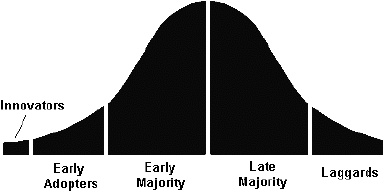 Please understand that since we are dealing with prioritization, I am looking at revenues, costs and profits for individual projects rather than the entire company. I guess we can have some estimate of the volume by looking at the product life cycle (see Figure 1).
At prodcut launch we would have only the innovators and the early adopters and we’ll have to cross the chasm before being able to reach an early majority. Normally, I would think, the only role costs play in pricing is to make sure that at the volume and pricing, costs including R&D and fixed+variable costs of mass production are covered. The pricing is typically based on what the consumer is willing to pay for it. To be able to make a better analysis of the revenues, both from the prices perspective and the volume perspective, I will need to understand how this firm earns its revenues. Can you help me with that?
Interviewer: Sure. The company has good relations with an automobile manufacturing company to which it sells its ideas. The automobile company hands it a royalty check based on estimated revenues depending on how they can price it. They also have the option of earning the royalties over 5-6 years based on actual revenues.
Candidate: So that rules out cost-considerations, pretty much?
Interviewer: It does.
Candidate: Is it fair to assume that volumes lose much of its relevance as the automobile company will fit the product in all cars of a particular model.
Interviewer: That is a fair assessment.
Candidate: Since pricing for end-consumer seems to be an important factor here, I’d want to explore what the end-consumer is willing to pay for the product.
Interviewer: And how would you go about doing that?
Candidate: By conducting some market research. Maybe even conducting a conjoint analysis on automobiles with different products, and prioritizing on the basis of that?
Interviewer: What is conjoint analysis?
Candidate: Conjoint analysis is a market research technique wherein the customers are presented with products with different attribute options, and their responses are analyzed to figure out which attribute options they prefer and how much they value each. Ummm….but yeah, there’s a problem that to conduct this analysis we need prototypes, and here we want to do the analysis before the prototype is created. I guess that could be solved by paper prototyping or giving out the product idea in some way.
Interviewer: Hmmm…..but this method assumes that consumers know about their preferences. The engineers would argue that since these are very innovative products, consumers don’t have enough information to develop sensible preferences before they can actually use them.
Candidate: Perhaps we could try using an economic-value based pricing model then.
Interviewer: What does that mean?
Candidate: It essentially means we find out how much economic benefit the consumer gains from using the product. That economic benefit is then split between the consumer and the manufacturer.
Interviewer: Okay, so how do you gauge the economic benefit a GPS has over a $5 map?
Candidate: I guess we could look at the average time saved, put it against the average worth of the consumers’ time. Ummm…..I guess we are not reaching anywhere with this approach. Could we possibly compare the products to similar products produced by competition?
Interviewer: For normal products you can do reference pricing. But, as I said, these are highly innovative, completely new products. There is nothing you can compare any of these new products to.
Candidate: I guess the only way left is to look at the products sold in the past or selling at present. I suppose it should be possible to determine price-elasticities of demand for different categories of products. For instance, demand would normally be less elastic for safety products. In other words, people would be willing to pay more for products that they perceive as making them safer on the road, just like they are normally willing to pay more for kids’ pharmaceuticals.
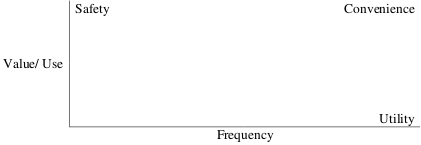 Interviewer: Right! That’s exactly what we did. We are almost out of time here, but let me tell you what we did in this case. Following the same logic as you did, we concluded that there are different attitudes that people have towards different types of products. We plotted all their products on two axes — value and frequency of use. We found that there was a pattern like this (Figure 2):
The products that are infrequently used but are perceived as having high value are safety products — in fact you wish you never have to use them. The GPS-Airbag-Cellphone combination I mentioned earlier falls in this category. Then there are products that are useful, but are used relatively frequently. These are convenience products like GPS. Then there are items that are less useful but are very frequently used…..like power windows. These, we called utility items. Invariably, products in the top-left corner were more successful. That’s where we took the leap of faith, and said that in general people are willing to pay more for safety products, and are more likely to buy them. We recommended that the client company prioritize their products on the basis of this chart….based on where the proposed product falls on this chart. Which, of course, they did.
Candidate: Wow! This was indeed a very different and interesting case. I thoroughly enjoyed it.
Interviewee’s Note: This business strategy case mainly involves process optimization and prioritization. It was an extraordinary case in several ways. For one, the interviewer spoke more than I did, which is very uncommon for a case interview. Then, the way the case is set up, applying traditional frameworks to crack it takes up a lot of time, though at the end you do reach close to the answer as I did. Lastly, this is the only McKinsey case without numbers that I have seen.