Bank of East Asia Improves Cost-to-Revenue Ratio
Case Type: reduce costs; operations strategy.
Consulting Firm: Roland Berger Strategy Consultants final round job interview.
Industry Coverage: banking.
Case Interview Question #00179: Your client is the processing division of the Bank of East Asia (BEA), a large regional Asian bank based in Hong Kong. You have been hired because the processing division wants to improve its cost-to-revenue ratio (CRR). Present calculations reveal that the current CRR is 0.60. The client wants to improve this to the industry standard of 0.40. What strategies can the client pursue to lower its CRR to 0.40?
Additional Information: (to be given to you if asked)
The processing division of BEA provides back-office services for the bank’s three other divisions: Retail Banking, Corporate Banking, and Regional Banking. These services include: credit processing, payments processing, customer service processing, call center services, and credit card processing.
The client receives $100M in annual revenues. In the past, revenues have always grown or diminished in accordance with industry trends; costs increase and decrease in proportion to revenue. This trend is expected to continue in the future. An analysis of the revenue/cost distribution will show that revenue and costs are distributed evenly among the three customers. [The candidate can calculate that costs are approximately $60M.]
The client is organized into three highly independent groups, with each group servicing one customer. Analyzing the individual groups will reveal that none of them stand out as being particularly inefficient, and they all have CRR’s of about 0.60. However, there are many similarities and overlaps in the processes they perform (all processes are handled internally). [There is no need for the candidate to explore the specific processes or overlaps.]
A cost analysis will reveal two types of costs: labor and systems. Labor costs stem from the organization’s workforce of 1,000 employees, with an average annual salary of $40,000 to $45,000 – salaries are in accordance with industry standards. [Salary cuts are not advisable.] Systems costs are primarily IT related, and comprise the remainder of costs.
A study of the client’s IT systems will reveal that they are below industry level in sophistication.
A competitive analysis will reveal that the average industry cost distribution is 60% labor, 40% systems. No other information is available about competition.
The client has no control over the volume of revenue it receives from its three internal customers. Furthermore, the client believes that strategies to boost revenue by fine-tuning the operations of its customers are beyond the scope of the engagement.
The client’s pricing for its internal customers is consistent with the industry standard. The client is aware that it can increase revenues by increasing internal pricing, but would like to hear other recommendations.
Possible Answer:
This case can be approached by looking at ways to reduce costs and increase revenues in order to hit the target.
 The client’s labor/systems cost mix is 70/30%, compared with an industry standard of 60/40%. Upgrading IT systems may allow it to decrease its workforce, and reduce overall costs.
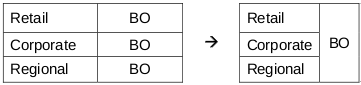
The client can integrate its three groups (servicing Retail Banking, Corporate Banking and Regional Banking), and look for synergies. Possible synergies include integrating common processes, and transferring best practices. This can result in reduced manpower requirements, and further cost savings. (The candidate should list possible synergies that can occur from integration.)
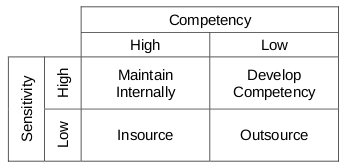 Reducing costs may not be enough to achieve the target CRR. There are no options to increase revenues from the internal customers; however, the client can explore insourcing, where they can offer processing services to external banks for services that they have high competencies in. This can increase revenues substantially, while bringing economies of scale.
The client can combine the insourcing strategy with outsourcing the processes that it does not have competencies in, and are not highly sensitive. The client can determine its strategy to maintain, develop, insource, or outsource the different processes as the above matrix.