Lockheed Martin Reduces Costs of Cyclical Swings
Case Type: reduce cost; operations strategy.
Consulting Firm: A.T. Kearney second round job interview.
Industry Coverage: Aerospace & Defense; Manufacturing.
Case Interview Question #00169: Our client Lockheed Martin (NYSE: LMT) is a United States aerospace, defense, security, and advanced technology company formed by the merger of Lockheed Corporation with Martin Marietta Corporation in 1995. In the early 1970′s, Lockheed Corporation manufactured L-1011 TriStar, a three-engined wide-body aircraft seating up to 400 passengers for commercial airlines.
The industry was very cyclical with swings in demand occurring as frequently as every 6 months (see attached figure below). During the down months, Lockheed would have to layoff employees and shutter the plants, which created turmoil for the company and the local community. Jet aircraft were normally built to the order specification of the purchasing airline. To alleviate the costs of cyclical swings, Lockheed considered building aircraft to a predetermined schedule based on average expected aircraft sales over the next five years (see attached figure). Do you think this is a good idea and why? What are the pros and cons of pursuing such a plan?
Possible Answer:
Unlike some other costs cutting cases, this case doesn’t really have a yes/no solution. The important thing in a case like this is to identify the major issues and state your approach for arriving at a solution. The interviewer wants to see if you have a basic understanding of manufacturing business and the costs inherent in running such an operation. On a real problem like this, you would need to model the costs (with a spreadsheet) of the current (build to order) approach and the new approach (build to schedule) and then test the new approach under a range of sensitivities, both positive and negative. Revenues are unlikely to be impacted by this decision, unless having aircraft in inventory would facilitate greater sales.
A good case solution would identify the cost drivers and risks and arrives at an educated guess of the right answer. Let’s look at some of the costs and how they would be impacted under a new “build to schedule” plan:
1. Inventory or Working Capital Holding Costs — This could be huge under a “build to schedule” production plan. If demand is not as predicted or the market heads into a cyclical dip, Lockheed could end up holding a lot of very expensive (tens of millions of dollars) inventory that just sits on the books. At a 6-8% risk free rate of return, the inventory holding costs of such expensive assets would add up rapidly.
2. Labor Costs — Labor would probably be cheaper under a build to schedule. The company could avoid costly retraining and rehiring of its workforce after layoff. Additionally, the company would have to pay less severance costs due to fewer layoffs. With a more guaranteed production schedule, the company may be able to extract wage concessions from its unions. But, such savings would evaporate if the company were to busily build new aircraft that the market doesn’t want.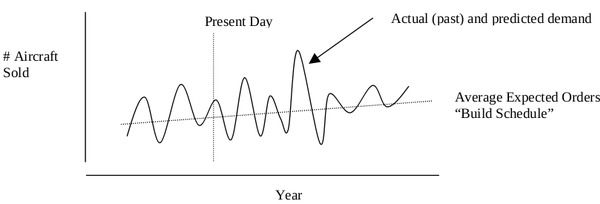
3.Technological Obsolescence — With build to schedule, you run the risk of building aircraft that aren’t demanded in the marketplace because they are obsolete. Thus, if a competitor introduces a much better model at the existing price points or a technology change renders current models as inefficient, Lockheed would have to liquidate any existing inventory at fire sale prices.
4. Forecasting — A build to schedule plan for such costly goods requires a very accurate forecast of future demand. Can demand really be forecasted with sufficient accuracy? Average expected sales based on linear regression of past sales, like the one shown in the attached figure, is clearly not good enough.
5. Rework Costs — Airlines request specialized configurations of the aircraft to meet their particular needs. If the company pursues build to schedule, they would need to budget rework costs to change pre-built models to the specifications of the purchasing airline. Or, if they only build aircraft partially, how will they handle the production backlog of moving these partially completed aircraft through the remaining production steps?
6. Fixed Production Equipment and Facilities — In general, the fixed costs of production equipment and facilities should not change with a change in production approach. Now, if the company amortizes equipment on a per unit basis, then net income could be affected under the new plan. But, cash flows, the important thing to look at when making business decisions, should not be affected.
7. Variable Materials Costs — These include materials and components required for building the aircraft. Under a build to schedule plan, Lockheed could probably negotiate lower costs from their suppliers since they would be able to guarantee a steady stream of purchases.
8. Unused capacity — Under “build to schedule” plan, Lockheed are likely to have unused production capacity since they currently carry sufficient capacity to meet cyclical demand surges. The analysis should carefully examine the existing production assets to determine if savings could be realized through capacity reduction.
Conclusion: After identifying the variables, the interviewer would expect you to take a guess on the right answer based on your assumptions. It turns out that “build to schedule” approach is not viable for this company because they cannot predict demand with sufficient accuracy and the capital holding costs are simply too expensive.