United Supermarkets to Boost Sales of Carbonated Beverages
Case Type: improve profitability; increase sales.
Business Concepts Tested: Revenue analysis; Marketing strategy; Mental math.
Consulting Firm: Capital One first round full time job interview.
Industry Coverage: retail; food & beverages.
Quantitative Difficulty: Easy; Qualitative Difficulty: Medium; Overall Difficulty: Medium
Case Interview Question #01386: Your client is United Supermarkets, a grocery store that primarily operates in Texas in the southern United States. Your point of contact works in the beverage  department of United Supermarkets which consists of carbonated beverages (soda), non-carbonated beverages, and water.
Revenue in the beverage department has been dropping in the last two years, specifically in carbonated beverages. How would you recommend the client improve the performance of carbonated beverages?
Possible Answers:
1. Suggested Framework
a. Guidance for Interviewer
This is a pretty simple “grow revenue” type of case offering a straightforward practice of basic casing concepts: framework, mental math, gathering data from exhibits, brainstorming and conclusion. Not much information to be given beyond the exhibit.
Ask what the candidate would consider to increase revenues (promotions, placement in store, etc..)
b. Additional Information if Asked
• The client’s main goal is profitability, not just revenue.
• Revenue fell 1% two years ago and 3% last year.
• Pricing has been stable and is in line with competitors.
• Stable pricing and falling revenue indicates lower volume.
c. Sample Framework
Profitability
• Profit = Revenue – Costs
• Revenue = # of units sold * price per unit
• Costs = Fixed Costs + Variable costs per unit
Company
• Beverages Profit
• Revenue (mix-brands, total $)
• Costs (costs per brand)
• Full Store Revenue
Customers
• Price Sensitivity
• Brand Loyalty
• Taste / trends
Market
• Growth or Decline
• Competitors
2. Detailed Analysis
a. Areas for Analysis
Store Placement: Where are the carbonated beverages sold?
• Currently the client sells carbonated beverages just in the beverage aisle.
• The carbonated beverages could also be sold on end-caps, coolers by the registers, or out front of the store.
Revenues / Costs
• See Exhibit 1 below
Beverage Department
• Brands of carbonated beverages: Coke, Pepsi, Dr. Pepper, Boylan’s (craft brand), Store Brand
Brand Loyalty
• While we don’t have numbers, we know that a large majority of Coke drinkers will always choose Coke. The same goes for Pepsi and Dr. Pepper.
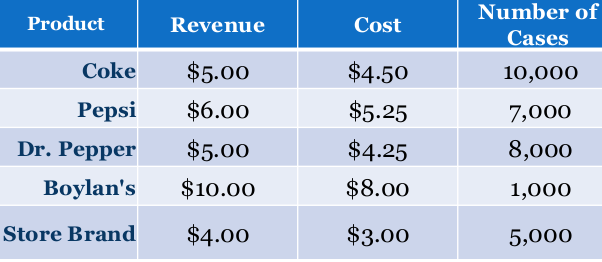
Question #1. Show Exhibit 1. Now that you’ve seen the volume and margins of each brand, which brand would you recommend the client focus on to increase revenue and profitability?
Exhibit 1. Volume and Margin of Carbonated Beverages in Client Store
Solution:
The client should focus on the store brand.
It offers the largest margin percentage (2X the revenue per case compared to coke), and at the lower volume it potentially has room to grow. Also, it would be harder to convert loyalists of the other brands which may remain customers and choose those brands no matter what promotion we could run. We need more customers to buy soda, and promoting the store brand gives the client the best opportunity to do so while increasing the profit margin.
Question #2.
(A) What percentage of the store’s profit is from the Store Brand?
(B) How many cases of the store brand would the client need to sell so that the profit earned from the store brand is equal to the profit it earns from its most profitable brand?
(C) The candidate should comment on the answer to question (B) and the interviewer can follow up: Do you think increasing sales by an additional 1K cases is a reasonable goal?
Solution:
Profit from Coke: $0.50 margin * 10K cases = $5K
Profit from Pepsi: $0.75 margin * 7K cases = $5.25K
Profit from Dr. Pepper: $0.75 margin * 8K cases = $6K
Profit from Boylan’s: $2 margin * 1K cases = $2K
Profit from store brand: $1 margin * 5K cases = $5K
Total Profit: $5K + $5.25K + $6K + $2K + $5K = $23.25K
(A) $5K/$23.25K = ~21.5% (it’s okay to round out)
(B) The most profitable brand is Dr. Pepper, with $6K profit. The client would need to sell an additional 1K cases of the store brand, for a total of 6K cases and a profit of $6K.
(C) Additional 1K of sales (~20% increase of sales) is not easy and is not realistic without any specific strategy on expansion.
Question #3. What are some ways the grocery store can increase the sales of the Store Brand?
Solution:
This is an open brainstorming question, the important element is to have the candidate remain structured while coming up with as many good ideas as possible.
Some examples include:
• Product
– Offer new flavors
– Offer more sizes
– Improve recipe
– Expand store brand to other products (food, snacks, etc)
• Marketing
– Discounts
– New packaging
– Bundling with other products
– Better placement in store
3. Conclusion & Recommendation
Recommendation
• The client should focus on the store brand to improve profitability.
Rationale
• Store brand has the highest margin.
• Store brand has the room to grow. We can attract the non-loyal soda drinkers to buy it. It has the best profit margin.
Risks
• Cannibalization of brands – having the small fraction of non-loyal Coke/Pepsi drinkers switch to the store brand, which would increase profit margin but not revenue.
Next Steps
• Determine the best promotion/marketing for our store brand as well as store placement to entice customers to buy it.
• Run taste tests to improve store brand is possible.